Aircraft Repositioning Of Mass With Moving CG | Lecture 10
Understanding Center of Gravity in Aircraft
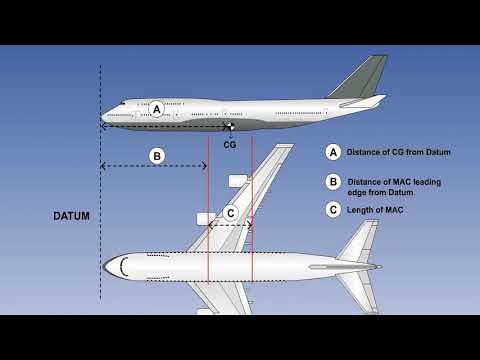
Introduction to Center of Gravity Limits
- The center of gravity (CG) must be within limits for safe flight; if not, the aircraft cannot depart until resolved.
- Adjusting CG can be done by repositioning existing mass (e.g., passengers or cargo) or adding/removing mass.
Formula for Repositioning Mass
- Define variables:
- Big M = mass of the airplane,
- cc = distance CG needs to move,
- little m = mass to be moved,
- d = distance that mass moves from one hold to another.
Practical Example of Moving Mass
- The formula m times d = M times cc is introduced for calculating how much mass needs to be moved.
- In an example, the CG is forward by 0.05 meters; solving gives a required movement of 50 kg from hold A to hold B.
Another Example: Calculating Distance
- A second scenario involves knowing the mass but needing to find out how far it must move to correct CG.
- Calculate change in CG (cc), then apply the same formula m times d = M times cc; results show a movement distance of 360 inches.
Conclusion on Managing Center of Gravity
- The lesson emphasizes using the formula m times d = M times cc effectively resolves out-of-limit CG issues through internal mass adjustments.
Turn any video into a summary like this
YouTube links, meetings, lectures. With transcripts, search, and chat.