Load Sheet For Aerodynamic Chord | Lecture 09
Understanding Center of Gravity in Aerodynamics
Introduction to Center of Gravity and Mean Aerodynamic Chord
- The center of gravity (CG) can be expressed as a distance from a datum or as a percentage of the mean aerodynamic chord (MAC), which is preferred for swept wing commercial airplanes due to its impact on stability.
Definitions and Importance
- A chord line connects the leading and trailing edges of a wing, while the mean aerodynamic chord represents the length of a rectangular wing with equivalent area and aerodynamic characteristics.
Calculating Center of Gravity
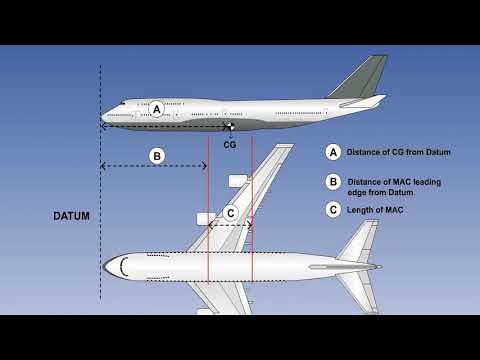
- To calculate CG as a percentage of MAC, three distances are defined:
- b : distance from datum to leading edge of MAC
- a : distance from datum to CG
- c : length of MAC
- The formula for calculating CG in terms of percentage MAC is given by:
[
textPercentage MAC = (a - b)/c times 100
]
Practical Example Calculation
- In an example where a = 420 inches, b = 380 inches, and c = 120 inches, substituting these values into the formula yields that CG is at 33% of the mean aerodynamic chord.
Further Example with Different Datum
- In another scenario with different values ( b = -26, c = 73, percentage MAC = 21%), solving for unknown a shows that CG is 10.67 inches forward from the datum.
Conclusion on Center of Gravity Calculation Methods
- It’s crucial to verify that once CG is established using any method, it must comply with certified limits set by manufacturers for safe aircraft operation.
Turn any video into a summary like this
YouTube links, meetings, lectures. With transcripts, search, and chat.