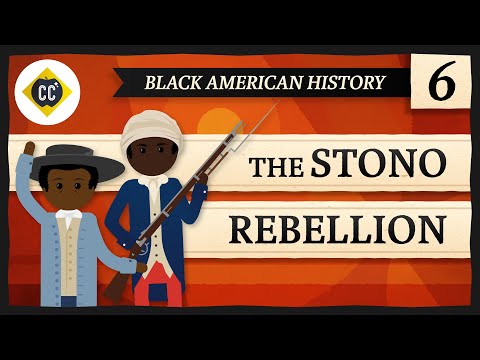
The Stono Rebellion: Crash Course Black American History #6
Introduction
In this section, Clint Smith introduces the topic of enslaved resistance and rebellion in Black American history.
Enslaved Resistance
- Enslaved people resisted their condition through various means, including small personal acts such as slowing down work or pretending to be sick. These actions allowed them to regain a sense of agency.
- Resistance also took on larger forms, such as slave uprisings and rebellions.
- It is important to note that the success or failure of a rebellion can be subjective and may not accurately reflect its significance.
The Stono Rebellion
This section focuses on the Stono Rebellion, one of the notable slave uprisings in South Carolina.
Plantations in South Carolina
- Large plantations where black people outnumbered white people were common in South Carolina due to the demand for cash crop production.
- Slavery was heavily relied upon in the southern colonial economy, leading to a significant black majority in South Carolina.
The Demographics and Concerns
- By 1740, slavery included both African captives and black people born on American soil.
- The population of black people in South Carolina had risen to approximately 40,000 compared to 20,000 white people.
- White planters became concerned about being outnumbered by enslaved black people and feared potential violent resistance.
Heightened Fear and Spanish Threat
- In response to the growing numbers of enslaved black people, South Carolina passed the Security Act requiring all white men to carry firearms. This act aimed at protecting themselves from potential uprisings.
- The Spanish threat from nearby Spanish-controlled Florida further heightened fear among white planters. The Spanish offered freedom to any Black person who could make it to St. Augustine, Florida.
The Perfect Storm for Rebellion
- The combination of a growing black population, including African natives not fully accustomed to plantation culture, and the Spanish offer created favorable conditions for the Stono Rebellion.
- The Stono Rebellion, led by an enslaved man named Jemmy, erupted on September 9, 1739.
Jemmy and the Rebellion
This section provides information about Jemmy, the leader of the Stono Rebellion.
- Jemmy was an enslaved man believed to be from Angola. Many Africans from Angola had military experience and knowledge of guns.
- Starting with twenty enslaved people, Jemmy and his group raided a warehouse to acquire guns and ammunition.
- They marched up the Stono River banks carrying banners that read "Liberty" and were joined by others along the way.
Timestamps are provided for each section based on available information in the transcript.
Captured and Executed
This section discusses the aftermath of the Stono Rebellion, including the fate of Jemmy and the specific targets chosen by the rebels.
Rebels' Targets
- The rebels had specific targets in mind for their attacks.
- Some white people were spared if they were known to be relatively kind to their laborers.
- One group of laborers even protected their enslaver, a Quaker man named Thomas Elliot, from the violence.
South Carolina's Response
This section explores how South Carolina authorities responded to the Stono Rebellion and their focus on preventing future uprisings.
Blaming Enslaved and Spanish
- Instead of addressing slavery as the root problem, South Carolina blamed the enslaved individuals and the Spanish.
- The government claimed that the rebellion wouldn't have happened without reliance on St. Augustine for refuge.
Enactment of Slave Codes
This section discusses the passing of "An Act for the Better Ordering and Governing [of] Negroes and Other Slaves in This Province" by South Carolina's House of Assembly.
Restricting Rights and Liberties
- The legislation became another means to deny Africans any rights or liberties.
- Enslaved people were prohibited from learning how to read and write through this law.
Preventing Literacy
This section highlights why planters wanted to prevent enslaved people from learning how to read and write.
Fear of Empowerment
- Planters feared that literacy would make enslaved individuals unmanageable and unfit for slavery.
- They worried that literacy would enable escape plans, recognition of written clues, or forging freedom papers.
Manipulating Religion
This section explores how white enslavers used religion to enforce illiteracy and control enslaved people.
Manipulating Biblical Interpretation
- Enslaved individuals were required to attend church services where sermons justified their enslavement.
- Whites manipulated scripture to convey that Africans were meant to be enslaved and obedience was necessary for salvation.
Disseminating Ideology
This section discusses the establishment of schools in South Carolina to indoctrinate enslaved people with pro-slavery ideology.
Justifying Slavery
- "Schools" were created to teach black people that slavery was ordained by God and should not be challenged.
- The aim was to discourage further rebellions by disseminating this ideologically-infused interpretation of Christianity.
Shifting Demographics
This section examines the policies implemented by South Carolina authorities after the Stono Rebellion to shift demographics and reduce the chances of future uprisings.
Reducing Slave Importations
- Slave importations were significantly reduced after the rebellion, cutting them by nearly 90% during the 1740s.
- Policies were put in place to encourage immigration from Europe, aiming to increase the white population in the colony.
Improving Conditions?
This section explores attempts made by legislators in South Carolina to improve conditions for enslaved people, albeit with limited impact.
Penalizing Cruelty and Excessive Work
- Planters could face penalties for particularly cruel punishments or excessive work imposed on enslaved individuals.
- The hope was that improved conditions would decrease the likelihood of another rebellion.
The Reality of Slavery in South Carolina
This section discusses the misconception that stipulations made slavery "more humane" in South Carolina and emphasizes that slavery is still slavery.
Slavery and the Stono Rebellion
- The stipulations did not make slavery "more humane" in South Carolina.
- The Stono Rebellion highlights the courage and bravery of enslaved Black people who sought freedom.
- Enslaved Black people were willing to go to extreme lengths to gain their freedom.
- The rebellion is similar to stories of Americans sacrificing their lives for liberty.
Resistance Against Slavery
This section emphasizes that the Stono Rebellion was not the first or last violent rebellion against slavery. It also highlights that determining success or failure misses the point, as resistance against slavery echoes throughout history.
Continuous Resistance Against Slavery
- The Stono Rebellion was not the first or last violent rebellion against slavery.
- Success or failure of a rebellion is not as important as its significance in resistance against slavery.
- The Stono Rebellion symbolizes a resistance that resonates throughout the history of slavery.
Importance of Resistance
This section reiterates the importance of recognizing and celebrating various forms of resistance exhibited by Black Americans over time.
Significance of Resistance
- The relative success or failure of a rebellion should not be the focus; instead, it's important to acknowledge its role in resistance against slavery.
- The Stono Rebellion serves as a reminder to celebrate the myriad forms of resistance displayed by Black Americans throughout history.
Conclusion and Farewell
This section concludes the video and expresses gratitude for watching, with an invitation to continue supporting Crash Course Black American History.
Conclusion and Support
- The video concludes by thanking the viewers and inviting them to watch future episodes.
- Crash Course Black American History is made with the help of various individuals and Thought Cafe animation team.
- Supporting Crash Course through Patreon helps keep the series free for everyone.
Timestamps are provided in English as requested.
Turn any video into a summary like this
YouTube links, meetings, lectures. With transcripts, search, and chat.