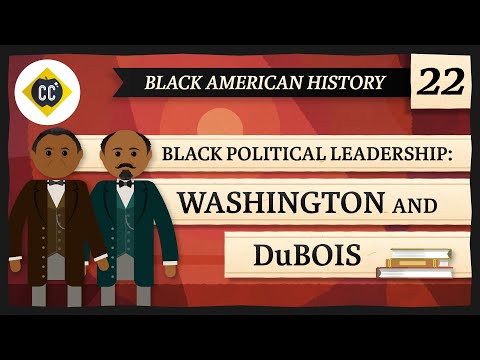
Booker T. Washington and W.E.B DuBois: Crash Course Black American History #22
Introduction to Philosophical Questions in Black American History
The Role of Philosophy
- Clint Smith introduces the episode, emphasizing that philosophical questions are part of everyday life, using humorous examples like "Why did the chicken cross the road?"
- He mentions historical leaders who have engaged in philosophical debates, such as Thomas Jefferson vs. Alexander Hamilton and Captain America vs. Iron Man.
Competing Philosophies: Washington vs. Du Bois
- The focus shifts to Booker T. Washington and W.E.B. Du Bois, two influential figures in late 19th and early 20th-century Black American history.
- Washington's background is outlined; born into slavery in Virginia, he later emphasized self-sufficiency for Black Americans.
Booker T. Washington's Philosophy
Economic Freedom and Acceptance
- Washington advocated for economic stability through skills and labor rather than direct confrontation with Jim Crow laws.
- His Atlanta Compromise Speech (1895) promoted "self-improvement" and dignity in labor while seeking acceptance from white society.
Contextual Challenges
- The historical context of rising lynchings created a climate of fear among Black Americans, influencing Washington’s approach to civil rights.
- He suggested separation in social matters but unity for mutual progress, stating that both communities could coexist peacefully.
Criticism of Washington's Approach
Limitations of Submission
- Despite his following, many contemporaries viewed Washington's philosophy as too submissive for achieving true equality.
W.E.B. Du Bois: A Different Perspective
Background and Education
- Born after the Civil War in Massachusetts, Du Bois had no direct experience with slavery unlike Washington.
- His educational journey included Fisk University and Harvard University where he became the first Black Ph.D., shaping his views on race relations.
Scholarly Contributions
- Du Bois aimed to study Black life through sociology; his work "The Philadelphia Negro" is considered foundational in the field.
Key Concepts from Du Bois' Work
Double Consciousness
- In "The Souls of Black Folk," he introduced “double consciousness,” describing it as a conflict between being both American and Black within a prejudiced society.
Talented Tenth Concept
- Du Bois proposed that leadership should come from an educated elite known as "The Talented Tenth," which has been critiqued for its narrow focus on higher education.
Legacy of Both Leaders
Diverging Visions for Progress
- While both men sought improvement for their communities, their methods differed significantly—Washington favored gradualism while Du Bois called for immediate change.
Lasting Impact on Civil Rights Movement
- Their contrasting philosophies laid groundwork for future leaders who would navigate similar challenges within the fight for civil rights.
Conclusion: Complexity of Black Thought
Non-Monolithic Perspectives
- The discussion highlights that there is no single way to approach racial issues; diverse perspectives enrich advocacy efforts toward justice.
Final Thoughts
- Both leaders cared deeply about their communities despite differing strategies; understanding these complexities helps frame contemporary discussions around race relations today.
Turn any video into a summary like this
YouTube links, meetings, lectures. With transcripts, search, and chat.