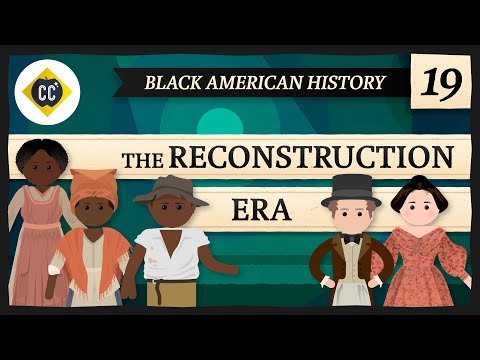
Reconstruction: Crash Course Black American History #19
Introduction and Context
In this section, Clint Smith introduces the topic of Reconstruction after the Civil War and highlights the challenges faced by the United States in rebuilding itself.
The aftermath of the Civil War
- Over 700,000 people lost their lives during the war, which was approximately 2% of the country's population at that time.
- The United States had to grapple with the concept of freedom for Black people, as they had never experienced it before.
The Meaning of Freedom
This section explores the question of what freedom meant for Black Americans during Reconstruction.
Challenges and uncertainties
- After generations of chattel slavery, Black people were finally free but unsure about what their freedom would look like.
- There was a concern whether they would be provided with necessary tools, skills, education, and resources to make their freedom meaningful.
Understanding Reconstruction
This section provides an overview of Reconstruction as a period following the Civil War aimed at remaking America and ensuring civil rights for Black people.
Definition and duration
- Reconstruction lasted from 1865 to 1877 (some argue it began in 1863 with the Emancipation Proclamation).
- It involved provisions, programs, and amendments intended to secure civil rights for Black people.
Challenges Faced During Reconstruction
This section discusses some of the challenges encountered during Reconstruction due to resistance from former Confederates.
Lingering Confederate beliefs
- Despite losing on the battlefield, many Confederates still held onto their beliefs about Black people's place in society.
- W.E.B Du Bois described this period as a moment where freedom was short-lived and followed by a regression towards slavery.
Federal Intervention and Hope
This section explores the initial hope for federal intervention to ensure a smooth transition for Black Americans during Reconstruction.
Glimmer of hope
- In the aftermath of the Civil War, there was hope that the federal government would support Black Americans in their transition to citizenship.
- The idea was to provide them with necessary assistance and protection to ensure a successful integration into society.
Restructuring Southern Life
This section discusses how emancipation fundamentally reshaped Southern life for both freed people and white Southerners.
Impact of emancipation
- Emancipation resulted in the loss of labor and sometimes land for former planters and enslavers.
- Union General William T. Sherman's March to the Sea left much land empty, which led to the idea of redistributing it among formerly enslaved people.
Sherman's Field Order No. 15
This section explains Sherman's Field Order No. 15, which aimed at providing land to newly freed Black people.
Redistribution of land
- General Sherman intended to distribute abandoned land in Georgia to formerly enslaved individuals.
- The famous "40 acres and a mule" concept originated from this order, although mules were not initially part of it.
Andrew Johnson's Presidency
This section focuses on Andrew Johnson's presidency and his contrasting views with Congress regarding Reconstruction.
Johnson's approach
- President Andrew Johnson believed in pardoning Confederates rather than redistributing their land.
- His views clashed with those of Congress, which was controlled by Republicans who sought more progressive measures.
The Reconstruction Amendments
This section introduces the Reconstruction Amendments and their significance in establishing legal protections for Black Americans.
Legal protections
- The 13th Amendment of 1865 abolished slavery across the United States.
- The 14th Amendment of 1868 addressed citizenship and equal protection under the law.
Unpaid Labor and Mass Incarceration
This section highlights a clause in the 13th Amendment that has implications for unpaid and underpaid labor in mass incarceration today.
Clause in the 13th Amendment
- The legislation states that slavery or involuntary servitude shall not exist, except as a punishment for crime.
- This loophole has been criticized for perpetuating unpaid labor within the context of mass incarceration.
The Equal Protection Clause
This section focuses on the equal protection clause of the 14th Amendment and its significance in ensuring equal rights for all citizens.
Ensuring equal rights
- The 14th Amendment establishes that no state shall make or enforce laws that abridge citizens' rights or deny them equal protection under the law.
- However, achieving true equality has been an ongoing struggle throughout history.
New Section
This section discusses the establishment of the Freedmen's Bureau and its role in protecting the rights of Black people after the Civil War.
The Role of the Freedmen's Bureau
- The Freedmen's Bureau was set up throughout the South to enforce the three Amendments and protect Black people's rights.
- It helped newly freed Black people by legally recognizing marriages and reuniting families that were separated during slavery.
- However, it was not successful in securing fair work contracts for Black Americans, as many were forced into sharecropping or tenant farming agreements.
- The Freedman’s Savings Bank, created to help formerly enslaved individuals, shut down within a decade, resulting in the loss of millions of dollars for depositors.
Education and Political Power
- The Freedmen's Bureau played a significant role in assisting Black Americans in pursuing formal education.
- It helped set up schools for Black people of all ages, leading to over 1,000 schools for freedmen in the South by 1870.
- African Americans also gained political power through initiatives supported by the 15th Amendment, resulting in elected Black politicians at both national and state levels.
Intersectionality and Opposition
- Black women advocated for an intersectional analysis that considered race and gender in politics during discussions surrounding constitutional amendments.
- White supremacist opposition grew as Black education and political power flourished, with violence often tied to organizations like the Ku Klux Klan.
Tenuous Presidential Election
- The presidential election of 1876 was disputed due to election results in Louisiana, Florida, and South Carolina. These 20 Electoral Votes would decide the election.
New Section Reconstruction and Its Impact
In this section, the speaker discusses the failure of Reconstruction and its impact on Black people in the United States.
The Failure of Reconstruction
- By the end of the 19th century, approximately 2,500 Black people were lynched throughout the South, with over a hundred Black men and women being lynched each year.
- Reconstruction did not fail because Black people were incapable of governance. Instead, it failed due to white southerners actively obstructing Black mobility and opportunity.
- The US had an opportunity to provide land, resources, and opportunities for millions of Black people after 250 years of bondage. However, a different choice was made that perpetuated the impact of exploitation on Black communities.
Conclusion
- The consequences of Reconstruction's failure are still felt today.
- Crash Course is made possible by support from patrons who believe in keeping educational content accessible for everyone.
Timestamps have been associated with relevant bullet points as per the transcript provided.
Turn any video into a summary like this
YouTube links, meetings, lectures. With transcripts, search, and chat.