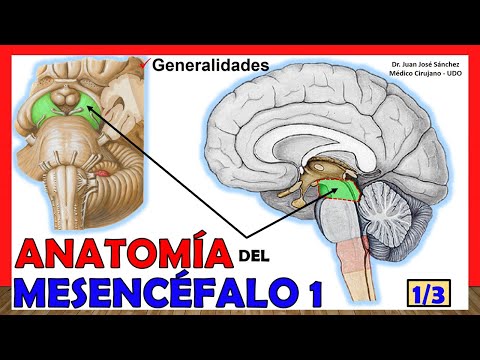
🥇 Anatomía del MESENCÉFALO 1/3. (Cerebro Medio) ¡Explicación Fácil!
Introduction to the Midbrain
Overview of the Video Series
- The video is presented by Juan José Sánchez on the Easy Anatomy channel, focusing on the midbrain.
- The midbrain, or mesencephalon, is a small structure compared to the forebrain but is significant enough to warrant three separate videos.
- The forebrain (prosencephalon) divides into telencephalon and diencephalon; however, the midbrain has no subdivisions.
Structure and Function of the Midbrain
- The midbrain will be discussed in three parts: Mesencephalon 1, 2, and 3.
- It consists of two main portions: cerebral peduncles and quadrigeminal plate.
- The quadrigeminal plate includes superior and inferior colliculi; also mentioned is the sylvian aqueduct.
Anatomical Positioning of the Midbrain
Location within Brain Structures
- The midbrain is centrally located at the lower part of the brainstem, connecting rhombencephalon (hindbrain) with diencephalon (forebrain).
- Its longitudinal axis runs obliquely from anterior to posterior rather than vertically.
Visual Representation
- When viewed anteriorly, it appears free and visible; however, its posterior part is obscured by the cerebellum.
- Dissection or sagittal cuts are necessary for studying its posterior aspects due to coverage by cerebellum.
Detailed Anatomy of Midbrain Components
Key Features
- The incisura of tentorium cerebelli marks where brainstem connects with higher structures; this area coincides with midbrain positioning.
Structural Breakdown
- Anteriorly positioned are cerebral peduncles while posteriorly lies quadrigeminal lamina.
Midbrain Anatomy and Relationships
Limits of the Midbrain
- The lower anterior limit of the midbrain is defined by the pontomesencephalic sulcus, which separates it from the pons. This sulcus is crucial for understanding midbrain boundaries.
- The superior antero sulcus connects to the cerebral peduncles but lacks a clear edge, making its delimitation challenging. It fades into adjacent structures like the anterior perforated substance.
- The superior lateral limits are marked by the optic tracts, which extend from anterior to posterior regions of the midbrain, although these posterior limits remain somewhat vague.
- The quadrigerminal plate serves as a rough boundary between the thalamus and pineal gland, with imprecise separations from other structures in this area.
Relationships of the Midbrain
Anterior Relationships
- The interpeduncular fossa, located between cerebral peduncles, will be elaborated on in future videos; it plays a significant role in midbrain anatomy.
- Emergence of the third cranial nerve (oculomotor nerve) occurs at the pontomesencephalic sulcus within this fossa, highlighting its importance in neuroanatomy.
- The posterior perforated substance lies anteriorly to cerebral peduncles; distinguishing between cerebral and cerebellar peduncles is essential for clarity in studies involving both brain regions.
Vascular Structures
- Key vascular structures include:
- The posterior cerebral artery, which encircles the midbrain.
- The superior cerebellar artery, also surrounding this structure laterally.
These arteries are vital for understanding blood supply to midbrain areas.
Cistern Relationships
- An important cavity known as the interpeduncular cistern allows cerebrospinal fluid flow and is situated between peduncles and adjacent occipital regions. Understanding its location aids in anatomical orientation.
Posterior Relationships
- The tentorium of the cerebellum separates midbrain from occipital lobe; central relationships involve colliculi visible from superior views, indicating spatial organization within brain structures.
- The presence of major vessels such as the great cerebral vein indicates significant vascular relationships behind midbrain structures, particularly near quadrigeminal cistern areas that serve as posterior boundaries for anatomical study.
Lateral Relationships
- Laterally, we find connections with structures like:
- The parahippocampal gyrus, which covers much of the lateral aspect of midbrain.