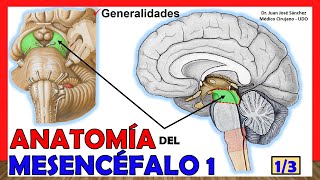
🥇 Anatomía del MESENCÉFALO 3/3. (Acueducto del Mesencéfalo) "De Silvio"
Introduction to the Mesencephalon
Overview of the Video
- The video is presented by José Sánchez on the channel "Anatomía Fácil," focusing on the mesencephalon, or midbrain, as part of a series on brain anatomy.
- This installment concludes the discussion on the mesencephalon before transitioning to posterior brain structures.
Structure of the Brain
- The brain is divided into three main parts:
- Anterior (prosencephalon)
- Midbrain (mesencephalon)
- Posterior (rhombencephalon)
- The mesencephalon does not have subdivisions like other brain regions and serves as a critical area for understanding brainstem anatomy.
The Aqueduct of Sylvius
Definition and Importance
- The aqueduct of Sylvius, also known as the cerebral aqueduct, is part of the ventricular system within the brain. It connects different cavities in the encephalic structure.
- This structure remains from embryonic development and plays a crucial role in cerebrospinal fluid circulation.
Anatomical Positioning
- Located posteriorly and superiorly in relation to specific regions such as the pons and medulla oblongata, it acts as a passage between:
- The third ventricle anteriorly.
- The fourth ventricle posteriorly.
Clinical Relevance
Pathologies Associated with Aqueduct Stenosis
- Congenital conditions can lead to narrowing or blockage of the aqueduct, potentially resulting in hydrocephalus due to impaired cerebrospinal fluid flow.
Functional Anatomy
- Each end of the aqueduct has an opening:
- Superior Opening: Connects to the larger third ventricle.
- Inferior Opening: Leads into the fourth ventricle through its upper angle. This anatomical distinction is important for understanding CSF dynamics.
Structural Characteristics
Symmetry and Shape Variations
Understanding the Central Region of Brain Connections
Importance of Mesencephalon and Cranial Nerves
- The central region of brain connections includes significant structures, particularly the nuclei associated with cranial nerves such as the oculomotor nerve (4th cranial nerve) and the trochlear nerve.
- Diseases affecting the mesencephalon can lead to issues with these cranial nerves, resulting in specific reflexes observed in patients with mesencephalic damage.
Anatomical Boundaries and Structures
- The upper posterior wall is defined by the base of the quadrigeminal plate, marking a boundary between segments of the mesencephalon.
- The anatomical separation line between mesencephalon and quadrigeminal plate passes through the cerebral aqueduct, which is crucial for understanding its structure.
Ventricular System Overview
- The first and second ventricles (lateral ventricles), third ventricle, and cerebral aqueduct are highlighted; they narrow to form a passage leading to the fourth ventricle.
- Due to its narrowness, this area is prone to pathologies that can obstruct cerebrospinal fluid flow, emphasizing its clinical significance.
Membrane Structure within Cavities
Turn any video into a summary like this
YouTube links, meetings, lectures. With transcripts, search, and chat.