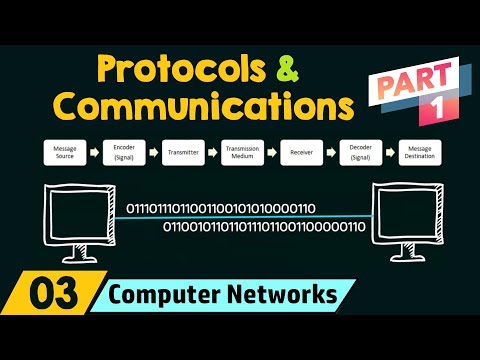
Network Protocols & Communications (Part 1)
Introduction to Network Protocols and Communication
Overview of Today's Learning Objectives
- The session will cover data communication, data flow, and the importance of protocols in computer networks.
- Emphasis on understanding what data communication entails and its significance in networking.
Understanding Data Communication
- Data communication refers to the exchange of data between two nodes through a transmission medium, such as cables.
Types of Data Flow
Simplex Communication
- Simplex is unidirectional; one node transmits while the other receives.
- Examples include keyboards (sending data to CPU) and traditional monitors (receiving data from CPU).
Half Duplex Communication
- Half duplex allows bidirectional communication but not simultaneously; one device sends while the other receives.
- Example: Walkie-Talkies allow talking or listening, but not both at once.
Full Duplex Communication
- Full duplex enables simultaneous two-way communication; devices can send and receive at the same time.
- Example: Telephone lines allow users to talk and listen simultaneously.
Importance of Protocols in Communication
Definition and Role of Protocols
- Protocols are essential rules governing all methods of communication, ensuring effective exchanges between sender and receiver.
Consequences of Lack of Protocol
- Without protocols, communications can become chaotic—issues like speed mismatches or language barriers can hinder understanding.
Key Elements Governed by Protocol
- A protocol determines what is communicated, how it is communicated, and when it occurs within a network context.
Protocols in Human vs. Network Communication
Human Communication Insights
- Effective human communication requires common language, grammar, timing, and acknowledgment from receivers for clarity.
Necessity for Network Protocol
Understanding Protocols in Data Communication
Key Elements of Protocols
- Protocols must handle message delivery options, defining whether messages are sent to one destination, a group, or all destinations in the network.
- The elements of a protocol include message encoding, formatting and encapsulation, timing, size, and delivery options. Each element plays a crucial role in effective communication.
Message Encoding
- Message encoding involves converting data from the source computer into signals for transmission. This is essential for both wired and wireless mediums.
- For wired mediums, data is converted into electrical signals; for wireless mediums, it is encoded as waves to facilitate transmission.
Message Formatting and Encapsulation
- Both sender and receiver must agree on specific formats for data exchange. This ensures clarity and consistency in communication.
- Encapsulation adds sender and receiver information to the data being transmitted so that each party can identify who sent or received the message.
Message Sizing
- Large messages should be broken down into smaller parts to accommodate limitations of the transmission medium. This process mirrors how humans communicate complex ideas by breaking them into manageable sentences.
Message Timing
- Timing involves flow control and response timeouts. It ensures that fast senders do not overwhelm slower receivers during communication.
- Acknowledgment mechanisms are vital; if a sender does not receive acknowledgment within a specified timeframe, they will retransmit the data to ensure delivery.
Delivery Options
- There are three primary delivery options:
- Unicast: One sender communicates with one receiver.
- Multicast: One sender communicates with multiple receivers but not all participants in the network.
- Broadcast: One sender sends data to all participants in the network.
Recap of Key Concepts
Turn any video into a summary like this
YouTube links, meetings, lectures. With transcripts, search, and chat.


