
XPS - X-rays Photoelectron Spectroscopy
25 of 25 videos summarized
This playlist provides detail explanation about the MOST asked questions regarding XPS analysis. I have tried my best to answer maximum questions. The following topics related XPS are covered. Working Principle of XPS: X-rays Photoelectron Spectroscopy (XPS) is a very important and key surface analysis technique. In XPS, an x-ray photon of known energy is shine on the sample, and photoelectron emitted from the core level of the atom. The Kinetic Energy (KE) of the photoelectrons detect by the XPS detector and then Binding Energy(BE) for the core- electrons are calculated by the famous equation, BE = hv - KE - ϕspec. The BE then reveals information for the elements exist at the surface or near surface. For instance, what type of elements exist, what the atom or element bonded with, the oxidation state or chemical state of the elements, the electron removed or added to the atoms etc.... Why Studying Surface is important? Response: All materials contains surfaces, which interact with other materials. For instance, the key properties such as surface wettability, corrosion, adhesion, charge transfer, and CATALYSIS are all determined by surfaces…. Survey Spectra in XPS Why we perform Survey Spectra? To know if we are analyzing the correct sample or NOT? Did somebody hand over us the wrong sample, or they have made the wrong coating! To know the contamination level etc. Simply, when the surface composition is unknown! Binding Energy (BE) in XPS analysis Binding energy (BE) generally refers how tightly the electron is attached to the nucleus. In XPS, it is a crucial concept used to understand elemental composition & their chemical environment How to measure Binding Energy? What are the common x-rays sources in XPS analysis? In XPS, two common x-rays sources are Mg Kα line (1253.6 eV) and Al Kα line (1486.6 eV). Most elements show major photoelectron or Auger peaks below 1100 eV. Why Core Electrons in XPS analysis? These core electrons are tightly bound to the nucleus having high BE and mostly influenced by the nucleus. In XPS, the common x-rays sources are Al Kα~1486.6 eV and Mg Kα ~1253.6 eV. When these high energy x-rays interact with the sample, the energy matching with the core-electron BE and the probability (cross section) of core electron emission is higher. Generally, the core level electrons are less affected as compared to the valance level electrons. The BE of these core-electrons are the characteristic of particular element. What is the Beer Lambert law of XPS? KE vs. BE in XPS Why KE and BE are inversely related in XPS analysis? Survey Spectra vs. High Resolution Spectra in XPS Types of Peaks in XPS spectra How Does XPS Technology Work? XPS data interpretation XPS surface analysis! X-ray Photoelectron Spectroscopy (XPS) is a surface technique in which x-rays bombard the surface of a material and the KE of the emitted electrons is measured. Why is XPS Surface Sensitive Technique? Multiplet Splitting / Doublet in XPS analysis If orbital angular momentum (l) = 0, single XPS peak, If *l* greater than zero, a doublet XPS peak The doublet simply occurs when there is unfilled shells containing unpaired electrons. For instance transition metals with unfilled p and d orbitals show doublet. Similarly, rare earths elements with unfilled f orbital also show doublet (multiplet splitting). hv = BE + KE + φspec Where hv is the x-rays photon energy (known value, Al ~1486.6 eV and Mg line ~ 1253.6) BE - Binding Energy of the electron or the atomic orbital from which the electron originates (unknown variable) KE - Kinetic Energy of the photoelectrons (measure in the XPS spectrometer) Øspec - Spectrometer work function (a constant value in few eV ~ 4.6 eV).
 7:12
7:12How to Analyse XPS Data / Plot / Graph / in Research Paper?
Oct 19, 2024
 6:12
6:12Intensity Vs. Binding Energy - XPS Interpretation
Sep 16, 2024
 2:10
2:10What is X-rays Photoelectrons Spectroscopy?
Sep 15, 2024
 5:12
5:12Why XPS can't detects Hydrogen & Helium
Sep 14, 2024
 6:14
6:14Shake-Up & Shake-Off Peaks Explained (XPS Satellites)
Aug 19, 2024
 4:14
4:14X-rays Satellite Peaks in XPS Spectra
Aug 18, 2024
 3:44
3:44Why Every XPS Spectra has a Background
Aug 16, 2024
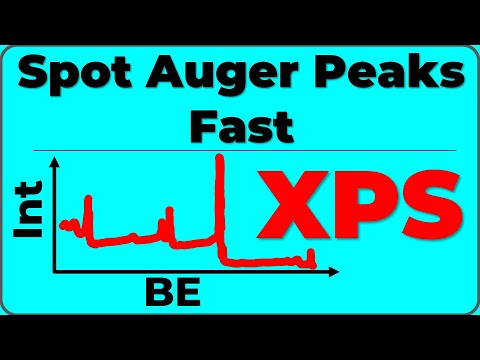 6:16
6:16How to Identify Auger Peaks in XPS Spectra - The Easy Way!
Aug 15, 2024
 4:39
4:39Confused by XPS Peaks? Here’s How to Identify Them Step-by-Step!
Aug 14, 2024
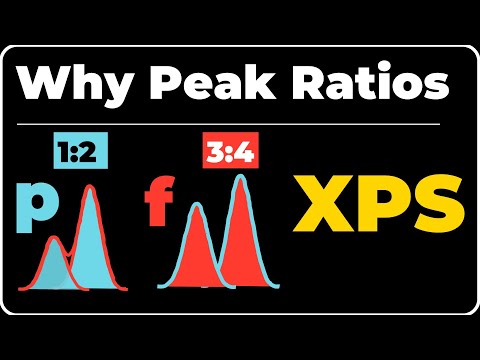 7:17
7:17XPS Spectra for p, d, and f-orbitals
Aug 13, 2024
 4:42
4:42XPS Basics: Understanding Survey and High-Resolution Spectra Simplified!
Aug 12, 2024
 3:56
3:56XPS Secrets: How Binding Energy Reveals the Chemical Environment!
Aug 11, 2024
 6:04
6:04Why Binding Energy increases with the increasing Oxidation State - XPS analysis
Aug 5, 2024
 5:11
5:11The Secret Behind XPS: How It Detects What’s Around an Atom!
Aug 4, 2024
 11:41
11:41XPS Simplified: Why Binding Energy Is Inversely Related to Kinetic Energy!
Jul 22, 2024
 6:36
6:36XPS Basics: Which X-ray Sources Are Most Common and Why!
Jul 21, 2024
 7:12
7:12What Makes XPS So Powerful? The Science Behind Its Superiority!
Jul 21, 2024
 13:52
13:52Why High-Resolution Spectra Matter in XPS (X-ray Photoelectron Spectroscopy Explained)
Jul 20, 2024
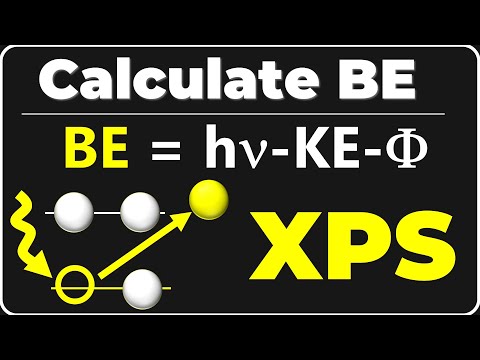 5:22
5:22How to Calculate Binding Energy in XPS (X-ray Photoelectron Spectroscopy)
Jul 17, 2024
 4:49
4:49Why Binding Energy is Crucial in X-ray Photoelectron Spectroscopy (XPS Explained)
Jul 16, 2024
 6:26
6:26XPS Basics: Understanding Binding Energy (BE) in X-ray Photoelectron Spectroscopy
Jul 16, 2024
 6:15
6:15Survey Spectra in X‑ray Photoelectron Spectroscopy (XPS) Explained: First Step Every Analyst Needs
Jul 14, 2024
 10:29
10:29Why XPS Only Analyze Core Electrons - X-rays Photoelectron Spectroscopy
Jul 14, 2024
 1:00
1:00Why d - orbital has a doublet in XPS Spectra - X-rays Photoelectrons Spectroscopy
Jul 11, 2024