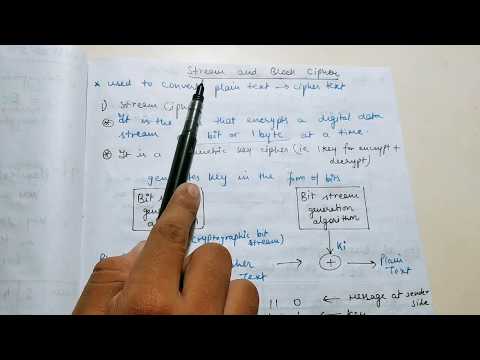
Stream and Block Cipher | Difference between Stream and Block Cipher
What are Stream Ciphers and Block Ciphers?
Introduction to Stream Ciphers
- The video begins with Abhishek introducing the topic of stream ciphers and block ciphers, inviting viewers to subscribe for more educational content.
Understanding Stream Ciphers
- A stream cipher encrypts digital data one bit or byte at a time, utilizing a symmetric key cipher where a single key is used for both encryption and decryption.
- The process involves generating a bit stream using a key generator, which produces bits that will be combined with the plaintext through an XOR operation.
- The result of the XOR operation between the plaintext (e.g., sending 'a' as plain text) and the key yields ciphertext, effectively converting readable messages into encrypted formats.
Decryption Process
- To decrypt, the same key must be used; if both sender and receiver have identical keys, they can successfully convert ciphertext back into plaintext.
Transition to Block Ciphers
- Abhishek transitions to discussing block ciphers, emphasizing their importance in cryptography. He notes that understanding differences between stream and block ciphers is crucial for technical assessments.
Characteristics of Block Ciphers
- In block ciphers, plaintext is converted into ciphertext by processing fixed-size blocks of bits. For example, if there are 12 bits in plaintext, they are grouped into blocks before encryption occurs.
- Each block undergoes conversion from plaintext to ciphertext using specific algorithms designed for this purpose. This method contrasts with how stream ciphers operate on individual bits or bytes.
Confusion and Diffusion Concepts