WARREN BUFFETT AND THE INTERPRETATION OF FINANCIAL STATEMENTS
How to Identify Companies with a Sustainable Competitive Advantage
Introduction to Warren Buffett's Investment Philosophy
- Warren Buffett, one of the wealthiest individuals globally, emphasizes buying companies with sustainable competitive advantages, citing examples like Coca-Cola and Moody’s.
- This video summarizes key takeaways from "The Interpretation of Financial Statements" by Mary Buffett and David Clark, highlighting the importance of understanding financial statements for investors.
Importance of Financial Statements
- Buffett describes financial statements as the "language of business," asserting that investors must understand them to invest in individual stocks effectively.
- He believes that consistency is crucial; he prefers investments that have shown stable performance over time, exemplified by Coca-Cola versus Snapchat.
Key Takeaway 1: Consistency is King
- Buffett looks for consistent earnings, low debt levels, and steady growth in capital expenditures and profitability over long periods.
- Long-term product durability reduces costs significantly for shareholders through decreased production and marketing expenses.
Key Takeaway 2: Analyzing Income Statements
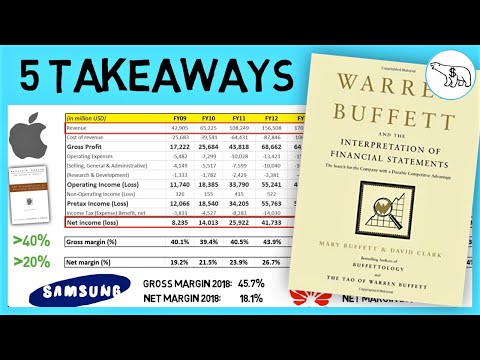
- Using Apple as an example, Buffett seeks consistent net earnings growth over time.
- A high gross margin (ideally above 40%) indicates scalability; Apple meets this criterion while outperforming competitors like Samsung and Huawei in net margins.
Key Takeaway 3: Evaluating Balance Sheets
- Retained earnings are critical; they reflect how well a company reinvests its profits. Steady growth here signals good management practices.
Understanding Key Financial Metrics in Business
Return on Net Tangible Assets
- The return on net tangible assets is a crucial metric for assessing how efficiently a company utilizes its capital. This concept is elaborated in the "Essays of Warren Buffett."
- Exceptional businesses typically do not rely heavily on debt for expansion, often leveraging strong cash flow instead.
- Companies with little to no long-term debt are preferable; ideally, they should be able to pay off all long-term debt within four years of earnings.
Analyzing Cash Flow Statements
- The cash flow statement differs from the income statement as it reflects actual cash transactions rather than just financial performance metrics.
- A key figure in the cash flow statement is capital expenditures (CapEx), which should ideally be less than 25% of net earnings for optimal efficiency.
- While lower CapEx percentages are preferred, exceptions exist when companies make one-time payments aimed at growth.
Shareholder Returns and Retained Earnings
- Apple consistently maintains capital expenses below 25%, unlike many competitors, indicating effective management of resources.
- High distributions to shareholders can lead to an augmented payout ratio exceeding 100%, meaning that a company may distribute more money than it earns.
When Should You Consider Selling Stocks?
Key Instances for Selling
- One reason to sell stocks is if better investment opportunities arise, especially during bear markets where undervalued stocks become available.
- If a company risks losing its competitive advantage due to market changes (e.g., local newspapers vs. online media), it may be time to divest.
- During bull markets, even great businesses can become poor investments if their prices escalate beyond reasonable valuations.
Valuation Considerations
- Buffett and David Clark suggest considering selling stocks when the price-to-earnings (PE) ratio reaches 40 or higher, regardless of confidence in the company's fundamentals.
Summary of Investment Principles
Consistency and Financial Health Indicators
- Look for businesses with consistent growth in net earnings and profit margins that outperform competitors as indicators of durability.
- In balance sheets, prioritize companies with high returns on capital that maintain low levels of debt and show steady growth in retained earnings.
Cash Flow Analysis and Selling Criteria
Turn any video into a summary like this
YouTube links, meetings, lectures. With transcripts, search, and chat.


