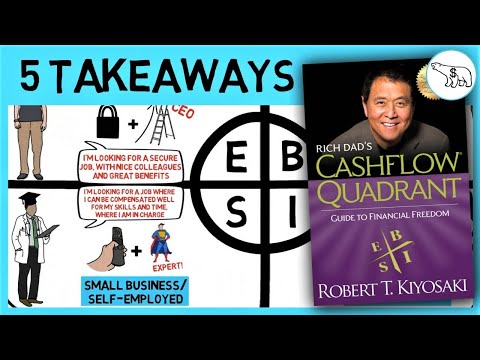
RICH DAD'S CASHFLOW QUADRANT (BY ROBERT KIYOSAKI)
Understanding the Cashflow Quadrant
The Traditional Path to Financial Success
- Many people are raised with the belief that attending school and securing a well-paid job is the key to financial success. This path may work for some, but it is not universally applicable.
The Cashflow Quadrant Explained
- Robert Kiyosaki introduces the Cashflow Quadrant, which outlines four paths to wealth: Employee (E), Small Business Owner/Self-Employed (S), Big Business Owner (B), and Investor (I).
Characteristics of Each Quadrant
- Employee (E): Seeks security through corporate advancement; often values job stability and benefits.
- Small Business Owner/Self-Employed (S): Aims for control by specializing in a field; desires compensation based on skills and time.
- Big Business Owner (B): Pursues freedom by creating profitable systems; focuses on hiring capable individuals to manage operations.
- Investor (I): Also seeks freedom, primarily through strategic allocation of money for maximum returns.
Key Differences Between Quadrants
- The left side of the quadrant (E and S) relies on personal effort, while the right side (B and I) leverages Other People's Time (OPT) and Other People's Money (OPM).
Understanding OPT and OPM
- B quadrant individuals utilize OPT by employing E and S workers while also using funds from I investors. They initially invest their own time but can transition to passive ownership.
Pros and Cons of Each Quadrant
Employee Insights
- Pros: Reduced financial uncertainty, benefits like paid vacation, supportive colleagues.
- Cons: Increased workload with success; performance often exceeds salary.
Small Business Owner Insights
- Pros: Autonomy as your own boss; performance-based pay.
- Cons: Similar workload issues as employees; potential financial instability.
Big Business Owner Insights
- Pros: Utilizes OPT/OPM for rapid financial freedom; retains more profits with lower taxes.
- Cons: Faces financial risks; requires different skills than traditional education provides.
Investor Insights
- Pros: Achieves quick financial freedom using OPT/OPM; potential for passive income.
- Cons: Subject to financial risks similar to other quadrants.
Overcoming Mental Barriers to Transitioning Quadrants
Addiction to Money Sources
- Money can create an addiction similar to drugs or sex. Transitioning between quadrants becomes challenging due to ingrained beliefs about job security and rewards associated with specific work types.
Educational System Influence
- Traditional education rewards mistake avoidance rather than risk-taking, which is essential in B and I quadrants where action leads to learning from failures.
Learning from Successful Investors
Embracing Mistakes
- Thomas Edison’s perspective on failure emphasizes that mistakes are part of learning—he viewed his numerous attempts as steps toward eventual success rather than failures.
Levels of Investors According to Kiyosaki
Five Levels Defined
- Kiyosaki categorizes investors into five levels starting from zero-financial intelligence level where individuals struggle financially due to higher expenses than income.
Financial Success: Understanding Investment Levels
The Savers Are Losers Level
- Placing money in low-interest accounts or under a mattress may seem safe, but it leads to financial stagnation.
- Inflation significantly erodes the value of savings; for example, from 1980 to 2017, the Swedish crown lost 69% of its value.
The I'm-Too-Busy Level
- Many individuals are too occupied with life responsibilities to invest time in learning about investing.
- This often results in them entrusting their finances to others, which prevents personal growth and understanding of investment strategies.
The I'm-a-Professional Level
- This level represents do-it-yourself investors who actively manage their own investments.
- While they educate themselves on investing, they have not yet reached the highest level of investment knowledge and strategy.
The Capitalist Level
- Investors at this level utilize concepts from business (B quadrant), employing advisors for market insights.
- They leverage Other People's Time (OPT) and Other People's Money (OPM), alongside their own funds, to maximize returns.
- Additionally, they use corporate structures to minimize tax liabilities on capital gains, positioning themselves for financial freedom ahead of other investor types.
Recap: Paths to Financial Success
- There are four primary paths to achieving financial success: as an employee, self-employed individual, business owner, or investor.
- Each path has its advantages and disadvantages; choosing the right one depends on personal goals and personality traits.
Turn any video into a summary like this
YouTube links, meetings, lectures. With transcripts, search, and chat.


