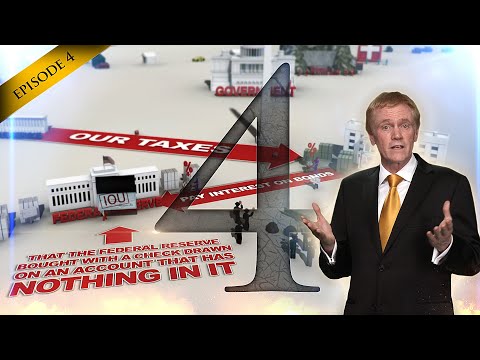
The Biggest Scam In The History Of Mankind - Hidden Secrets of Money Ep 4
Introduction and the Secret of the World Economy
The speaker introduces a secret that has significant effects on the world economy. Most people sense that something is wrong, but few understand what it is.
The Biggest Secret in History
- The world economy is not functioning properly.
- Only a few individuals know the real reason behind the inequality in our world today.
- Learning about this system will change your life and the choices you make.
- If enough people learn about it, it can change the world.
The System Responsible for Inequality
The speaker reveals that there is a system responsible for most of the inequality in our world today, and those in power do not want us to know about it.
The Hidden System
- This system has kept those in power at the top of the financial food chain for 100 years.
- Understanding this system will lead to better decision-making.
- It is a hidden secret that has affected many people throughout history.
The Biggest Scam in History - Money Creation
The speaker explains how money creation plays a crucial role in perpetuating inequality and describes it as "the biggest scam in history."
Money Creation Process
- Modern banking systems create currency faster than trees can grow.
- Most people don't understand how currency is created because economists and bankers make it sound complex.
- Simplifying our monetary system reveals the scam behind it and its impact on individuals.
Deficit Spending and Treasury Bonds
The speaker discusses deficit spending, treasury bonds, and their role in financing government expenses.
Deficit Spending and Borrowing Currency
- Politicians promise more free stuff to gain votes, leading to deficit spending.
- To cover the deficit, the Treasury borrows currency by issuing bonds.
- Treasury bonds are glorified IOUs that need to be paid back with interest.
Bond Auction and National Debt
The speaker explains how bond auctions work and how they contribute to the national debt.
Bond Auction and National Debt
- The Treasury holds a bond auction where banks compete to buy part of the national debt.
- Banks profit from buying these bonds.
- Open Market Operations allow banks to sell some of those bonds to the Federal Reserve at a profit.
Currency Creation and Check Writing
The speaker discusses how currency is created through check writing and its connection to treasury bonds.
Bonds as National Debt
- Treasury bonds represent our national debt.
- When the government issues a bond, it steals prosperity from the future by spending it today.
- Banks buy more bonds using currency created through check writing.
Shell Game - Open Market Operations
The speaker explains how open market operations allow banks to profit from selling bonds to the Federal Reserve.
Open Market Operations
- Banks sell some of their bought bonds to the Federal Reserve through open market operations.
- The Federal Reserve writes checks without sufficient funds in their account, effectively creating money.
- Currency springs into existence when banks receive these checks.
Swapping IOUs - Enriching Banks, Indebting Public
The speaker reveals how swapping IOUs between the Federal Reserve and Treasury enriches banks while indebting the public.
Swapping IOUs for Currency Creation
- The Federal Reserve and Treasury swap IOUs using banks as middlemen.
- Currency is created through this process, enriching banks and increasing the national debt.
Buildup of Bonds and Currency
The speaker explains how the buildup of bonds at the Federal Reserve and currency at the Treasury occurs.
Buildup of Bonds and Currency
- The result is a buildup of bonds at the Federal Reserve and currency at the Treasury.
- This process is where all paper currency comes from.
- The Federal Reserve mistakenly calls it "Base Money," but it should be referred to as "Base Currency."
Difference Between Money and Currency
The speaker highlights the difference between money and currency, emphasizing that base currency is not money.
Money vs. Currency
- Money must be a store of value over time, while currency does not maintain its purchasing power.
- Base currency is not money; it is simply currency created through this system.
Swapping IOUs - Enriching Banks, Indebting Public (Continued)
The speaker continues to explain how swapping IOUs between the Federal Reserve and Treasury affects banks and indebts the public.
Swapping IOUs for Currency Creation (Continued)
- The Federal Reserve writes IOUs (checks) in exchange for Treasury's IOUs (bonds).
- This process repeats, enriching banks while raising the national debt.
New Section
This section explains how currency is created and circulated in the economy, focusing on the role of banks and fractional reserve lending.
Currency Creation Process
- Currency is essentially a receipt or claim check on an IOU (bond) issued by the government.
- The Treasury creates new currency and deposits it into various branches of the government through deficit spending.
- Government employees, contractors, and soldiers deposit their pay in banks, which allows banks to use that currency for various purposes.
- When individuals deposit currency in a bank, they are actually loaning the bank their money.
- Banks can use deposited money for activities like gambling in the stock market or loaning it out at a profit through Fractional Reserve Lending.
Fractional Reserve Lending
- Fractional Reserve Lending allows banks to reserve only a fraction of deposited money and lend out the rest.
- A typical example uses a 10% reserve ratio: if $100 is deposited, the bank can legally take $90 and loan it without informing the depositor.
- The bank must hold $10 as reserves in case the depositor wants to withdraw some funds.
- The remaining $90 is replaced with IOUs called "bank credit" created by the bank.
Expansion of Currency Supply
- Bank credit numbers created through fractional reserve lending are considered currency even though they exist only in computers.
- This process repeats when borrowers use loans to make purchases. Sellers deposit that currency into their accounts, allowing their banks to lend out 90% of it again.
- Under a 10% reserve ratio, an initial deposit of $100 can create up to $1,000 of bank credit backed by just $100 of vault cash (reserves).
- Reserve ratios vary widely across different types of deposits.
Impact on Currency Supply and Inflation
- The expansion of currency supply by banks is far greater than the initial deposit, leading to a significant increase in the overall currency supply.
- Approximately 92% to 96% of all currency in existence is created by banks rather than the government.
- The increase in currency supply can lead to inflation, as rising prices are a symptom of an expanded currency supply.
New Section
This section highlights how the majority of our currency supply is created within the banking system and discusses the relationship between currency supply and inflation.
Currency Creation by Banks
- The banking system creates massive amounts of currency through loans and redeposits.
- When individuals deposit money in banks, it allows banks to lend it out again, creating bank credit that circulates as currency.
- Around 92% to 96% of all existing currency is created within the banking system, not by the government.
Impact on Inflation
- An expanding currency supply leads to inflation, where rising prices are a consequence of increased money circulation.
- Inflation occurs when there is an expansion of the overall currency supply.
- The true definition of inflation is an expansion of the currency supply; rising prices are just a symptom.
New Section
This section emphasizes that our entire currency supply consists only of numbers created through government IOUs and bank credit. It also explores how we trade our time for these numbers.
Our Currency Supply
- Our entire currency supply is composed solely of numbers: printed ones from government IOUs and typed ones from bank credit.
- These numbers represent our labor, ideas, talent, and time traded for pieces of paper or computer entries.
Trading Time for Currency
- We work hard to earn some portion of this currency supply so that we can save it or pay taxes with it.
- True wealth lies in our time, but we exchange moments in our lives for numbers that represent currency.
- The value of currency comes from the collective effort and contribution of individuals.
New Section
This section discusses how we work hard to earn currency, only to have a portion of it taken as taxes. It also mentions the role of the Federal Reserve in buying bonds with checks.
Paying Taxes
- We work hard to earn currency, but a portion is taken as taxes by entities like the IRS (in the United States).
- The tax money collected is then transferred to the Treasury, which uses it to pay off principal and interest on bonds purchased by the Federal Reserve.
The transcript ends here.
New Section
This section discusses the establishment of the Federal Reserve and its connection to personal income tax.
The Creation of the Federal Reserve and Income Tax
- Before the establishment of the Federal Reserve in 1913, there was no need for personal income tax.
- The Constitution was amended in the same year to allow for income tax, raising questions about whether this was a coincidence or not.
- Much of the income tax paid by individuals has been siphoned away into the hands of those who own the system.
New Section
This section explains the concept of the "debt ceiling" and how it relates to interest on loans.
The Paradox of Debt and Interest
- The concept of the "debt ceiling" is based on a paradox where interest is due on every dollar in existence.
- Borrowing money into existence creates a cycle where more debt is needed to pay off existing debt with interest.
- This results in a system where there is always more debt than currency available to pay it off, making it impossible to sustain indefinitely.
New Section
This section explores what would happen if borrowing stopped and payments on treasury bonds ceased.
Consequences of Stopping Borrowing
- If borrowing were to stop, no new currency would be created to replace what is used for payments.
- Payments on loans, bonds, taxes, etc., continue regardless of borrowing, leading to a deflationary collapse if not sustained by increasing levels of debt.
- Balancing budgets and paying down debt under our current monetary system is deflationary and unsustainable without collapsing the economy.
New Section
This section discusses the continuous need for increasing levels of debt and the fraudulent nature of the monetary system.
The Need for Increasing Debt
- The current monetary system requires ever-increasing levels of debt to sustain itself.
- Politicians raise the "debt ceiling" repeatedly to avoid a collapse under the weight of the system.
- The Federal Reserve, despite its name, is not federal and has stockholders, making it a form of legalized theft.
New Section
This section highlights the founding fathers' understanding of central banking and their intent to protect future generations from fiat currency and debt-based systems.
Founding Fathers' Intentions
- The founding fathers fought against central banking and understood the dangers of fiat currency and debt-based systems.
- They wrote into the constitution that only gold and silver can be money to prevent institutional theft and out-of-control government.
- Our current unconstitutional system robs us of liberty, prosperity, and purchasing power.
New Section
This section explains how inflation is a result of our debt-based monetary system.
Inflation as a Stealth Tax
- Inflation is a slow and insidious stealth tax resulting from our debt-based monetary system.
- Those who create currency benefit from spending it into circulation before it affects the economy, stealing purchasing power from individuals.
- The Federal Reserve acknowledges that inflation benefits issuers of money at the expense of holders through decreased purchasing power.
New Section
This section reveals that our current monetary system is a form of legalized theft and the Federal Reserve is not truly federal.
The Fraudulent Nature of the Monetary System
- Our entire monetary system is a form of legalized theft, including pyramid and Ponzi schemes.
- The Federal Reserve, despite its name, has stockholders, making it non-federal and contributing to the fraudulent nature of the system.
- This system robs individuals of their wealth and undermines the principles our forefathers fought for.
New Section
This section discusses the ownership and secrecy surrounding the Federal Reserve, as well as the profit-making process through selling national debt bonds.
Ownership of the Federal Reserve
- The ownership of the Federal Reserve is a closely guarded secret.
- It is speculated that the primary dealers, which are banks, are the owners of the Federal Reserve.
- Due to mergers and acquisitions over time, it is difficult to trace who exactly owns stock in the Federal Reserve.
Profit-Making Process
- Banks sell part of our national debt (bonds) to the Federal Reserve at a profit.
- The Federal Reserve buys these bonds with checks created out of nothing.
- Taxpayers then pay taxes to cover both principal and interest on these bonds.
- The Federal Reserve pays banks a 6 percent dividend on their ownership of the Fed.
New Section
This section explains how currency is created through swapping IOUs and highlights the complexity of the system.
Currency Creation Process
- The Treasury sells bonds to banks in exchange for IOUs.
- Banks sell our national debt at a profit to the likely owner, which is believed to be the Federal Reserve.
- The Federal Reserve buys these IOUs with more IOUs written on checks from an account with zero balance.
- Currency comes into existence when these checks are given to banks.
Complexity of System
- The system is purposely complex and not easily comprehended by most people.
- Economist John Maynard Keynes stated that this complexity allows governments to secretly confiscate wealth without detection.
- However, with proper presentation, anyone can understand this complex system.
New Section
This section provides a recap and further breakdown of how the monetary system works, including steps involving government bonds, currency creation, and taxation.
Recap of the Monetary System
- Step 1: The government creates bonds that increase national debt.
- Step 2: Bonds are sold to banks, who then sell them to the Federal Reserve at a profit.
- Step 3: The Federal Reserve buys these bonds with checks created out of nothing.
- Step 4: Banks multiply the numbers by inventing more IOUs through Fractional Reserve Lending.
- Step 5: Taxation occurs on the numbers (currency) earned by individuals.
- Step 6: The system relies on ever-increasing levels of debt and may eventually collapse due to politicians avoiding its collapse during their tenure.
- Step 7: The world's largest banks, as owners of the Federal Reserve, profit from selling national debt and receiving interest and dividends.
New Section
This section highlights the negative consequences of the monetary system, including wealth disparity and enslavement through future tax obligations.
Negative Consequences
- The monetary system causes artificial booms and busts in economies.
- It leads to significant wealth disparity between the rich and working class.
- The use of currency instead of real money enables this system to exist.
- Government bonds create promises for future tax payments, leading to a form of enslavement.
New Section
This section emphasizes the importance of understanding the monetary system and how individuals can bring about positive change.
Importance of Understanding
- Public ignorance about how the monetary system works is crucial for its continuation.
- Sharing knowledge about this system is essential for building a better future for generations to come.
New Section
This section concludes with a quote highlighting the power held by bankers in creating money and controlling credit.
Quote on Banking Power
- A former Director of the Bank of England stated that the modern banking system creates money out of nothing and holds immense power.
- The quote suggests that if people continue to allow bankers to create money, they will remain enslaved and bear the cost of their own slavery.
Timestamps have been associated with each section based on the provided transcript.
New Section
This section discusses the importance of understanding the current monetary system and taking action to protect oneself from its potential collapse.
What Can You Do?
- Watch the video until you can describe and teach it to others. Understanding the system allows for preparations in case of a collapse.
- Share the video with everyone, especially those you care about. Spread the message through social media platforms like Facebook, Twitter, and email.
- Join the conversation at HiddenSecretsOfMoney.com, an open-source platform for designing a new world monetary system. Encourage economists, students, colleges, and anyone interested to participate in discussions.
New Section
This section emphasizes the importance of education and discussion in preventing further loss of freedoms and potentially regaining some of them.
Educating Ourselves
- By educating ourselves and each other about the flaws in the current monetary system, we can prevent further loss of freedoms.
- The video features insights from Ron Paul, Jim Rickards, and Steve Forbes.
- Visit HiddenSecretsOfMoney.com for more episodes on this topic.
New Section
Ron Paul shares his thoughts on how understanding the Federal Reserve is crucial for effecting change.
Ron Paul's Perspective
- Ron Paul finds Episode 4 beneficial in introducing ideas to people and changing their minds about the Federal Reserve.
- He believes that providing explanations and diagrams helps people understand since they are not taught about it in school or college unless under rare circumstances.
New Section
Jim Rickards, a former monetary economist, praises the accuracy and clarity of the video.
Jim Rickards' Perspective
- As a former monetary economist, Jim Rickards appreciates the accuracy and clarity of the video.
- He mentions his experience working with primary dealers in the Treasury market and how it relates to the content discussed.
New Section
The discussion highlights how advancements in communication technology have made it easier to educate people about the Federal Reserve.
Revolution in Communications
- The creation of social media platforms allows for millions of people to be reached and informed about what's happening with the Federal Reserve.
- The video is commended for successfully reaching out to a wide audience and sparking discussions on this topic.
New Section
Steve Forbes discusses how money creation by the Federal Reserve undermines social trust and leads to turmoil.
Undermining Social Trust
- Money creation by the Federal Reserve is seen as a form of taxation and confiscation, which undermines social trust.
- The consequences are corrosive throughout society, leading to future turmoil but also potential positive change.
New Section
Mike Maloney concludes the episode with acknowledgments and sponsor information.
Conclusion
- Mike Maloney thanks everyone for watching Episode 4 of Hidden Secrets Of Money.
- This episode was brought to you by GoldSilver.com and features the new Silver Pegasus round.
Turn any video into a summary like this
YouTube links, meetings, lectures. With transcripts, search, and chat.


