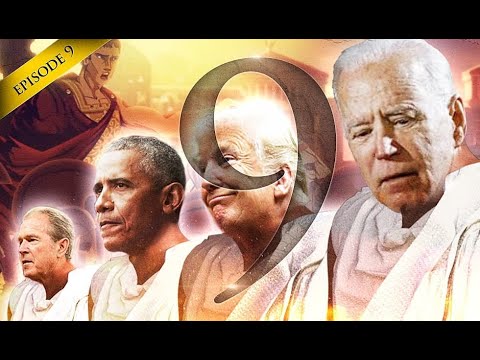
Fall Of Empires: Rome vs USA (Hidden Secrets Of Money Ep 9)
The Historical Cycles of the World Economy
In this section, the speaker introduces the concept of historical cycles in the world economy and how understanding these cycles can help predict future outcomes.
The Repeating Patterns of History
- Throughout history, there have been recurring patterns in the world economy.
- Economic gyrations, inflation, loss of personal freedom, and out-of-control government are consequences of the monetary system itself.
- Most world history is determined by monetary history.
Lessons from the Past for Navigating Economic Storms
- Debasing a nation's currency supply to pay for public works and war is a pattern that repeats throughout history.
- Understanding past events can help us navigate economic storms in the present.
- By studying historical cycles, we can make preparations for predictable outcomes.
Parallels Between Ancient Rome and the United States Today
This section explores the similarities between ancient Rome and the United States today, focusing on their early economies and monetary systems.
Early Economy of Ancient Rome
- In its early days as a republic, Rome had no evidence of significant inflation for 178 years.
- They used gold and silver coinage as their currency, with small denominations made out of copper and bronze.
Debasement of Currency in Ancient Rome
- During the second Punic War with Carthage, Rome resorted to deficit spending by melting down coins taken in taxes and adding cheap base metals like copper to mint more coins. This caused significant inflation.
- The debasement of currency was one factor that led to the downfall of the Roman Republic and its transition into a dictatorship.
Similarities Between Ancient Rome and the United States Today
This section highlights the parallels between ancient Rome and the United States today, focusing on their monetary policies and economic chaos.
Sound Money in Early United States
- From the late 1700s to the early 1900s, the United States had stable prices due to laws mandating the use of gold and silver as money.
- The use of sound money prevented inflation and protected people's wealth.
Debasement of Currency in the United States
- Similar to ancient Rome, ongoing debasement of currency for war spending and public works has led to economic chaos in the United States.
- Excessive taxation and debasing of money are common factors between Rome and the United States today.
Broad Parallels Between Ancient Rome and the United States Today
This section explores broader parallels between ancient Rome and the United States today, including their political systems and monetary policies.
Political Systems
- Both ancient Rome and the United States started as republics after overthrowing monarchies.
- In both societies, there were mechanisms in place to prevent concentration of power.
Debasing Currency
- Both ancient Rome and the United States experienced debasement of currency through excessive taxation and manipulation of coinage.
- The value of currency diminished over time due to these practices.
Currency Debasement Throughout History
This section delves into how currency debasement is a recurring pattern throughout history, using examples from ancient Rome.
Rarity Maintains Currency Value
- The Romans understood that a currency maintains its value because of its rarity.
- Julius Paulus stated that a currency's purchasing power is maintained not just by its substance but also by its quantity.
Continuous Currency Production
- Despite understanding rarity, both ancient Romans and modern societies like the USA continue to churn out more currency.
- The Romans came up with techniques like coin clipping to expand the currency supply.
Patterns Repeat Themselves
- Historical patterns of currency debasement and inflation always repeat themselves.
- The same patterns observed in ancient Rome can be seen in the United States today.
Coin Clipping in Ancient Rome
This section focuses on a specific technique used by ancient Romans called coin clipping, which contributed to their currency debasement.
Coin Clipping Process
- When entering a government building, Romans would clip the edge off their gold or silver coins.
- These clippings were collected, melted down, and minted into new coins, expanding the currency supply.
Conclusion
Understanding historical cycles and patterns in the world economy is crucial for predicting future outcomes. By studying examples from ancient Rome and comparing them to the United States today, we can see how monetary policies and currency debasement have had significant impacts throughout history. Recognizing these parallels can help us navigate economic storms and make informed decisions for the future.
The Move Away from Precious Metals
This section discusses the historical debasement of currency, starting with the Roman Empire's practice of clipping coins. It also highlights a modern phenomenon where product portions are shrinking while prices remain the same.
Currency Debasement in History
- The Roman Empire famously clipped their coins as a form of currency debasement.
- Today, a similar pattern can be observed with shrinking product portions at supermarkets while prices remain unchanged.
Importance of Stable Money
- The quality of a society is directly proportional to the quality of its money.
- Stable money leads to stable prices and a stable society.
- Currency debasement has historically led to the demise of empires.
Historical Examples
- Rome's ongoing currency debasement was driven by financing their expanding empire and wars.
- The precious metals content in Roman coinage fell until it had no connection to stable economy.
- Similar patterns can be seen in the United States' history, where high levels of precious metals were gradually replaced by fiat currency.
Nixon's Severing Ties Between Dollar and Gold
This section focuses on President Nixon's decision to end the Bretton Woods system, severing ties between the US dollar and gold. It explains how this move shifted the world onto a fiat currency system.
Nixon's Actions
- President Nixon ended the Bretton Woods system on August 15th, 1971, severing ties between the dollar and gold.
- This act of global debasement had significant repercussions for generations to come.
Fiat Currency System
- The world transitioned to a fiat currency system, accepting that currencies were no longer tied to gold.
- The advantage of the US dollar is its liquidity, making it the most attractive currency despite being a fiat currency.
Importance of Fixed Measure in Money
This section emphasizes the importance of having a fixed measure in money and how it affects economic transactions and stability.
Fixed Measure of Value
- Money should be a fixed measure of value, similar to standardized measurements like feet or inches.
- Having a fixed measure makes economic activities, such as building houses or baking cakes, easier and more predictable.
Impact on Transactions
- A floating measure in money would complicate everyday transactions, such as telling time or measuring ingredients.
- A fixed measure allows for easier exchange and creates wealth through productive interactions.
The Power of the US Dollar as a Fiat Currency
This section discusses the unique position of the US dollar as a fiat currency and its global acceptance despite its inherent flaws.
Liquidity of the US Dollar
- The US dollar is considered the most attractive fiat currency due to its liquidity.
- Despite being criticized as the worst currency in the world, it remains widely accepted due to its liquidity.
Printing Lies
- The ability to print money is seen as an amazing feat but also morally questionable.
- People scramble to borrow liabilities, with the US dollar being the most attractive option.
The transcript provided is in English, and the notes have been written accordingly.
International Trade and Currency Value
The speaker discusses the dynamics of international trade and currency value, highlighting the example of Germany sending a Mercedes to the US and Japan sending a stereo in return. They mention that while it may seem amusing, there will eventually be consequences for such imbalances.
Understanding the Value of a Dollar
- The US dollar is a major global currency, involved in half of all transactions.
- Historically, the value of a dollar was defined by its weight in silver or gold according to the Constitution.
- However, current definitions are unclear as former Federal Reserve chairs Bernanke and Greenspan were unable to define it.
Determining Currency Value
- The value of a currency is determined in the marketplace.
- With no gold standard, determining the value of a dollar in relation to other currencies becomes challenging.
- Speculators in gold may be affected by these changes.
Gold's Role in Fiat Currency Supply
- Official gold prices have not been changed recently.
- Throughout history, gold has accounted for expanding fiat currency supplies by rising in price.
- In 1934, gold was revalued from $20.67 an ounce to $35 an ounce due to debasement.
Gold's Response to Inflation and Fiat Currency Supply
This section explores how gold responds to inflation and fiat currency supply. It highlights historical instances where gold's price rose as a response to an expanding money supply.
Gold's Response to Fiat Currency Supply Expansion
- Gold has historically responded to expanding fiat currency supplies by increasing in price.
- In 1971, after Nixon removed restrictions on currency creation, gold's price rose from $35 an ounce.
- By 1980, it reached $850 an ounce due to massive quantities of newly created currency.
Gold as Ultimate Money
- Governments have a history of trying to manipulate or cheat gold, but gold has always prevailed.
- Gold's scarcity and inability to be printed make it the ultimate money.
- Cryptocurrencies are seen as an exciting development with potential, but gold remains a reliable store of value.
Historical Examples of Currency Debasement and Inflation
This section delves into historical examples of currency debasement, inflation, and their impact on societies. It emphasizes the importance of controlling the quantity of currency.
Rome's Cycles of Currency Debasement
- Rome experienced cycles of currency debasement for war spending, resulting in inflation.
- Those who held gold outside the official system maintained purchasing power while others suffered.
- Emperor Aurelian recalled worthless coins in 270 AD and minted new ones with only 5% silver.
Government Meddling and Economic Consequences
- Governments levied high taxes on businesses and the rich to fund wars, leading to economic decline.
- Increased government intervention worsened economic conditions.
- Private property was confiscated by force to fill state coffers.
Emperor Diocletian's Failed Solutions
This section focuses on Emperor Diocletian's attempts to control inflation through government solutions. However, these actions exacerbated economic problems instead.
Wage and Price Controls Fail
- Emperor Diocletian implemented works projects and hired unemployed individuals as soldiers and government employees.
- Deficit spending increased uncontrollably, leading to hyperinflation in 301 AD.
The Enduring Power of Gold
This section highlights how gold has consistently retained its value throughout history despite attempts at currency manipulation.
Gold's Resilience Against Currency Manipulation
- Governments have repeatedly attempted to manipulate or debase currencies throughout history.
- Despite these efforts, gold has always maintained its value and acted as a hedge against inflation.
The transcript provided is in English, so the response is also in English.
New Section
This section discusses the impact of wage and price controls enforced under the penalty of death.
Impact of Wage and Price Controls
- The government implemented a system of wage and price controls, with severe penalties for non-compliance.
- Instead of risking their lives to sell goods at a profit, people closed their businesses or pursued unlisted jobs.
- Diocletian introduced a law requiring sons to enter their father's business under the penalty of death.
- Government interference in the economy leads to distorted prices, economic turmoil, shortages, and black markets.
- Similar to Nixon's economic interference with gold, Diocletian's meddling caused hyperinflation in gold prices.
- Wage and price controls give more power to the government but distort market signals and hinder production.
- Failed price controls are seen throughout history, leading to chaos, inflation, food shortages, and black markets.
- Nixon's 90-day wage and price freeze aimed to curb inflation but resulted in further economic instability.
New Section
This section explores the implementation of wage and price controls during the French Revolution.
Wage and Price Controls during the French Revolution
- The French government imposed wage and price controls known as the law of maximum under threat of death.
- Governments often deflect attention from problems they create by blaming businesses as greedy hoarders or gougers.
- Innocent people were executed, food shortages occurred, and black markets thrived during the law of maximum.
- The law was repealed after fifteen months due to its failure, leading to further chaos and inflation in France.
New Section
This section discusses Nixon's wage and price controls during the 1970s.
Nixon's Wage and Price Controls
- In addition to announcing the end of the gold standard, Nixon implemented a 90-day wage and price freeze.
- The United States faced inflation due to deficit spending for the Vietnam War and expansion of paper currency supply.
- Similar to Diocletian and French Revolution, Nixon's team believed wage and price controls could curb inflation.
- However, these controls only led to further economic instability and did not effectively address inflation.
New Section
Prices and wages throughout the United States for a period of 90 days. Working together to break the back of inflation. Lack of learning from history.
Economic Levers and Duration of Controls
- Nixon's adviser discusses the duration of controls.
- Uncertainty about whether breaking the back of inflation will take longer than 90 days.
- Sailing into uncharted waters, but a reasonable estimate is provided for the required time.
New Section
President Nixon's address on new economic policies against a backdrop of high gold prices and increasing cost of living.
Freeze on Prices
- Immediate order for a freeze on prices at June levels.
- Coverage includes all prices paid by consumers.
New Section
The consequences and dangers of inflation, government intervention, and manipulation.
Consequences of Inflation
- Historical pattern: borrowing leading to bankruptcy, increased money supply causing price hikes, rebellion, system collapse.
- Fearful anticipation of country collapse, wars, rebellion due to inflation.
Government Intervention
- Government intervention worsens situations globally.
- Manipulation and control lead to unexpected outcomes in free markets.
Examples from History
- Dot-com bubble burst led to real estate bubble due to interest rate manipulation by Alan Greenspan in 2000.
- Depression of 1921 as an example where non-intervention allowed free markets to heal naturally after initial hardships.
New Section
The importance of understanding the consequences of government intervention and manipulation.
Lessons from History
- Lack of awareness about the Depression of 1921 due to non-intervention by the government.
- Free markets allowed to work, leading to recovery after initial hardships.
- Bankruptcies and foreclosures led to more efficient businesses and new opportunities.
Financial Responsibility
- Leveraged individuals and inefficient businesses faced consequences during economic downturns.
- Non-intervention allows free markets to heal naturally over time.
New Section
Mark Twain's quote about history repeating itself is explored, highlighting the recurring patterns in history and their relevance to the present.
History Repeating Itself
- Mark Twain is often quoted as saying "history doesn't repeat"
- However, it does rhyme, as evidenced by the events discussed in this episode
- Examples of wage and price controls failing in the past are given: Diocletian's attempt during his reign and the French Revolution
- Nixon also tried wage and price controls with negative consequences for the economy
- The speaker emphasizes that these mistakes are likely to be repeated in future attempts at implementing such policies
New Section
The cyclic nature of historical events is further explored, with a focus on how political cycles contribute to recurring problems.
Four-Year Election Cycle
- The four-year election cycle plays a role in perpetuating historical patterns
- Politicians prioritize short-term gains and their own reputations over long-term consequences
- Problems are often pushed forward to future administrations rather than being addressed effectively
- The speaker highlights that politicians are more concerned with immediate outcomes than future implications
New Section
Lack of knowledge about monetary history among politicians is discussed as a contributing factor to repeating mistakes.
Ignorance of Monetary History
- Politicians' lack of familiarity with monetary history leads to repeated errors
- This ignorance contributes to ongoing similarities between ancient Rome and the United States today
- The speaker suggests that if the same path is followed, the future of the United States may mirror that of past societies
The transcript provided does not include specific timestamps for each bullet point. I have associated the bullet points with the closest available timestamps in order to provide a structured summary.
Turn any video into a summary like this
YouTube links, meetings, lectures. With transcripts, search, and chat.


