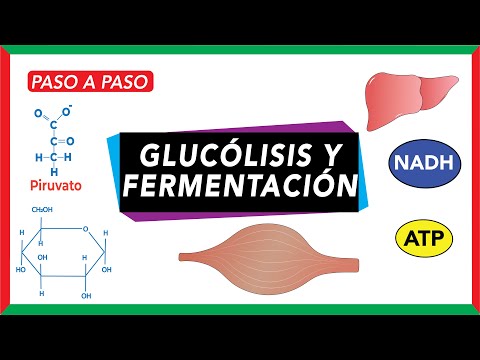
Glucólisis: pasos y destino del piruvato (fermentación)
Introduction to Glucose Metabolism
In this section, we will discuss the general aspects of glycolysis and the different pathways that pyruvate can follow, such as fermentation.
Generalities of Glucose
- Glucose is a molecule with 6 carbons and plays a crucial role in the metabolism of plants, animals, and microorganisms.
- It serves as an excellent fuel source and acts as an intermediary for other metabolic pathways.
- Glucose is involved in processes like the pentose phosphate pathway, extracellular matrix component synthesis, and glycogen synthesis.
Glycolysis Overview
- Glycolysis is a series of enzyme-catalyzed reactions that degrade glucose to produce ATP, pyruvate, and NADH.
- All glycolytic reactions occur in the cytosol.
Steps of Glycolysis
- Conversion of glucose to glucose 6-phosphate by hexokinase or glucokinase using ATP.
- Conversion of glucose 6-phosphate to fructose 6-phosphate by phosphohexose isomerase.
- Conversion of fructose 6-phosphate to fructose 1,6-bisphosphate by phosphofructokinase using ATP.
- Cleavage of fructose 1,6-bisphosphate into dihydroxyacetone phosphate (DHAP) and glyceraldehyde 3-phosphate (G3P) by aldolase.
- Interconversion between DHAP and G3P by triose phosphate isomerase.
- Oxidation of G3P to 1,3-bisphosphoglycerate (BPG) by glyceraldehyde 3-phosphate dehydrogenase with NAD+ reduction to NADH.
- Conversion of BPG to 3-phosphoglycerate (3PG) by phosphoglycerate kinase, producing ATP.
- Conversion of 3PG to 2-phosphoglycerate (2PG) by phosphoglycerate mutase.
- Dehydration of 2PG to phosphoenolpyruvate (PEP) by enolase, releasing water.
- Conversion of PEP to pyruvate by pyruvate kinase, producing ATP.
Summary of Glycolysis
- Glycolysis degrades glucose to produce 2 pyruvates, 2 NADH, and 2 ATPs.
Pyruvate Pathways
In this section, we will discuss the two main pathways that pyruvate can follow depending on the cellular context: aerobic conditions or anaerobic conditions.
Aerobic Conditions
- Under aerobic conditions (presence of oxygen), pyruvates enter the mitochondria for further metabolism.
- In the mitochondria, each pyruvate is converted into acetyl-CoA through a series of reactions known as the Pyruvate Dehydrogenase Complex (PDC).
- Acetyl-CoA then enters the citric acid cycle (Krebs cycle) for complete oxidation and energy production in the form of ATP.
Anaerobic Conditions
- Under anaerobic conditions (absence of oxygen), or in cells without mitochondria like red blood cells or highly active muscle cells, pyruvates undergo fermentation.
- Fermentation involves converting pyruvates into other compounds such as lactate or ethanol to regenerate NAD+ for glycolysis to continue.
- Only a small amount of ATP is produced through fermentation compared to aerobic respiration.
Summary
- Depending on the cellular context, pyruvate can either enter the mitochondria for aerobic metabolism or undergo fermentation under anaerobic conditions.
- Aerobic metabolism yields a higher amount of ATP, while fermentation produces only a small amount of ATP.
Conclusion
In this video, we learned about the general aspects of glycolysis and the pathways that pyruvate can follow. Glycolysis is an essential metabolic pathway that degrades glucose to produce ATP, pyruvate, and NADH. Pyruvate can then enter either aerobic metabolism in the mitochondria or undergo fermentation under anaerobic conditions. Understanding these processes is crucial for comprehending cellular energy production and metabolism.
Formation of Lactate in Glycolysis
This section discusses the formation of lactate in the process of glycolysis.
Lactate Production and Recycling
- During glycolysis, lactate is released as a byproduct when hydrogen is not oxidized.
- The unoxidized lactate can be utilized again in the seventh step of glycolysis to regenerate NADH.
- This cycle repeats constantly to recycle the oxidized and reduced forms of NAD.
Alcoholic Fermentation
This section explains alcoholic fermentation as an example of fermentation.
Steps of Alcoholic Fermentation
- Pyruvate undergoes decarboxylation through pyruvate decarboxylase to form acetaldehyde.
- The enzyme pyrophosphate thiamine and magnesium cations are required as cofactors for this decarboxylation reaction.
- Acetaldehyde is then converted to ethanol by alcohol dehydrogenase enzyme.
- In this process, NADH is not used, and NAD+ is regenerated.
- The oxidized form of NAD is recycled and utilized again in the seventh step of glycolysis.
Summary of Fermentation Processes
This section provides a summary of fermentation processes discussed earlier.
Recap on Glycolysis and Fermentation
- Glycolysis consists of two phases: an investment phase that uses ATP and a payoff phase that generates ATP.
- Fermentation occurs when oxygen is limited or absent, leading to the production of different end products such as lactate or ethanol.
- Both lactate and ethanol production involve recycling the oxidized form (NAD+) back to its reduced form (NADH) in the seventh step of glycolysis.
The transcript is not in English, so the summary is provided in the same language as the transcript.
Turn any video into a summary like this
YouTube links, meetings, lectures. With transcripts, search, and chat.