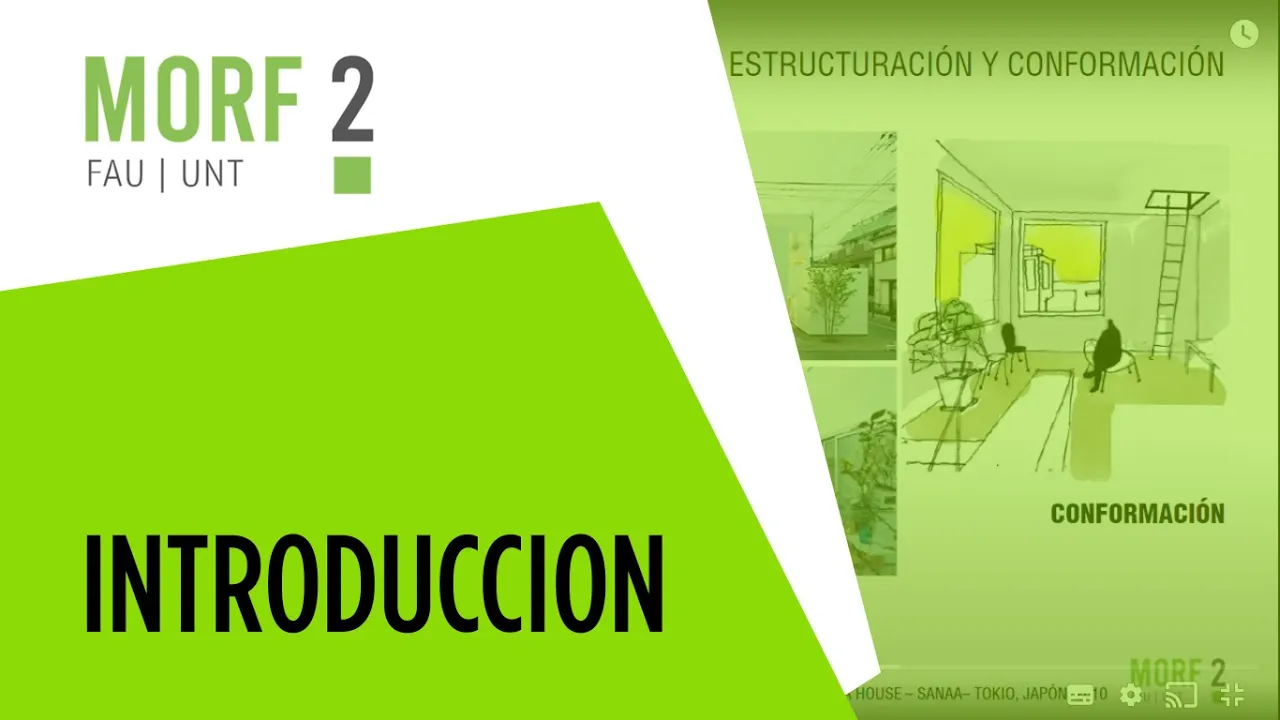
morf2 | introducción a la materia
Introduction to Morphology
In this section, Marina Arroyo introduces herself as an architect and teacher of morphology. She outlines the basic concepts that will be covered in the introductory class, focusing on defining morphology and its significance in creating new forms.
Defining Morphology
- Morphology is etymologically derived from "morpho" meaning form or figure, and "logia" referring to study.
- It involves studying existing forms and figures while also providing tools to generate new forms.
Understanding Form
- Form can be viewed as a formal structure that supports something (structuring) and as the visible appearance of something (conforming).
- Various factors such as technical, environmental, functional, economic, and cultural aspects influence form creation.
Aspects of Morphology
Marina discusses how morphology relates to projects by operating on and generating forms. She categorizes morphology into three subgroups: morphological indicative, architectural morphology, and urban portfolio.
Subgroups of Morphology
- Morphology can be divided into morphological indicative (object-oriented), architectural morphology (study of architectural form), and urban portfolio.
- The focus in this course will be on architectural morphology emphasizing the inseparable relationship between form and space.
Variables in Form Creation
The discussion shifts towards variables involved in creating form within a project. Two main categories are highlighted: structuring variables related to geometry and symmetry, and conforming variables linked to materiality and atmosphere creation.
Structuring Variables
- Include principles like Euclidean geometry, symmetry, rhythm, sequential spatial organization, proportion, scale.
- These variables help order and relate elements initially in the design process.
Conforming Variables
- Encompass considerations such as envelope design, materiality choices like light, color, texture; spatial distribution; aiming to define atmospheres for architectural use.
Example Analysis - Four Houses
Marina provides an example analysis of four houses showcasing how morphological tools are applied differently based on technical, environmental, functional aspects within each design.
Example Analysis
- Examines a housing complex with distinct textures indicating specific technologies for light entry.
- Notable features include defined access points delineating interior-exterior boundaries using varied materials strategically.
New Section
In this section, the importance of architectural examples in analyzing spatial continuity and relationships is discussed.
Analyzing Architectural Examples
- Emphasizes the significance of architectural examples in understanding spatial relationships.
- Discusses the development of a school by architects facing constraints such as specific site characteristics, technology, and limited resources.
- Highlights the constructive resolution concerning the environment in architectural design processes.
- Examines how plans and lines delineate spaces within a volume, considering environmental factors.
- Explores the materiality and technology integration in architectural projects like schools.
New Section
This section delves into a larger architectural project, emphasizing material usage, internal spatial aspects, and societal communication.
Analysis of Large-Scale Architectural Project
- Focuses on the Mediateca de Sendai by El Toyo Ito, highlighting material usage and internal spatial design.
- Discusses technical, functional, social-cultural, and economic aspects influencing public architecture projects.
- Explores transparency in design through non-traditional space separation methods.
- Examines how structural elements like columns contribute to inhabitable spaces rather than just support structures.
- Considers organic interior divisions instead of traditional orthogonal walls for flexibility in spatial design.
New Section
This part focuses on structural elements impacting spatial perception and technological considerations in architecture.
Structural Elements Impacting Spatial Perception
- Explores how structural elements like slabs impact spatial atmosphere differently based on their coverage from floor to ceiling.
- Discusses how technical features such as elevators integrate with architectural structures for functional purposes.
- Considers the interplay between technological advancements and economic factors in architectural design decisions.
New Section
The importance of studying forms' inseparability from space perception is highlighted along with creating specific sensations through architectural designs.
Importance of Form-Space Relationship
- Emphasizes that form is inseparable from space perception in architecture.