Explicación y Definición del Átomo
What is an Atom?
Definition and Historical Context
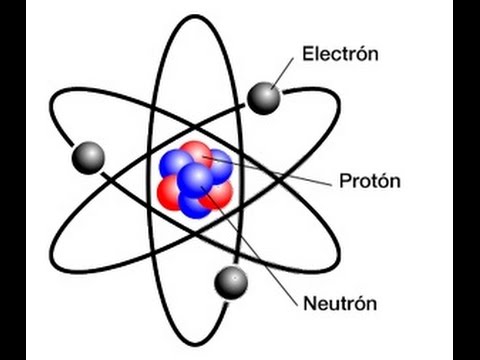
- An atom is defined as the smallest unit that composes a chemical element, consisting of a nucleus surrounded by electrons.
- The concept of the atom has evolved significantly from its ancient Greek origins to modern discoveries in particle accelerators.
- Ancient philosophers Leucippus and Democritus first described atoms as indivisible units making up all matter, revolutionizing contemporary thought.
Structure of Atoms
- The periodic table organizes all known elements based on their atomic number, which corresponds to the number of protons in an atom.
- Atoms bond through chemical links to form more complex structures like molecules, cells, tissues, and organs.
Modern Understanding of Atoms
- While ancient Greeks viewed atoms as indivisible, modern science reveals they are composed of electrons orbiting a nucleus made up of neutrons and protons.
- The nucleus accounts for 99.9% of an atom's weight but occupies less than 0.01% of its volume; electrons contribute minimal weight yet occupy significant space.
Forces Within Atoms
- Electrons carry a negative charge while protons have a positive charge; neutrons are neutral, resulting in overall electrical neutrality when electron and proton numbers are equal.
- Various forces (weak nuclear force, strong nuclear force, electromagnetic force) keep these atomic components stable over billions of years.
Discoveries Beyond Traditional Models
- Particle accelerators have revealed that atoms consist not only of electrons, neutrons, and protons but also numerous subatomic particles leading to the development of the Standard Model in particle physics.
- This model categorizes fundamental particles into bosons and fermions further divided into quarks and leptons.
Theoretical Perspectives on Matter
- String theory posits that all matter—including elementary particles like quarks—is made up of tiny vibrating strings or filaments responsible for the universe's origin.
Fun Fact About Atoms