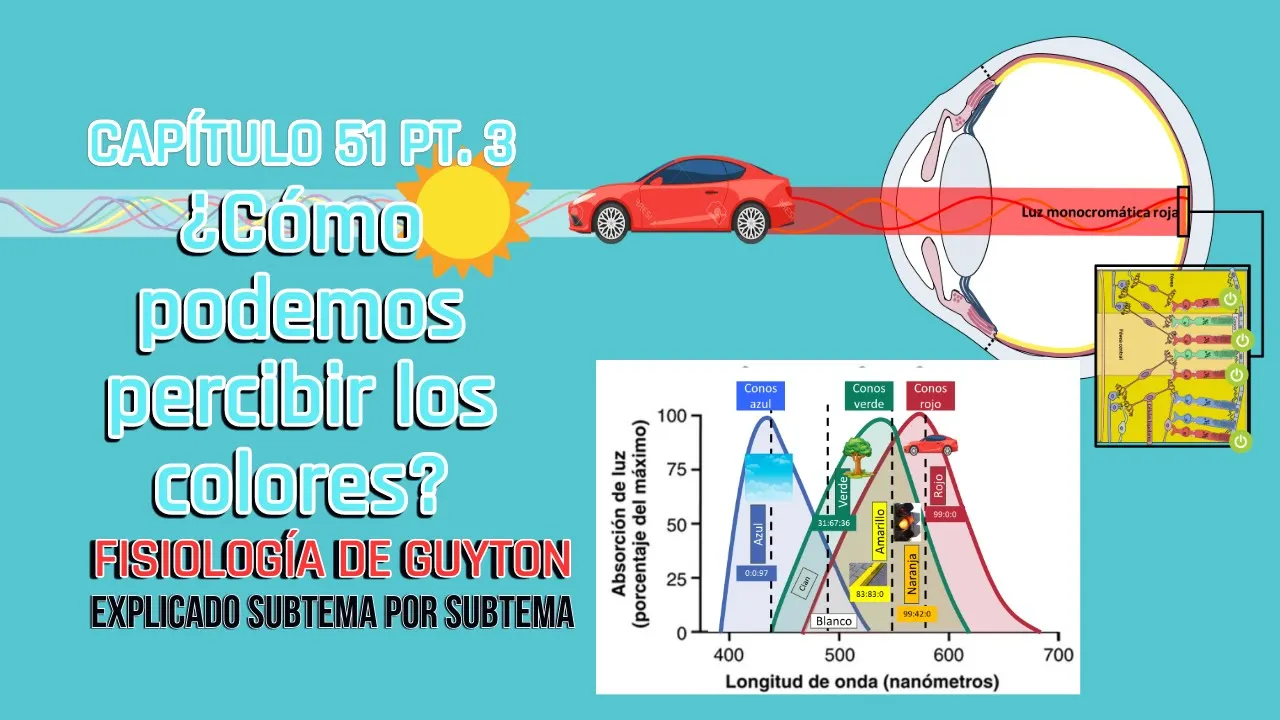
CAP 51 3/4: ¿Cómo podemos percibir los colores? l Fisiología de Guyton
How the Human Eye Detects Colors
In this video, the process of how the human eye detects colors is explored, focusing on the role of cones and color pigments in color perception.
Cones and Color Perception
- Cones are essential for detecting colors within the human eye. Each cone contains three essential color pigments: blue, red, and green.
- The rule dictates that only one color pigment can be present in a single cone at a time. Therefore, cones can only have one pigment (red, blue, or green) at any given moment.
- There are three types of cones known as red, green, and blue cones or large, medium, and short cones based on their ability to detect different wavelengths. These cones are responsible for detecting various colors.
Color Detection Mechanism
- The basic mechanism for detecting color involves the combination of signals from different cones. By mixing signals from red, green, and blue cones in varying intensities, new colors are formed such as yellow (red + green), magenta (blue + red), and cyan (green + blue).
- When multiple cones are stimulated simultaneously by different wavelengths of light, the brain interprets these signals as specific colors through a complex process of signal integration.
Wavelengths and Color Perception
- Colors are determined by their wavelengths; each color corresponds to a specific wavelength. For instance, red has a wavelength of 700 nanometers while orange has a wavelength of 600 nanometers.
- Visible light consists of various wavelengths that form different colors. The combination or separation of these wavelengths results in the perception of white light or individual colors respectively.
Understanding Color Perception
In this section, the speaker delves into how light impacts our perception of color, explaining why objects appear in certain colors based on their interaction with light.
The Role of Light in Color Perception
- Light is essential for us to perceive colors; when sunlight hits an object like a car, it acquires a color based on the absorbed and reflected light wavelengths.
- Objects appear in specific colors because they absorb certain light waves and reflect others.
- White objects reflect all colors, appearing white to us as they do not absorb any specific wavelength.
- On the other hand, black objects absorb all colors, reflecting none back to our eyes.
- Understanding why people wear white on sunny days: white objects reflect light and heat, keeping them cooler compared to dark-colored objects that absorb more heat.
- Black objects absorb more heat from sunlight due to their absorption of all colors.
Cones and Color Detection
- The retina contains three types of cones responsible for detecting different wavelengths: red cones (long wavelengths), green cones (medium wavelengths), and blue cones (short wavelengths).
- Each cone type is sensitive to specific ranges of wavelengths.
- Cones work together to help us perceive various colors by responding differently to incoming light waves.
- Different combinations of cone activations result in our perception of diverse hues.
Color Perception Mechanisms
- When we see a red object, it indicates that mainly the red cones are activated while green and blue cones remain inactive.
- Our brain processes these cone signals to interpret the perceived color accurately.
- For complex colors like orange or yellow, multiple cones are stimulated simultaneously due to the combination of different wavelength absorptions by the object.
- The brain integrates signals from various cones to identify mixed hues effectively.
Cone Sensitivity and Environmental Influence
- Cones respond differently depending on environmental factors; for instance, greenery activates all three cone types but with varying intensities.
- The environment influences how cones react collectively or individually based on the predominant color stimuli present.
Understanding Color Blindness
In this section, the speaker discusses how the human eye perceives colors and delves into the concept of color blindness, specifically focusing on red-green color blindness.
The Perception of White Light
- The speaker explains how the human body or eye detects differences to perceive multiple colors.
- Stimulating red, green, and blue cones simultaneously generates white light.
Red-Green Color Blindness (Daltonism)
- Introduction to Daltonism or color blindness, particularly red-green color blindness.
- Daltonism occurs when a person lacks a group of cone receptors in the eye, leading to an inability to distinguish between certain colors.
Types of Red-Green Color Blindness
- Protanopia: Absence of red cones in the retina, affecting the perception of long wavelengths.
- Deuteranopia: Absence of green cones in the retina; ability to see long wavelengths remains unaffected.
Genetic Basis and Diagnosis
This section explores the genetic factors influencing color blindness and methods for diagnosing color vision deficiencies.
Genetic Factors in Color Blindness
- Red-Green Color Blindness is a genetic disorder primarily found in males due to chromosomal composition (XY).
- Errors in X chromosome genes lead to cone receptor deficiencies causing color vision issues.
Gender Influence on Color Vision Deficiencies
- Women can be carriers of color blindness due to X chromosome inheritance but may not exhibit symptoms themselves.
Other Forms of Color Blindness
- Mention of blue cone synthesis deficiency as another rare form of color vision impairment with a genetic origin.
Diagnosis through Ishihara Plates
The discussion shifts towards diagnostic tools like Ishihara plates used for identifying color vision deficiencies.
Diagnostic Tools for Color Blindness
- Ishihara plates are crucial for assessing proper color perception by asking individuals to identify numbers within colored patterns.
Identifying Red-Green Color Blindness