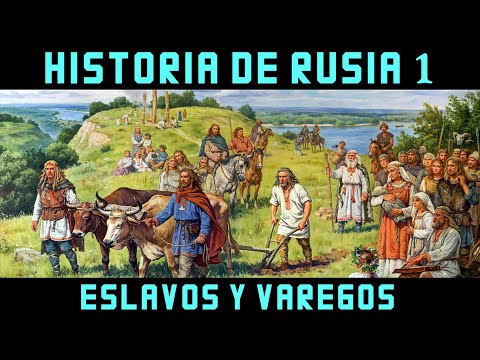
Historia de RUSIA 1: El origen de los Eslavos y los Varegos de Rurik (Documental Historia)
Introduction to the History of Russia
Overview of the Series
- The series will cover the history of Russia from its origins to the end of the Middle Ages, focusing on the Principality of Moscow.
- Viewers are encouraged to engage with the content by liking and commenting, which helps increase visibility through YouTube's algorithm.
Geographical Context
- The focus is primarily on Eastern European plains, stretching from central plains and Carpathian Mountains to the Ural Mountains, marking a boundary between European and Asian Russia.
- Key rivers include:
- Ural River: Flows into the Caspian Sea.
- Volga River: The most significant river in Russia, also flows into the Caspian Sea after passing through major cities like Kazan and Volgograd (formerly Stalingrad).
- Moskva River: Passes through Moscow, Russia's capital.
Important Rivers and Lakes
Major Waterways
- Other notable rivers include:
- Don River: Flows into the Sea of Azov near Crimea.
- Dnieper River: Cuts through Ukraine and flows into the Black Sea.
- Vistula River: Significant in Poland, traversing its entirety.
Northern Lakes
- In northern Russia, three large lakes are highlighted:
- Onega Lake
- Ladoga Lake
- Peipus Lake
Early Human Settlement in Russia
Prehistoric Cultures
- The earliest hominids appeared around two million years ago; Homo erectus was found in Caucasus regions.
- Denisova Man remains were discovered in Altai Mountains dating back approximately 110,000 years; they represent a distinct human species separate from Homo sapiens.
Proto-Indo-European Influence
- Around 45,000 years ago, early Homo sapiens settled across both European and Asian parts of modern-day Russia.
- Proto-Indo-European speakers likely inhabited areas now known as Ukraine; their language influenced many modern languages including Slavic ones.
Emergence of Slavic Cultures
Origins of Slavs
- The first identifiable Slavic culture emerged from two ancient cultures around third century BC—Celtic influences in Poland and cultures between Belarus and northern Ukraine.
Cultural Developments
- Tcherniakov culture along Black Sea shores engaged in agriculture and animal husbandry while creating pottery and jewelry influenced by Scythian culture.
- Viable theories suggest proto-Slavic roots may trace back to various cultural groups including Miłograd or Chernyakhov cultures.
Early Slavic Societies
Social Structure
- The first identifiable Slavic society is linked to Kiev culture; little is known about them but they constructed semi-subterranean homes with chimneys.
- These societies were organized under local chieftains with primitive animistic beliefs centered around nature spirits.
Religious Practices
- Ritual practices involved worshipping natural elements led by figures called "golf," who oversaw rituals at sacred sites such as trees or springs.
History of the Slavs and Their Cultures
The Arrival of the Huns and Early Slavic Tribes
- In the century after Christ, the Huns invaded and devastated regions, led by Attila. They were temporarily halted by the Roman Empire but were ultimately defeated in 451.
- Following their defeat, surviving Huns mingled with Slavic populations, leading to significant cultural developments in Eastern Europe.
- By 560 AD, Avars, a Turkic people, appeared in Eastern Europe alongside Khazars who settled in the Caucasus region.
Historical Accounts of Slavic Tribes
- Byzantine historian Jordanes referred to Slavic tribes as Benetti or Vénetos from the Vistula River area; he noted their common language roots.
- The term "Slav" was not used until the 6th century; its origin is uncertain but may relate to honor or language among those speaking similar tongues.
Development of Slavic Groups
- Three main groups emerged: Western Slavs (Czechs, Slovaks), Eastern Slavs (Ukrainians, Russians), and Southern Slavs (Balkans including Croats and Serbs).
- During medieval times, many Slavs became enslaved; this historical context links to how "slave" derives from "Slav."
Formation of Early States
- Between 631 and 658 AD, Frankish merchant Samu united several Western Slav tribes into a short-lived state known as Samo's Empire.
- This early state was located in present-day Moravia and Slovakia but fell quickly to Avar conquest.
Rise of Christianity Among the Slavs
- Christian leaders promised aid against Avars if certain tribes converted; this led to further integration into European political structures.
- By around 814 AD, Charlemagne defeated Avars and began influencing Czech and Slovak territories politically.
Establishment of Great Moravia
- In 833 AD along the Morava River, Great Moravia was established under Prince Mojmir I who introduced Christianity.
- Missionaries Cyril and Methodius arrived in 863 AD promoting Christianity using Old Church Slavonic for liturgy.
Development of Written Language
- Cyril developed an early alphabet called Glagolitic for translating religious texts; it had Greek influences.
- Boris I of Bulgaria later commissioned an alphabet based on Glagolitic during his reign which evolved into what is now known as Cyrillic.
Decline of Great Moravia
- Svatopluk I expanded Great Moravia but faced internal strife leading to its decline by 907 AD due to Magyar invasions.
Exploration and Settlement of the Vikings in Eastern Europe
Viking Expansion and Trade
- The Swedish Vikings began exploring eastern and southern routes, discovering that trade was more profitable than raiding coastal towns.
- They utilized rivers like the Volga and Dnieper as north-south highways to engage in commerce with the Byzantine Empire, fostering relationships with various Slavic tribes along these waterways.
Rurik's Leadership
- Rurik, a significant leader according to Nestor's Chronicle, unified local tribes around Lake Ilmen after they called for his assistance against internal conflicts.
- He established a settlement named Holmgard (later Novgorod) and created the principality of Novgorod, which became foundational for Kievan Rus' and the Rurik dynasty.
Economic Growth
- Under Rurik’s leadership, Novgorod prospered due to its strategic location on trade routes; key traded goods included timber, furs, wax, and honey.
- Rurik maintained control over the principality until 869 when he passed leadership to his relative while his son Igor awaited succession.
Conquest of Kiev
- Two soldiers from Rurik's group traveled south towards Constantinople and discovered Kiev, a city founded by three brothers; they eventually took control of it after several attacks.