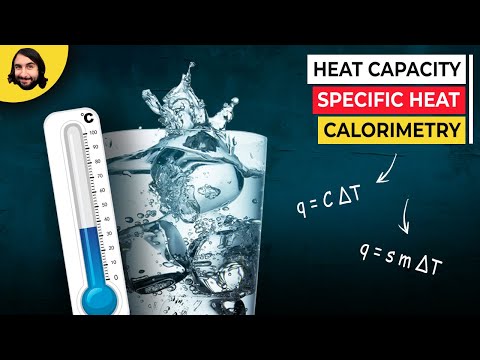
Heat Capacity, Specific Heat, and Calorimetry
Introduction to Calorimetry
In this section, Professor Dave introduces the concept of calorimetry and explains the heat capacity and specific heat of substances.
Heat Capacity and Specific Heat
- Different substances have different rates of heat absorption due to structural factors.
- Heat capacity is the amount of energy required to raise the temperature of a sample by one degree Celsius.
- Specific heat is a more useful variation for calculations, representing the energy required to raise one gram of a substance by one degree Celsius.
Heat Exchange Equations
This section discusses the relationship between heat, temperature, and heat capacity in terms of equations.
Heat Exchange Equations
- The amount of heat exchanged in a reaction is equal to the product of the substance's heat capacity and the change in temperature.
- Alternatively, it can be calculated using specific heat, grams of substance present, and change in temperature.
Calorimetry Process
Professor Dave explains how calorimetry can be used to study heat transfer.
Coffee Cup Calorimeter Experiment
- A coffee cup acts as an insulator, allowing for accurate measurement of temperature changes.
- By adding a hot piece of metal to water in a coffee cup calorimeter, we can measure the resulting temperature change.
- Using specific heat equations and data for water, we can calculate the absorbed heat by water and then use that value to determine the specific heat of the metal.
Calculating Specific Heat
This section explains how to calculate specific heat using calorimetry data.
Calculation Steps
- Measure mass (in grams) or volume (in milliliters) of water.
- Use the known specific heat value of water to calculate the heat absorbed by the water.
- Since the heat absorbed by water is equal to the heat released by the metal, use this quantity to calculate the specific heat of the metal.
- Solve for the specific heat of an unknown metal using known specific heats and temperature changes.
Comprehension Check
Professor Dave suggests checking comprehension after explaining calorimetry.
Comprehension Check
- The ability to identify unknown metals can be enhanced by calculating their specific heats using calorimetry data.
The transcript provided does not include any non-English content or timestamps beyond 3 minutes and 9 seconds.
Turn any video into a summary like this
YouTube links, meetings, lectures — with transcripts, search, and chat.