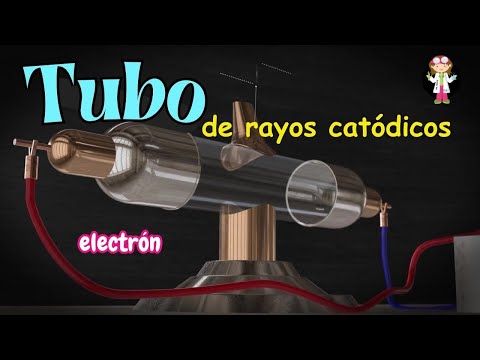
💡🔬 ¿Qué son los Tubos de Rayos Catódicos? Experimento de Descubrimiento del electrón. J.J Thomson
Introduction to Cathode Ray Tubes
Overview of Cathode Ray Tubes
- The video introduces cathode ray tubes (CRT), highlighting their significance in scientific history, including the discovery of electrons and their role in early television and monitors.
Functionality of Cathode Ray Tubes
- A cathode ray tube is a type of discharge tube used to study gas behavior under low pressure and its interaction with electricity.
- It operates by using a vacuum pump to remove air from the tube, allowing for electrical connections between the cathode (negative electrode) and anode (positive electrode).
Observations at Low Pressure
- At very low pressures (around 0.0001 mm of mercury), applying a potential difference of 10 to 20 kV causes a glow on the glass walls of the tube, indicating electron movement towards the anode.
Properties of Cathode Rays
Key Characteristics
- Shadow Projection: When an object obstructs the path of cathode rays, it casts shadows, demonstrating that these rays travel in straight lines.
- Movement Induction: Placing a small wheel in the path of cathode rays causes it to spin, proving that these rays consist of particles with kinetic energy.
Behavior in Electric and Magnetic Fields
- Deflection in Electric Fields: In an electric field, cathode rays bend towards positive plates, confirming they are negatively charged particles.
- Deflection in Magnetic Fields: Similarly, when passing through magnetic fields, cathode rays also deviate, showcasing their susceptibility to magnetic forces.
Impact on Science
Contribution to Understanding Matter