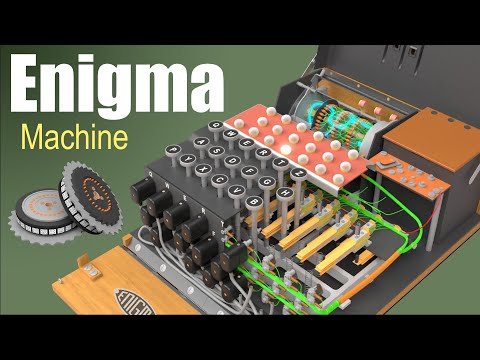
How did the Enigma Machine work?
Introduction to the Enigma Machine
In this section, Jared introduces the Enigma machine and its purpose during World War II. He explains that the machine was used for encryption to keep messages secret.
The Enigma Machine
- The Enigma machine was used during World War II for encryption.
- It was designed to keep messages secret or encrypted.
- Jared mentions that in this video, they will explore why the Enigma machine exists and how it was used.
Understanding Encryption and Scrambling Messages
In this section, Jared explains the concept of encryption using a simple example involving two friends, Alice and Bob. He introduces the idea of scrambling messages to make them unreadable without decryption.
Encryption Example with Alice and Bob
- Alice wants to send a message to Bob without anyone else being able to read it.
- She scrambles or encrypts the message so that it appears as random letters.
- When Bob receives the encrypted message, he needs to decrypt or unscramble it to read the original message.
- Encryption ensures that only intended recipients can understand the message while keeping it secure from others.
Acknowledgments and Animation Preview
In this section, Jared acknowledges enigmamuseum.com for their assistance in understanding the inner workings of an actual Enigma machine. He also mentions a preview of animation related to the topic.
Acknowledgments
- Jared expresses gratitude towards enigmamuseum.com for their help in understanding how an actual Enigma machine works.
- Their assistance with examining the inside wiring and mechanical pieces saved time in 3D modeling and animating.
Animation Preview
- Jared mentions that later in the video, there will be animations explaining how the Enigma machine functions.
- This preview indicates that visual representations will be used to enhance understanding.
Importance of Encryption in War
In this section, Jared emphasizes the significance of encryption during times of war. He explains that commanding officers need to send messages to troops without the enemy being able to understand them.
Encryption in War
- Commanding officers require a secure method to communicate with troops on the battlefield.
- Encryption ensures that messages cannot be intercepted and understood by the enemy.
- While modern encryption is performed by computers, the Enigma machine was used during World War II for encryption and decryption purposes.
Introduction to Caesar Cipher
In this section, Jared introduces a simple method of encryption called the Caesar cipher. He explains how shifting letters in the alphabet can scramble a message.
Caesar Cipher
- The Caesar cipher involves shifting all letters in a message three spaces to the right in the alphabet.
- This shift scrambles the original message, making it appear as gibberish.
- To decrypt or unscramble the message, Bob simply needs to shift each letter back three spaces.
- As long as Eve does not know how the messages were encrypted, she cannot read them.
The Enigma Machine as a Letter Scrambler
In this section, Jared describes the Enigma machine as a sophisticated letter scrambler. He mentions its invention in the early 1900s and its prominent use by the German military during World War II.
The Enigma Machine
- The Enigma machine is like a typewriter but with a different purpose - encrypting and decrypting messages.
- It was invented in the early 1900s and gained significant usage by the German military during World War II.
- The machine functions as an advanced letter scrambler using electrical circuits and light bulbs.
Components of the Enigma Machine
In this section, Jared explains the components of the Enigma machine, including the keyboard and lamp board. He describes how pressing a letter on the keyboard illuminates a different letter on the lamp board.
Keyboard and Lamp Board
- The Enigma machine consists of a keyboard with 26 letters and a lamp board with 26 letters.
- Pressing a letter on the keyboard connects a circuit that lights up one of the 26 light bulbs on the lamp board.
- The illuminated letter on the lamp board is always different from the one pressed on the keyboard.
- Two people typically operate the machine: one types in letters, while another writes down the corresponding illuminated letters.
Encryption Process with the Enigma Machine
In this section, Jared explains how encryption is performed using an Enigma machine. He describes typing in letters, recording illuminated letters, and sending encrypted messages via radio using Morse code.
Encryption Process
- To encrypt a message using an Enigma machine, each letter is typed in and its corresponding illuminated letter is recorded.
- The recorded illuminated letters form an encrypted or scrambled message that cannot be read by others.
- Encrypted messages are usually sent via radio using Morse code.
- The recipient also needs an Enigma machine to decrypt or unscramble received messages.
Importance of Having an Enigma Machine for Decryption
In this section, Jared emphasizes that both sender and receiver need an Enigma machine for successful communication. He highlights that decryption requires typing in letters and recording illuminated letters to obtain the original message.
Decryption Process
- Decrypting or unscrambling an encrypted message requires typing in each letter on an Enigma machine's keyboard.
- The corresponding illuminated letters are then recorded to obtain the original message.
- Both the sender and receiver need an Enigma machine to ensure successful communication.
Scrambling Wires in the Enigma Machine
In this section, Jared explains how the Enigma machine scrambles letters using electrical circuits. He demonstrates a simple circuit example with switches and light bulbs to illustrate the concept of scrambling wires.
Scrambling Wires
- The Enigma machine scrambles letters by rearranging electrical circuits.
- Jared demonstrates a simple circuit example with switches and light bulbs to showcase how scrambling can occur.
- By scrambling the wires, pressing one letter on the keyboard can illuminate a different letter on the lamp board.
Inner Workings of the Enigma Machine
In this section, Jared showcases the actual Enigma machine and its inner workings. He points out the battery location, keyboard, and 26 light bulbs on the lamp board.
Inner Workings
- The battery is located inside the top right-hand corner of the Enigma machine.
- The keyboard consists of 26 keys representing each letter of the alphabet.
- Pressing a key connects a circuit that illuminates one of 26 light bulbs on the lamp board.
- The illuminated letter represents an encrypted version of the pressed key.
New Section
In this section, the speaker introduces the three main parts of the machine: the rotors, keyboard mechanism, and plugboard.
Rotors
- The machine has three rotors that scramble the letters.
- Each rotor has numbers 1 to 26 corresponding to the letters A to Z.
- There are 26 metal contact points on each side of the rotor.
- When two rotors connect, electricity can pass through them.
- Inside the rotors are wires that connect the two sides in a scrambled manner.
- Electricity passing through one rotor changes the letter once, and with three rotors, it changes three times.
Reflector
- At the end of the machine is a reflector with 26 metal contacts.
- Inside are wiring connections between letters in pairs.
- The input letter goes in and comes out as a different letter.
New Section
This section focuses on the input wheel and how electricity flows through it.
Input Wheel
- The input wheel has 26 wires connecting to 26 metal contacts.
- Electricity flows through one wire representing a letter (e.g., Y).
- It passes through all three rotors, changing letters each time.
- Then it hits the reflector, which changes the letter again.
- Finally, it goes back through the rotors for three more letter changes before coming out on a wire representing a completely different letter.
Scrambling Path
- The example shows that a letter can be changed seven times as it travels through different components of the machine.
- The path can vary depending on rotor positions, making it difficult to predict which letters will come out.
New Section
This section explains how rotor positions affect electricity flow and makes predicting output letters challenging.
Rotor Positions
- Each rotor can rotate to 26 different positions.
- Changing rotor positions alters the path of electricity, making it unpredictable which letters will come out.
Plugboard
- The plugboard is another component that affects letter arrangement.
- It allows swapping two letters by using cables with plugs at each end.
- Plugging a cable into specific spots changes the flow of electricity and alters the output letter.
New Section
This section focuses on the keyboard mechanism and how key switches control electricity flow.
Key Switches
- Each key is connected to a long stem with springs that push it back up when released.
- There are 26 key switches, one for each letter.
- Each switch has three copper-colored tabs controlling the flow of electricity.
- Pressing a key changes which tabs are connected, altering the path of electricity.
Wiring Connections
- The top tabs of the switches connect to light bulbs through wires.
- The middle tabs connect to the plugboard via wires on the right side of the machine.
- A wire from the battery connects to the bottom tabs of each key switch.
New Section
This section provides further details about wiring connections in relation to light bulbs and plugboard sockets.
Light Bulbs
- The top tabs of key switches connect to corresponding light bulbs via wires on the left side of the machine.
Plugboard Sockets
- The middle tabs of key switches connect to plugboard sockets through wires on the right side of the machine.
- When nothing is plugged into a socket, electricity flows through without changing letters.
- Plugging a cable into a socket redirects electricity, changing input and output letters accordingly.
New Section
In this section, the speaker explains the path of electricity in an Enigma machine circuit.
Path of Electricity
- The battery and plugboard are connected to complete a circuit.
- Electricity flows from the battery to the switch for the pressed key (in this case, X) and then directly to the plugboard.
- If nothing is plugged in for the letter X on the plugboard, it comes back out as X and goes into the input wheel.
- The electricity passes through three rotors, a reflector, and then back through the rotors again, changing letters at each step.
- The letter X is transformed into K after going through the rotors.
- The letter K is swapped with C on the plugboard.
- From there, it travels back to the middle tab on the C key switch and then up to the C light bulb.
- Finally, it completes its circuit by flowing through a metal plate in the light bulb and connecting back to the battery.
New Section
This section focuses on how pressing different keys affects rotor movement and letter output.
Rotor Movement
- Each time a key is pressed, at least one of three rotors turns.
- Pressing a key multiple times results in different letters being displayed.
- The rotor movement is mechanical and does not require electricity. Even without a battery, pressing a key will still turn a rotor.
New Section
This section explains how rotor movement is controlled by mechanisms such as ratchet gears and pawls.
Mechanisms for Rotor Movement
- A large metal plate called an actuator bar is located at the bottom of the machine. Pressing any key pushes down one side of this bar, causing it to move up on the other side.
- The rotor movement is controlled by a ratchet and pawl mechanism. The pawl, when pushed up, spins the rotor in one direction.
- The first rotor has a notch that allows the pawl to make contact with the second rotor, allowing it to spin once. This happens every 26 key presses.
- Similarly, there is an edge on the second rotor that must go all the way around before the third rotor can spin.
New Section
This section discusses how index wheels ensure proper alignment between rotors and electrical contacts.
Index Wheels and Electrical Contacts
- At the back of the machine, there are three levers with index wheels at their ends.
- These index wheels ride along the outside of the rotor gear teeth and ensure that the rotors always stop spinning at the next number.
- This alignment is crucial for maintaining proper electrical contacts between rotors.
New Section
This section explains four settings that need to be configured on an Enigma machine before use.
Machine Configuration Settings
- The first setting is choosing three out of five available rotors and determining their order.
- The second setting involves adjusting ring settings for each rotor, which includes shifting number wheels and considering notches on their sides.
- These adjustments determine when leftmost rotors can be advanced to the next number.
New Section
This section discusses the configuration of the plugboard in the Enigma machine and how settings were distributed to the German army.
Configuration of the Plugboard
- The final setting in the Enigma machine is the configuration of the plugboard at the front.
- Settings for the Enigma machine were distributed to the German army in advance through paper.
- Each day of the month had specific settings that needed to be used.
- Without knowing the correct settings, even if someone has an Enigma machine, they won't be able to read messages.
New Section
This section highlights that understanding some concepts behind the Enigma machine may require mathematical and scientific skills.
Complexity of Enigma Machine
- Some ideas behind the Enigma machine are complex and may be difficult to understand.
- Increasing mathematical and scientific abilities can help in comprehending these concepts.
New Section
Introduction to Brilliant.org as a problem-solving platform for learning mathematics, science, and computer science.
Introduction to Brilliant.org
- Brilliant.org is a problem-solving website and app offering over 60 courses in mathematics, science, and computer science.
- The platform focuses on learning by doing, providing immediate opportunities to apply learned concepts.
- It caters to students, professionals, or anyone interested in keeping their skills sharp.
- Brilliant.org offers a wide range of content with new courses being added periodically.
- The platform emphasizes visual understanding rather than blindly applying formulas.
Turn any video into a summary like this
YouTube links, meetings, lectures — with transcripts, search, and chat.