ICT W.E.N.T. Series - Part 2 of 5
Understanding the Power of Compounding
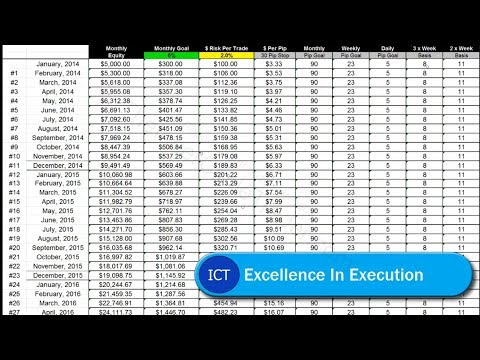
In this section, the speaker discusses how a 6% monthly return can lead to significant growth in your account over time.
The Power of Compounding
- Starting with $5,000 and consistently earning a 6% monthly return would more than double your account in one year.
- This translates to a little over doubling your money to $10,000 after one full year.
- Achieving a 6% monthly return may sound too good to be true, but it is a realistic goal in trading.
Setting Realistic Goals
- It is recommended to use a 30 pip stop (initially) when trading.
- Aiming for 6% per month and targeting around 423 pips for the week (less than 100 pips per month) allows you to risk only 2% of your equity.
- Even with these conservative goals, it may take several years to reach certain financial milestones.
Case Study: Monthly Income Goal
In this section, the speaker presents a case study on achieving a specific monthly income goal through trading.
Monthly Income Goal
- Assuming an average person requires $3,500 per month as income.
- With a goal of earning 6% per month and aiming for less than 100 pips per month with a 30 pip stop loss, it would take several years to reach that income level.
- It is important to understand that reaching financial goals takes time and consistent effort.
Increasing Returns with Larger Goals
Here, the speaker explores the potential for larger returns by increasing the monthly percentage goal while keeping risk percentage constant.
Increasing Return Percentage
- By aiming for a respectable 10% monthly return while keeping the risk at 2%, you would need to target around 38 pips per month.
- This is a reasonable goal and still allows for conservative risk management.
- Over time, this approach can significantly increase your account balance.
Long-Term Growth Potential
In this section, the speaker discusses the long-term growth potential of consistent returns and compounding.
Long-Term Growth
- Assuming consistent 10% monthly returns, a $5,000 account could grow to approximately $170,000 over three years.
- It is important to note that taxes are not considered in this calculation.
- Consistency and discipline are key to achieving these results.
Fine-tuning Entries for Better Results
Here, the speaker introduces the concept of fine-tuning entries to potentially reduce initial stop loss requirements.
Fine-tuning Entries
- By improving entry precision and reducing initial stop loss from 30 pips to 20 pips, it may be possible to achieve better results with the same risk percentage.
- Further topics will be covered in subsequent videos on specific applications, concepts, and skill sets related to trading.
The transcript provided does not include any timestamps beyond this point.
Adjusting Stop Loss for Smaller Pip Targets
In this section, the speaker discusses the concept of adjusting stop loss to achieve smaller pip targets. By reducing the initial stop loss, traders can aim for lower pip targets while maintaining the same risk percentage.
Adjusting Stop Loss to 15 Pips
- Reducing the stop loss to 15 pips allows for smaller pip targets.
- The speaker acknowledges that a 15-pip stop loss may seem small, but there are strategies to manage it effectively.
- By reducing the total monthly pip expectancy from 150 pips to 75 pips, traders can focus on accuracy and reduce their risk.
- It takes time and practice to become comfortable with a smaller stop loss.
Growing into Smaller Stop Losses
- Traders should start with a model that aims for 23-30 pips per week using a 30-pip stop loss.
- Consistently achieving a 6% return over six months demonstrates proficiency in applying trading concepts.
- As traders become more consistent and confident, they can gradually reduce their initial stop-loss amount.
Increasing Flexibility with Reduced Risk
- By reducing the initial risk from a 30-pip stop loss to a 15-pip stop loss, traders gain flexibility in monthly returns without changing their overall risk per trade.
- The math changes, but not the percent risk or dollar amounts involved.
Aim for Higher Returns with Adjusted Stop Loss
This section explores how adjusting the initial stop-loss amount can allow traders to aim for higher returns while still managing risk effectively.
Aiming for a 20% Return
- With a 30-pip stop loss, aiming for a 20% return requires making 75 pips per week.
- The speaker mentions that this was a model taught in the past.
- By reducing the initial stop loss to 20 pips, traders only need to make 50 pips per week while maintaining a 2% risk.
Further Reducing Stop Loss for Higher Returns
- If the initial stop loss is reduced to 15 pips, traders can aim for a 30% return by making 56 pips per week.
- The total monthly pip expectancy decreases as the stop loss is reduced, but the overall risk per trade remains at 2%.
Challenging Pip Targets and Risk Management
This section discusses challenging pip targets and risk management strategies.
Aiming for a 30% Return
- To achieve a 30% return with a 30-pip stop loss, traders would need to make 113 pips per week or 450 pips per month.
- While this may be difficult for new or developing traders, it demonstrates the potential of higher returns.
Adjusting Stop Loss for Manageable Pip Targets
- By reducing the initial stop loss to 20 pips, traders can aim for a more achievable target of making 75 pips per week or 300 pips per month.
- Even with low volatility, it is still possible to reach these targets with consistent effort and practice.
Further Reduction in Stop Loss
- If the initial stop loss is further reduced to 15 pips, traders only need to make 38 pips per week or 150 pips per month while maintaining a total risk of 2%.
- The dollar amount at risk changes based on pip amounts, but the overall risk percentage remains constant.
The transcript provided does not specify any language other than English. Therefore, all notes are written in English.
Calculating Pip Stops and Returns
In this section, the speaker discusses the calculation of pip stops and returns in trading.
Pip Stops and Returns
- Assuming a 20 pip stop loss, with a 2% risk per trade, one would need to risk $5 per pip.
- With a 20 pip stop loss and a one-to-one reward-risk ratio, one would aim to make 20 pips.
- For a two-to-one trade, risking 20 pips would require making a net gain of 40 pips.
- A three-to-one trade would involve risking 20 pips and aiming for a gain of 60 pips.
- Similarly, for a four-to-one trade, risking 20 pips would require making an 80-pip gain.
Different Trading Approaches
This section explores different trading approaches based on desired daily or weekly pip targets.
Daily vs. Weekly Pip Targets
- Many traders focus on making daily or weekly pip targets such as 20 or 15 pips per day.
- However, attempting to make trades every single day can be challenging and may lead to losses.
- Traders should choose their preferred approach based on their comfort level and available time for trading.
- Position traders hold trades for longer periods (weekly range), swing traders hold trades twice a week, while day traders aim for short-term gains.
Achieving High Returns with One-to-One Risk-Reward Ratio
This section discusses how to achieve high returns using a one-to-one risk-reward ratio.
One-to-One Risk-Reward Ratio Strategy
- By using a one-to-one risk-reward ratio strategy, where the stop loss is 20 pips and aiming for a 32% return, one can achieve significant returns.
- Making four-to-one reward-risk setups consistently can lead to a 32% return with one trade per week.
Applying Strategies to Charts
This section demonstrates how to apply trading strategies to charts using the British Pound USD pair as an example.
Analyzing Chart Patterns
- The speaker uses the British Pound USD pair chart to demonstrate how trading strategies can be applied.
- Identifying important support levels, such as the 17060 level, can help in finding potential trade setups.
- Rounding numbers or using whole numbers for support and resistance levels is a common practice.
Simplifying Trading Strategies
This section emphasizes that creating profitable trading strategies is not difficult but requires understanding chart patterns.
Creating Profitable Trading Strategies
- Developing profitable trading strategies is relatively easy once you understand how to analyze charts effectively.
- The key challenge lies in interpreting chart patterns and identifying high-probability trade setups.
- Profitable returns can be achieved by implementing well-defined risk-reward ratios and maintaining tight stop losses.
New Section
This section discusses the concept of support and resistance levels in trading and how they can be used to identify potential entry and exit points.
Support and Resistance Levels
- Support level is identified at 17060, which is a price point where a bounce or reaction is expected.
- Price trades down to the support level at 17060 on Tuesday.
- Entry point for a long trade would be around 17065, with a stop-loss at 17050.
- The risk-to-reward ratio can be calculated based on different exit points:
- Exiting at the top of the range provides a 1:1 risk-to-reward ratio.
- Exiting further up provides higher ratios, such as 2:1, 3:1, or even up to 8:1.
- A range of 132 pips was observed during this trading day.
New Section
This section focuses on analyzing swing points and using them to predict future reactions in price movements.
Analyzing Swing Points
- Swing points are analyzed by looking at the high and low of each candle, as well as the opening and closing prices.
- Drawing lines based on swing points helps identify important price levels.
- Weekly highs, daily highs, and lows are marked on the chart for analysis purposes.
New Section
This section expands on analyzing swing points by considering weekly levels in addition to daily levels.
Analyzing Weekly Levels
- Weekly highs and lows are marked on the chart along with daily levels.
- By considering both weekly and daily levels, traders can gain more insights into potential price reactions.
New Section
In this section, the speaker discusses a trading strategy focused on selling at weekly and daily highs with a 20 pips stop loss and target. The analysis is based on the month of June to July 15th, 2014.
Selling at Daily Highs
- When price trades down to a specific level (167.30), it is an opportunity for a reaction trade with a target of 20 pips.
- By buying at 167.30 and setting the stop loss at the lowest point (160.720), the trade avoids being stopped out and achieves the target.
Following a Consistent Plan
- The purpose of this exercise is not to find profits but to follow a consistent plan of action.
- Traders may encounter days where opportunities don't work out, resulting in being stopped out for 20 pips.
- This exercise can be done in a demo account to learn from adversity.
New Section
In this section, the speaker continues discussing trading setups using resistance levels and demonstrates examples from different trading days.
Selling at Resistance Level
- A resistance level is identified on the chart at 168.25, which presents an opportunity to sell.
- Setting the stop-loss above (168.44) ensures protection against potential losses if price moves against the trade.
Surgical Strikes and Controlled Risk
- The trading exercise focuses on taking specific surgical strikes with controlled risk and execution.
- Traders need to know when to enter, exit, and why based on specific price levels derived from daily and weekly charts.
New Section
In this section, the speaker explains how traders can fine-tune their approach by adjusting stop-loss levels and aiming for higher profit targets.
Adjusting Stop-Loss and Profit Targets
- Traders can experiment with different stop-loss and profit target levels to optimize their strategy.
- For example, using a 30 pip stop loss and aiming for a 25 pip profit target can potentially yield better results.
Developing Trading Skills
- The exercises help traders develop the skills needed to identify levels, manage risk, and execute trades effectively.
- By gradually reducing the stop-loss level to 15 pips, traders can further refine their approach.
New Section
In this section, the speaker provides additional examples of trading setups and emphasizes the importance of discipline in following the trading plan.
One Shot One Kill Mentality
- Traders should adopt a "one shot one kill" mentality by focusing on one trade per week.
- By taking controlled risks and executing trades based on specific price levels, traders can achieve consistent results.
Opportunities and Sidelines
- Traders need to be patient and let other potential trades pass by if they don't align with their strategy.
- Once a trade is executed and the target is reached, traders should move to the sidelines until another suitable opportunity arises.
Trading at Support and Resistance Levels
In this section, the speaker discusses trading strategies based on support and resistance levels in daily and weekly charts.
Buying at Support Level
- The speaker suggests buying at a support level indicated by the red lines on the weekly chart.
- Place a stop-loss 25 pips below the support level to manage risk.
Selling at Resistance Level
- When price trades back up to a resistance level, consider selling.
- Set a stop-loss 20 pips away from the resistance level.
- If price reaches the stop-loss, it would result in a losing trade.
Recouping Losses
- If you experience a loss from a trade, look for opportunities to recoup it.
- By taking multiple entries, you can potentially recover losses.
- For example, if you sell at a resistance level and get stopped out, but price comes back down to that same level again, consider buying it.
Learning Experience
- Going through losses and recoveries can be valuable learning experiences.
- Even if there are no gains for consecutive weeks, being able to recoup losses is important.
Developing Consistency in Trading
This section emphasizes the importance of consistency in following a trading plan and identifying key levels on charts.
Capturing Opportunities
- Look for weekly and daily highs and lows as potential trading opportunities.
- Once these levels are identified, wait for price action confirmation before entering trades.
Chart Organization
- Use different colors or markers (e.g., red for weekly levels, green for daily levels) to differentiate between weekly and daily highs/lows on your charts.
- Organize your charts with these delineated levels for easy reference.
Personal Preference
- The choice of colors or markers is subjective; use what works best for you.
- Focus on differentiating levels based on their significance (weekly or daily) rather than adhering to a specific standard.
Trading Exercise Example
The speaker provides an example of a trading exercise to demonstrate the application of strategies discussed earlier.
Applying the Strategy
- Intraday, sell at a resistance level of 170-180 with a 20-pip stop-loss.
- If price does not reach the stop-loss and moves in your favor, you can capture profits.
Consistency and Adaptability
- The purpose of the exercise is to develop consistency in following a plan.
- It is not necessary for every trade to be profitable; focus on executing the strategy consistently.
Conclusion and Personalization
The speaker concludes by emphasizing the importance of consistency and personalization in trading strategies.
Recapitulation
- Consistency in following a trading plan is crucial for long-term success.
- Recouping losses and capturing opportunities are essential skills to develop.
Personalize Your Approach
- Customize your charts and markers based on personal preference.
- Focus on differentiating levels based on their significance rather than conforming to specific standards.
Turn any video into a summary like this
YouTube links, meetings, lectures. With transcripts, search, and chat.