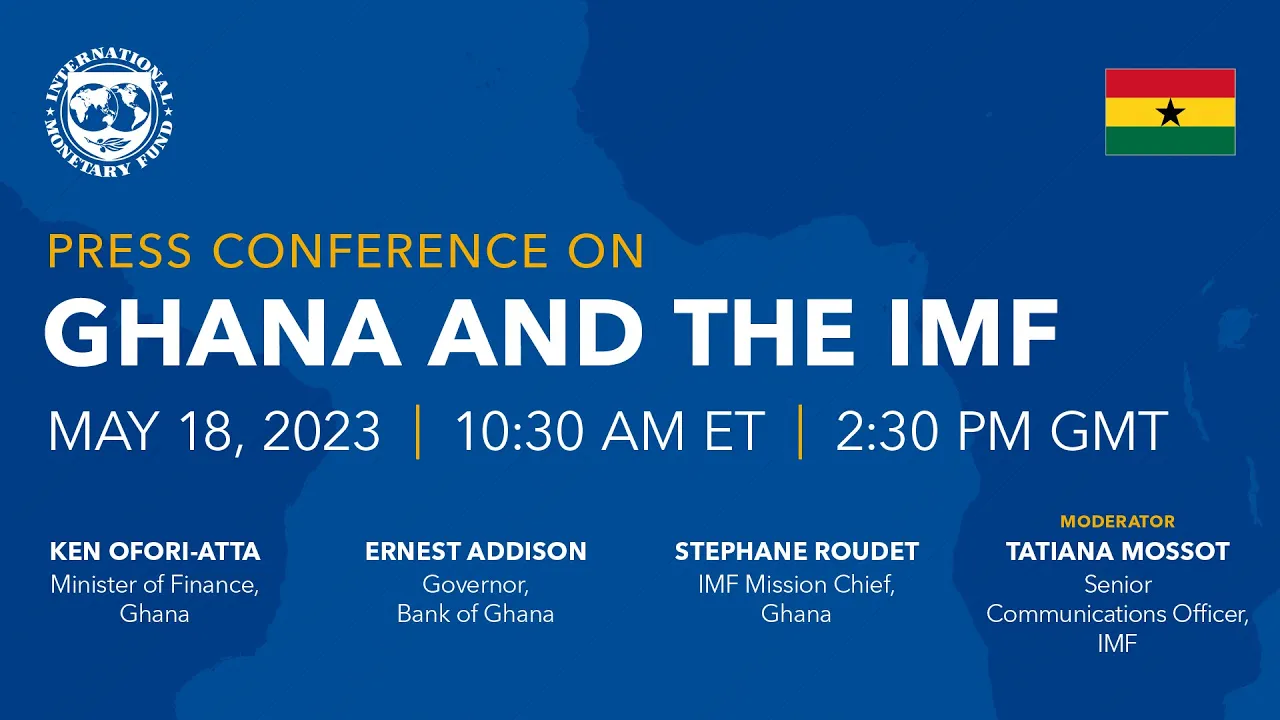
Press Conference on Ghana and the IMF
New Section
The transcript begins with a welcome message and introduces the special press conference on the executive board approval of a three billion US Dollars extended credit facility arrangement for Ghana. The IMF Mission chief for Ghana, Stefan Rudy, discusses the approval and highlights the economic challenges faced by Ghana.
Introduction to Press Conference
- Tatiana Mossot welcomes viewers and introduces the special guest, Ken Ofori Atta, Minister of Finance of Ghana.
- Dr. Ernest Addison, Governor of Ghana Central Bank, joins remotely from Accra.
- Stefan Rudy, IMF Mission Chief for Ghana, provides an overview of the press conference.
Economic Challenges Faced by Ghana
- Ghana has been facing a severe economic and financial crisis due to pre-existing vulnerabilities and external shocks such as the COVID-19 pandemic and Russia's war in Ukraine.
- This crisis has led to acute financing pressures, depreciating currency, declining international reserves, slowing economic activity, and high inflation.
Steps Taken by Ghanaian Authorities
- The Ghanaian authorities have taken decisive steps to address these challenges.
- Measures include launching a comprehensive debt restructuring and implementing reforms to control inflation.
- Efforts have been made to protect vulnerable groups through increased benefits for targeted cash transfer programs and allocations towards school feeding programs.
Objectives of the Program
- The approved three billion dollar extended credit facility aims to achieve three key objectives:
- Restore macroeconomic stability.
- Ensure sustainable debt management.
- Lay foundations for stronger and more inclusive growth.
Policy Priorities
- The government plans to bring public finances back on a sustainable path through mobilizing domestic revenue and improving public spending efficiency.
- Ambitious structural reforms will be implemented in tax policy, revenue administration, public financial management, energy sector reforms, and cocoa sector reforms.
- Steps are being taken to bring inflation under control through interest rate adjustments and a flexible exchange rate policy.
- Measures to preserve financial stability and encourage private investment, higher growth, and job creation will also be implemented.
Conclusion
- The approved program, along with debt restructuring, is expected to help Ghana overcome immediate economic and financing challenges.
- It paves the way for a brighter future for all Ghanaians.
- Minister Ofori Atta expresses gratitude to the IMF board and management for their support.
New Section
Minister Ofori Atta expresses his appreciation for the approval of Ghana's extended credit facility. He thanks the IMF managing director and emphasizes the significance of this approval for Ghana and other African countries.
Appreciation for Approval
- Minister Ofori Atta thanks the IMF board and management for their commitment towards Ghana's reform agenda.
- He extends special appreciation to the IMF managing director for her unwavering support.
- Deputy Manager I'm Saboli is acknowledged for his encouragement and work as well.
Significance of Approval
- The approval of Ghana's extended credit facility is seen as a special day for Ghana and a signal to other African countries looking to be in similar programs.
- Minister Ofori Atta highlights the importance of this approval in supporting Ghana's ambitions and reform agenda.
Gratitude
- On behalf of the President, government, and people of Ghana, Minister Ofori Atta expresses gratitude towards the IMF board and management.
This summary has been created based on the provided transcript.
The Role of Bilateral Partners and Financial Assurances
This section highlights the pivotal role played by bilateral partners, such as members of the G20 common framework, Pirates Club, G7, India, Saudi Arabia, China, and Turkey in bringing financial assurances. These financial assurances were instrumental in securing board approval for the program request.
Bilateral Partners' Support
- The support from bilateral partners has been tremendous in bringing Ghana this far.
- Members of the G20 common framework, Pirates Club, G7, India, Saudi Arabia, China, and Turkey have played a crucial role.
- Their financial assurances were delivered on May 12th.
Board Approval and Common Framework
- The board approval is a crucial first step towards strong reforms and inclusive growth.
- It signals that the common framework can be made to work effectively.
- Ghana looks forward to fruitful engagement with both bilateral and private creditors in achieving economic sustainability.
Board Approval: A Crucial First Step
This section emphasizes that while board approval is not a magic solution, it is a crucial first step towards implementing strong reforms for inclusive growth. It sets the stage for restoring Ghana's economy to a place of strength and resilience.
Importance of Board Approval
- Board approval is not a magic solution but an essential first step towards strong reforms.
- It paves the way for inclusive growth and relentless pursuit of a growth agenda.
- The goal is to restore Ghana's economy to a place of strength, prosperity, and resilience.
Economic Toll and Debt Exchange Program
- The global pandemic has had an undeniable economic toll on Ghanaians.
- The domestic debt exchange program was a difficult but necessary exercise that impacted banking institutions.
- Collaboration with banks is needed to ensure financial stability.
Stability Achieved through Reforms
This section highlights the positive impact of the debt exchange program and Ghana's focus on growth, fiscal sustainability, and debt sustainability. It also acknowledges the stability achieved in currency and inflation rates.
Debt Exchange Program and Stability
- The debt exchange program, combined with a multi-year focus on growth, fiscal sustainability, and debt sustainability, is expected to accelerate economic recovery.
- Relative stability has been observed in the currency and inflation rates.
- The Central Bank's efforts have contributed to these positive outcomes.
Inspired by Momentum for Recovery
This section expresses confidence in Ghana's ability to overcome current challenges and emerge stronger. It acknowledges the support of the IMF, collective effort of Ghanaians, and emphasizes that greater things lie ahead.
Confidence in Recovery
- The government is inspired by the momentum gained through staff level agreement, financial assurances from bilateral creditors, and board approval.
- Ghana is on the path towards recovery and revitalizing its economy.
- The government is confident that with support from the IMF and collective effort of Ghanaians, they will overcome challenges.
Perspective from Governor of Central Bank
This section provides insights from Dr. Ernest Addison, Governor of the Central Bank of Ghana. He emphasizes that the approved IMF support program goes beyond financial assistance as it sets out policy reforms to reset Ghana's economic fundamentals.
Importance of Approved Program
- The approved IMF support program goes beyond financial assistance.
- It sets out policy reforms to reset Ghana's economic policy fundamentals.
- These reforms aim to make Ghana's economy more resilient.
Beginning the Work
- The approval marks just the beginning of the real work needed to build a better Ghana.
- Implementation of deep structural reforms is crucial for long-term success.
Strong Government Willingness
- The quick approval timeframe indicates strong government political will and commitment to the reform agenda.
- The sacrifices made by Ghanaians, including measures like the domestic debt exchange, have helped reach these conclusions.
Burden Sharing and Reform
- The approval demonstrates burden sharing and includes macro and structural reforms.
- Domestic debt exchange has played a role in reaching this stage.
Conclusion
Ghana's journey towards economic recovery and stability is supported by bilateral partners, financial assurances, board approval, and policy reforms. The focus is on strong reforms, inclusive growth, fiscal sustainability, and debt sustainability. Ghana remains confident in its ability to overcome challenges and emerge stronger with the support of the IMF and collective effort of its people.
Ghana's IMF Program and Economic Stability
In this section, the Minister of Finance and a journalist discuss Ghana's reliance on the IMF for support, the focus on inflation control and foreign reserves, and how this program differs from previous ones.
Ghana's reliance on the IMF
- Critics argue that the IMF's support has not been a solution to Ghana's challenges despite relying on them 17 times.
- The program aims to focus on reigning in inflation and rebuilding foreign reserves.
Structural reforms for economic stability
- The program emphasizes restoring macroeconomic stability, debt sustainability, and inclusive growth.
- It includes a range of structural reforms across various sectors to make the economy more resilient to future shocks.
Moving forward with clarity
- The program is anchored by a post-COVID economic growth plan developed by Ghana itself.
- Strategies include increasing revenue-to-GDP ratio, expenditure controls, and creating an enabling environment for private sector investments.
Concerns about Borrowing and International Capital Markets
In this section, concerns about borrowing and access to international capital markets are addressed by the Minister of Finance and Governor.
Managing borrowing and debt levels
- The program aims to reduce Ghana's debt-to-GDP ratio to 55%. Revenue measures and expenditure management will play key roles in achieving this goal.
- While working towards accessing international capital markets is important for attracting foreign investors, there is no rush to do so at present. Ratings improvement is desired before returning to these markets.
Delivering low inflation
- Inflation in Ghana rose significantly within a year, partly due to the economic challenges faced. The government is committed to delivering low inflation and stabilizing the economy.
Due to technical difficulties, some parts of the journalist's question were not clearly heard or understood.
Monetary Policy and Timely Release of Funds
This section discusses the effectiveness of monetary policy, inflation control, and the timely release of funds in Ghana.
Monetary Policy Effectiveness
- Inflation has started to decrease, indicating that monetary policy is becoming more effective.
Timely Release of Funds
- The Monetary Policy Committee will announce their decisions on Monday regarding the release of funds.
- There are no additional conditions for the first disbursement of $600 million. The money is available to the central bank and government.
- An MOU needs to be signed with official external creditors to secure the next $600 million payout after the first review later this year. Discussions with commercial creditors are also ongoing. [t=1390s, t=1499s]
- The timeline for restructuring external debt will depend on reaching an understanding with official creditors by the time of the first review in November. Discussions with commercial creditors aim to advance rapidly. [t=1456s, t=1477s]
- The estimated net present value haircut for external debt restructuring is not specified at this stage.
Criteria for June Assessment and IMF's Contribution to Macroeconomic Stability
This section focuses on the criteria for June assessment and how the IMF's extended credit facility contributes to macroeconomic stability in Ghana.
Criteria for June Assessment
- The criteria for the June assessment include zero Central Bank financing of the budget and an indicator on primary balance. These factors will be key in making assessments and may trigger another disbursement after evaluation.
IMF's Contribution to Macroeconomic Stability
- The extended credit facility program aims to contribute to macroeconomic stability in various areas, including inflation control and exchange rate stability.
- The fiscal consolidation program embarked on by the Ghanaian government will help reduce pressures on prices and contribute to controlling inflation.
The transcript is already in English, so there is no need to switch languages for the summary.
Increasing Reserves and External Position
The discussion focuses on the factors contributing to increasing reserves and improving the external position of the economy.
Factors Contributing to Increasing Reserves
- Policies discussed will help improve the external position and contribute to taming import growth.
- These policies will make the economy more competitive and boost exports, leading to a more favorable external position and higher reserves.
- The program's impact on financing, including support from the IMF and other partners, will also contribute to bolstering international reserve positions in Ghana.
Addressing Inflation and Exchange Control
The focus is on addressing inflation and exchange control measures.
Role of Fiscal Consolidation in Inflation Control
- Fiscal consolidation is a major part of the program, aiming to reduce demand for financing through new revenue measures and debt exchange programs.
- Implementation of these measures should help bring down inflation rates by reducing foreign exchange outflows and attracting bilateral support.
Impact of Government Size Reduction on Program
Questions regarding the impact of reducing government size on the current program are addressed.
Ambitious Program Goals for Government Finances
- The program aims to put government finances on a sound footing by increasing domestic revenue substantially over the next few years. This will contribute to deficit reduction, resilience against shocks, priority spending, infrastructure development, and efficient government expenditure.
Supporting Banks and Stability Fund Usage
Questions about supporting banks, stability fund usage, and incoming funds are answered.
Support for Banks and Stability Fund Usage
- The government aims to support banks to ensure they can provide funds to businesses. Specific measures are not mentioned.
- The purpose of the incoming 600 million fund is not specified in the transcript.
Some questions were not fully addressed in the transcript.
The Effect of the DDEP Program on the Banking Sector
In this section, the speaker discusses the impact of the DDEP program on the banking sector and introduces the Ghana Financial Stability Fund.
Impact on Banks
- The DDEP program has had a significant effect on the banking sector.
- The structure of the Ghana Financial Stability Fund is being established to support the banks.
- The fund aims to be funded with up to $1.5 billion, including $250 million from the World Bank and $500 million from the government.
- Efforts are being made to engage with development partners for additional contributions.
Ensuring Efficiency and Food Security
This section focuses on efficiency in government services and promoting food security through local production.
Efficiency in Government Services
- Improving efficiency in government operations is crucial.
- It is important for all Ghanaians to understand that there is a new era emphasizing efficiency and behavior re-engineering.
- The goal is to provide better services to citizens.
Promoting Food Security
- Importation of rice, poultry, tomatoes, etc., will be reduced.
- Emphasis will be placed on producing these items locally.
- This approach will increase resilience and sustainability.
Impact of IMF Program on Social Programs
This section addresses concerns about potential cuts in social programs due to the IMF program.
Protection of Vulnerable Groups
- The IMF program prioritizes protecting vulnerable groups.
- Resources for programs like school feeding and LEAP (Livelihood Empowerment Against Poverty) have been increased or maintained.
- President's commitment to protecting lives and livelihoods remains strong.
Social Protection Measures in Budget 2023
This section highlights social protection measures in the budget and encourages referring to the staff report for more details.
Social Protection Objectives
- The budget for 2023 includes steps to protect and support vulnerable groups.
- Effective and targeted programs are being implemented.
- The staff report provides detailed analysis and descriptions of how these programs will be monitored.
Central Bank's Role and Impact of Debt Exchange on Banks
This section addresses questions about the role of central banks, debt exchange impact on banks, and commercial foreign investments.
Monetary Policy Stance
- The IMF statement suggests maintaining a tight monetary policy stance until inflation is firmly on a downward path.
- It does not necessarily mean increasing the policy rate.
Impact of Debt Exchange on Banks
- Banks have sufficient liquidity, and there are no liquidity issues.
- The Bank of Ghana is ready to provide liquidity support if needed.
- The debt exchange mainly reduced capital buffers, but regulatory forbearance has been granted.
- Capital conservation buffer was reduced from 3% to 10%, with three years given to rebuild capital buffers.
Governor's Response to Moses' Questions
This section summarizes the governor's response to Moses' questions regarding debt forgiveness and commercial foreign investments.
Clarification on IMF Statement
- There was a misunderstanding regarding the IMF statement about central banks increasing rates.
- The focus is on maintaining a tight monetary policy stance until inflation decreases, not necessarily raising interest rates.
Impact of Debt Exchange on Banks (Continued)
- Banks have sufficient liquidity, and there are no liquidity issues.
- Capital buffers were reduced due to the debt exchange, but measures have been taken to address this issue.
Due to limitations in access to the full transcript, some sections may be missing.
Concerns about the US Dollar and Inflation
The speaker expresses concerns about the US dollar not being known as the global currency and asks if there are any concerns regarding inflation in the US and recent interest rate hikes by the Federal Reserve.
Questions Raised
- Is there any concern about the US dollar not being known as the global currency?
- Are there concerns about inflation in the US and recent interest rate hikes by the Federal Reserve?
Apprehensions about Ghana's Program Approval
The speaker raises concerns about the time taken to approve Ghana's program and whether it was rushed, potentially exposing it to shocks. They also inquire about what happens if Ghana fails to meet critical benchmarks and how other donor partners are committed to supporting this program.
Questions Raised
- Could rushing the approval process expose Ghana's program to shocks?
- What happens if Ghana fails to meet critical benchmarks?
- What is the commitment of other donor partners in terms of financing assurance?
Contagion Effect of US Rates on African Economies
The speaker discusses how increasing US rates can have a contagion effect on economies, including credit availability for African countries like Ghana. They emphasize the need for reducing imports and becoming more sustainable.
Key Points
- Increasing US rates can have a contagion effect on economies.
- Weaknesses in banking systems affect credit availability.
- Reducing imports and becoming more sustainable is crucial for shielding against economic vulnerabilities.
Comparing Ghana's Program Approval with Other Countries
The speaker highlights that compared to other countries like Zambia and Ethiopia, Ghana has successfully worked with fund partners to achieve program approval. They encourage celebrating this achievement rather than viewing it negatively.
Key Points
- Ghana's program approval should be considered an achievement.
- Comparisons with other countries show Ghana's success in working with fund partners.
- It is important to celebrate and savor achievements.
Financial Stability Fund and Support from Development Partners
The speaker discusses the commitment of development partners, including the World Bank, in supporting Ghana's financial stability fund. They express confidence in making major breakthroughs through ongoing negotiations.
Key Points
- The World Bank has committed to supporting the financial stability fund.
- Ongoing negotiations with other development partners for their role in the fund.
- Confidence in making major breakthroughs through the negotiation process.
Positive Outlook on Program Approval and Structural Benchmarks
The speaker expresses positivity about the program approval and emphasizes that it is a reason to celebrate. They highlight strong commitment from authorities regarding structural benchmarks and believe it will catalyze additional financing for Ghana.
Key Points
- Program approval is a reason to celebrate.
- Strong commitment from authorities regarding structural benchmarks.
- Program approval signals positive support from international organizations and can attract additional financing.
Timestamps are approximate and may vary slightly.
Bilateral Creditors Group and Debt Restructuring Agreement
This section discusses the bilateral creditors group co-chaired by China and France, as well as the progress on debt restructuring negotiations with external creditors.
Bilateral Creditors Group
- A bilateral creditors group has been formed, co-chaired by China and France.
Debt Restructuring Agreement
- The details of the debt restructuring agreement with external creditors are not clear at the moment.
- Negotiations with eurobond holders to restructure the debt are ongoing.
- There is optimism about Ghana's ability to work with the common framework and fulfill structural targets.
Seminal Moment for Common Framework and Optimism for Ghana's Future
This section highlights the significance of a recent event for the common framework and expresses optimism about Ghana's future.
- Last Friday was a seminal moment for the common framework, indicating progress in discussions with France and China.
- There is optimism about Ghana's ability to overcome challenges and achieve economic stability.
- Approval of Ghana's efforts received positive feedback during a board meeting.
Questions on IMF Confidence in Ghana's Reforms
This section addresses questions regarding IMF confidence in Ghana's ability to address its debt crisis, implement necessary reforms, and ensure long-term economic stability.
Confidence in Reforms
- The IMF expresses confidence in Ghana's reforms based on the strength of the program put together by the government and authorities.
- Sound policies related to revenue generation and expenditure management contribute to this confidence.
- The program also focuses on implementing structural reforms to improve policy frameworks in the long term.
Safeguards and Contingency Plans
- Mechanisms are in place to monitor the implementation of the program and prevent unsustainable debt levels in the future.
- The IMF aims to provide support and contingency plans to help mitigate risks and ensure the sustainability of Ghana's economic recovery efforts.
Due to technical difficulties, some questions from Benjamin Tawia were not fully captured.
Conclusion
The transcript covers discussions on a bilateral creditors group, debt restructuring negotiations, optimism for Ghana's future, and questions regarding IMF confidence in Ghana's reforms. The IMF expresses confidence in Ghana's ability to address its debt crisis through sound policies and structural reforms while providing safeguards and contingency plans for sustainable economic recovery.
Mission Success Optimism
The speaker expresses optimism about the success of the next mission in June and thanks the Minister, Governor, and media for their presence.
Optimism for Next Mission
- The speaker is confident that the upcoming mission will be successful.
- The next mission is scheduled for June.
- There is a high level of optimism regarding the outcome of the mission.
Acknowledgements
- The speaker thanks the Minister and Governor for being present.
- Appreciation is expressed towards all members of the media for their attendance.