Протокол DNS | Курс "Компьютерные сети"
New Section
The lecture discusses the Domain Name System (DNS) protocol, focusing on how DNS servers work and the different modes of operation within the DNS system.
Understanding DNS Servers
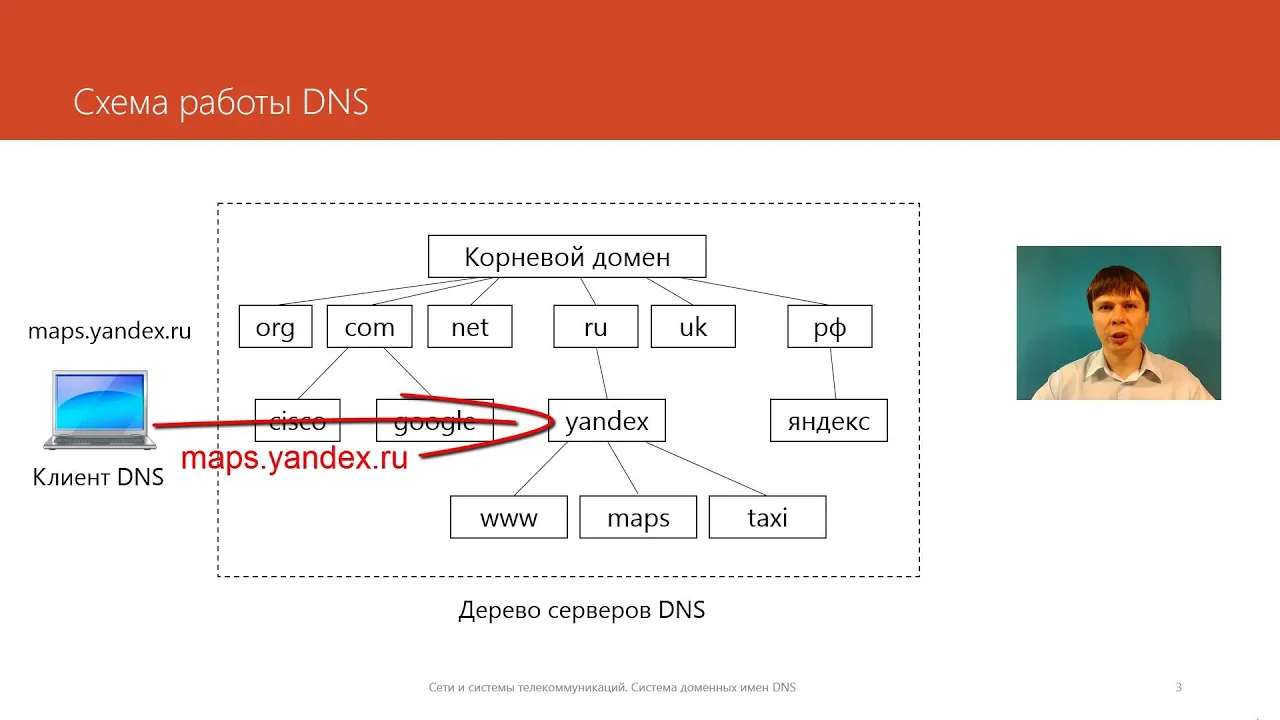
- DNS operates with a tree structure of servers, each responsible for a specific domain name zone.
- When a client seeks an IP address for a domain name, the query starts at the root domain and progresses through authoritative servers until the IP address is found.
- Two modes of operation in DNS: iterative (server provides answer or referral) and recursive (server resolves queries by querying other servers).
Types of DNS Servers
- Two types of DNS servers: authoritative servers store domain-to-IP mappings and work interactively, while resolver servers resolve names for clients in a recursive manner.
- Resolver servers are typically located in local networks provided by ISPs or organizations. Alternatively, public resolver servers like Google's 8.8.8.8 can be used.
Exploring DNS Protocol Details
This section delves into the technical aspects of the DNS protocol, including packet structure and response types.
Packet Structure in DNS
- The client-server model is employed in DNS using UDP port 53. A DNS packet comprises an identifier, flags indicating data sections, and information about queries and responses.
- The header includes fields like query type (standard), flags indicating response authority, truncation status, recursion desired (for queries), etc.
Data Sections in a DNS Packet
- Data sections include details about queries (domain names), answers containing IP addresses, authoritative server IPs, and additional information that may be useful.
- Flags specify operations such as query type (standard), whether responses are authoritative or not, truncation status, etc., aiding communication between clients and servers.
Interpreting Responses
Working with DNS Protocol
In this section, the discussion revolves around working with the DNS protocol, focusing on recursive mode, response flags, operation status codes, and the format of DNS queries and responses.
Recursive Mode and Response Flags
- Working in recursive mode is indicated by the flag 'r' in responses.
- The server communicates its ability to work in recursive mode using this flag.
- The 'z' flag is reserved for future use.
Operation Status Codes
- The last four bits of a response indicate the status of operation execution.
- A status code of 0 signifies successful operation completion.
- Any other codes denote errors or issues during the operation.
DNS Query Format
This part delves into the format of DNS queries, encompassing simple query structures containing record name, type, and class. It also introduces different types of records like A records mapping domain names to IP addresses.
Simple Query Structure
- A basic query includes record name, type (e.g., A), and class (e.g., internet).
- For instance: querying 'yandex.ru' for an A record.
Record Types
- Various record types exist beyond A records in DNS systems.
- These will be explored further in subsequent lectures.
Complexity of DNS Responses
This segment elucidates the intricate nature of DNS responses compared to queries. It outlines fields such as time-to-live, data length, and actual response data within a DNS response packet.
Detailed Response Format
- The structure of a DNS response includes fields like name, record type, class, time-to-live (TTL), data length, and response data.
- TTL specifies how long a resolver should cache the information.
DNS Protocol Functionality
Exploring how the DNS protocol operates in iterative and recursive modes while handling client requests efficiently through server interactions.
Operational Modes
- DNS functions in iterative and recursive modes for query resolution efficiency.
- In iterative mode: sequential queries to different servers until finding relevant zone servers.