Clases de funciones
Functions in Mathematics
Overview of Special Functions
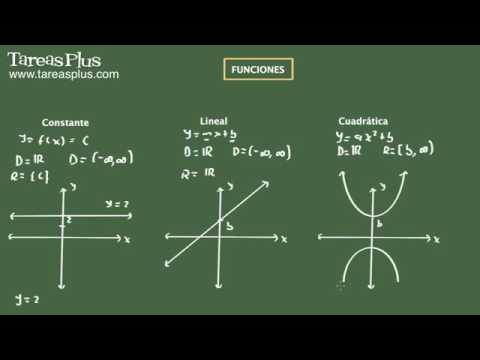
- The discussion introduces six types of mathematical functions, focusing on their domains, ranges, and graphical representations.
- Emphasis is placed on the importance of understanding these functions as foundational concepts in mathematics.
Constant Function
- A constant function is defined as f(x) = c , where c can be any real number (e.g., f(x) = 2 ).
- The graph of a constant function is a horizontal line at the value of c .
- The domain of a constant function includes all real numbers, represented as (-infty, +infty) .
- The range consists solely of the constant value itself; for example, if c = 2 , then the range is 2.
Linear Function
- A linear function follows the form y = mx + b , where m represents the slope and b is the y-intercept.
- The graph will vary based on whether the slope ( m ) is positive or negative.
- Similar to constant functions, the domain encompasses all real numbers: (-infty, +infty) .
- The range also includes all real numbers since there are no restrictions on possible output values.
Quadratic Function
- A quadratic function takes the form y = ax^2 + b . Its graph resembles a parabola.
- The domain remains all real numbers; however, its range depends on whether it opens upwards or downwards.
- If it opens upwards (positive coefficient), the range starts from its minimum point (y-intercept 'b') to infinity. Conversely, if it opens downwards (negative coefficient), it ranges from negative infinity to its maximum point.
Additional Types of Functions
Polynomial Function
- Polynomial functions are expressed as sums of powers of x with coefficients (e.g., x^2 + 1 ).
Understanding Polynomial and Exponential Functions
Graphing Polynomials
- The discussion begins with the concept of graphing polynomials, emphasizing the importance of understanding the polynomial's exponent.
- A method is described for sketching curves that pass through specific points on a graph, illustrating how to transition between positive and negative values.
- The domain of the polynomial function is identified as all real numbers, indicating that x can take any value.
- The range of the polynomial is also established as all real numbers, allowing for any output value.
Exponential Functions
- An introduction to exponential functions is provided, specifically focusing on the function f(x) = e^x , where e approx 2.71 .
- The graphical representation of an exponential function is discussed; it never touches the x-axis and consistently increases.
- The domain for this exponential function remains all real numbers, while its range extends from zero to positive infinity.
Logarithmic Functions
- Transitioning to logarithmic functions, it’s noted that they are represented as f(x) = log_a(x) , with a focus on their graphical behavior.
- The domain of logarithmic functions is restricted to positive values (from zero to infinity), contrasting with their range which includes all real numbers.
- This highlights a fundamental difference between exponential and logarithmic functions in terms of their domains and ranges.
Conclusion