Comparative advantage specialization and gains from trade | Microeconomics | Khan Academy
Understanding Comparative Advantage in Dinnerware Production
Introduction to Dinnerware Market
- The discussion shifts from hunter-gatherer societies to the dinnerware market, focusing on two products: cups and plates.
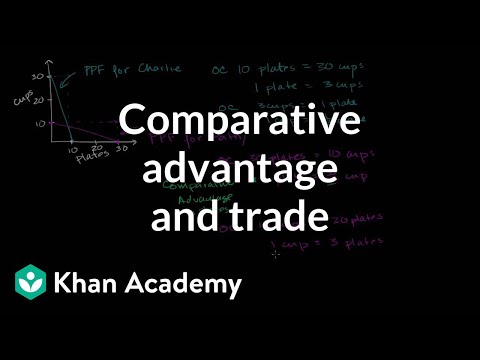
- A producer named Charlie is introduced, who can produce either 30 cups or 10 plates if he focuses solely on one product.
Production Possibilities Frontier (PPF)
- Charlie's production possibilities frontier (PPF) is linear, indicating a constant opportunity cost between cups and plates.
- If Charlie produces 10 plates, he must give up all 30 cups; thus, the opportunity cost of producing one plate is 3 cups.
Patty's Production Capabilities
- Another producer, Patty, can produce either 10 cups or 30 plates in a day with her own linear PPF.
- For Patty, the opportunity cost of producing one plate is only 1/3 of a cup since she gives up 10 cups for every 30 plates produced.
Comparative Advantage Analysis
- Comparing their opportunity costs reveals that Patty has a comparative advantage in producing plates due to her lower opportunity cost (1/3 cup vs. Charlie's 3 cups).
- Conversely, Charlie has a comparative advantage in producing cups because his opportunity cost for one cup is lower than Patty’s (1/3 plate vs. 3 plates).
Specialization and Trade Benefits
- If both producers specialize according to their comparative advantages—Charlie in cups and Patty in plates—they can trade effectively beyond their individual PPF limits.
Understanding Market Prices and Opportunity Costs
The Concept of Opportunity Cost in Trading
- Charlie's decision-making is influenced by market prices being lower than his opportunity cost; he can acquire an extra plate for only 1 cup instead of the 3 cups it would take to produce it himself.
- Patty faces a similar situation; she would need to give up 3 plates to obtain a cup on her own, but the market allows her to trade just 1 plate for a cup, making it a favorable deal.
- Both Charlie and Patty are incentivized to transact because the market price is advantageous compared to their individual opportunity costs, leading them to consider trading.
Trading Dynamics Between Charlie and Patty
- The potential trades between Charlie and Patty could lead them both towards an optimal scenario where they exchange resources effectively, such as trading cups for plates.