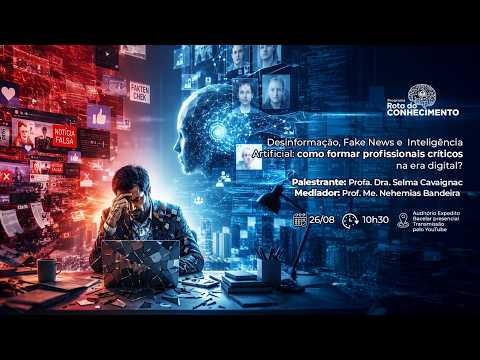
Desinformação, Fake News e Inteligência Artificial
Opening of the Knowledge Route Project
Introduction to the Event
- The event is introduced by a speaker welcoming students and professors, marking the opening of the Knowledge Route for the second semester of 2026.
- The project was initiated in response to ENAD demands due to poor student performance on exams linked to a lack of discussion on current societal issues in higher education.
- Today's theme focuses on disinformation, fake news, and artificial intelligence, emphasizing their relevance for professional integration in a changing market.
Importance of Discussion Topics
- Professor Nemias Bandeira highlights that these topics are crucial for developing critical thinking amidst rapid information dissemination.
- The need for critical thinking is compared to adapting health practices in a fast-food society; similarly, we must adapt our thinking in an age of instant information.
The Hyper-information Age
Understanding Information Overload
- Professor Selma Cavac discusses living in a hyper-information age where access to information has drastically increased compared to historical contexts.
- This era presents contradictions: while we can filter more information, it also leads to widespread disinformation as seen at global events like the World Economic Forum.
Global Risks Associated with Disinformation
- At Davos, disinformation was ranked as a significant global risk due to its potential manipulation affecting political outcomes and social fractures.
- A report indicates that misinformation deepens societal divides and amplifies extremist views, highlighting its pervasive impact across various sectors.
Areas Affected by Disinformation
Key Sectors Impacted
- Disinformation is particularly rampant during election years, influencing political campaigns globally and specifically within Brazil.
- Other affected areas include finance (scams related to fake content), healthcare (misleading vaccine information), showcasing how misinformation can lead to real-world consequences.
Case Study: Measles Pandemic
- The resurgence of measles in the U.S. and Brazil is attributed largely to anti-vaccine misinformation campaigns that gained traction during COVID-19 discussions.
Challenges of Critical Thinking
Diminished Critical Evaluation Skills
- Despite being inundated with information, individuals often fail to critically evaluate what they consume online due to habitual autopilot behavior when using technology.
Historical Context of Fake News
- Fake news isn't new; it has existed since ancient times but has evolved with technology. The internet democratized knowledge but also allowed misinformation proliferation.
Regulation vs. Freedom of Expression
Balancing Control and Censorship
- Discussions around regulating social networks raise concerns about censorship versus safeguarding rights against harmful content without compromising free speech.
Examples from Recent Events
- An example involving tragic incidents linked with digital platforms illustrates the urgent need for effective regulation without infringing on freedom.
Responsibility in Digital Environments
Shared Accountability
- Responsibility lies with everyone involved—content creators, platforms, governments—to ensure safety and accuracy within digital spaces.
Educating Others
- Emphasizing personal responsibility extends beyond individual actions; educating family members about navigating misinformation is crucial for broader awareness.
Developing Critical Thinking Skills
Addressing Questions from Viewers
- Questions arise regarding motivations behind creating fake news and strategies for fostering autonomous opinions amid overwhelming misinformation.
The Rise of AI in Creating False Content
Increase in AI-Generated Disinformation
- In just one year, the use of artificial intelligence for producing false content surged from 4.65% to 25.77%, highlighting a significant and alarming trend.
Motives Behind Disinformation
- Various motives drive the creation of false content, including discrediting individuals and promoting movements like anti-vaccine campaigns.
Categories of Misinformation
- The main categories of misinformation circulating online today include:
- Politics
- Financial scams
- Health-related issues
Formats of Fake Content
- AI-generated fake content typically appears in video format, with deepfakes being a prominent example.
Importance of Media Literacy
Understanding Media Literacy
- Media literacy is essential for maintaining critical thinking amidst the proliferation of misinformation.
Steps to Enhance Digital Literacy
- Digital literacy involves three key steps when receiving messages:
- Stop before reacting impulsively.
- Question the source and intent behind the message.
Engaging Family in Critical Discussions
Personal Experience with Misinformation
- A personal anecdote illustrates how discussing media consumption with family members can foster critical thinking about information validity.
Strategies for Resisting Misinformation
Encouraging Thoughtful Sharing
- It’s crucial to resist sharing questionable content immediately; instead, take time to analyze its credibility before dissemination.
Building a Movement Against Disinformation
Collective Responsibility
- Promoting digital literacy within educational institutions can help cultivate awareness and combat disinformation collectively.
Evaluating Information Sources
Cross-referencing News Outlets
- Developing skills for lateral reading—comparing multiple sources—can enhance trustworthiness assessments regarding news stories.
Challenges Facing Traditional Media
Trust Issues with Established Outlets
- Traditional media outlets are struggling to maintain audience trust due to widespread misinformation on social media platforms.
The Role of Influencers in Information Dissemination
Shift Towards Influencer Credibility
- Audiences increasingly prefer information from influencers over traditional media, complicating trust dynamics in news consumption.
Ethical Use of AI in Content Creation
Distinguishing Between True and False Content
- Using AI responsibly can streamline content production without contributing to misinformation if ethical guidelines are followed.
Pseudoinformation's Impact on Public Perception
Absurdity in News Consumption Trends
- Many audiences gravitate towards sensationalized or trivial news rather than substantive reporting, leading to widespread misinformed public perceptions.
Characteristics of Critical Thinkers
Essential Traits for Navigating Misinformation
- Seek knowledge actively.
- Maintain an ethical stance while consuming information.
- Exercise responsibility when sharing or acting on information received.
Turn any video into a summary like this
YouTube links, meetings, lectures. With transcripts, search, and chat.