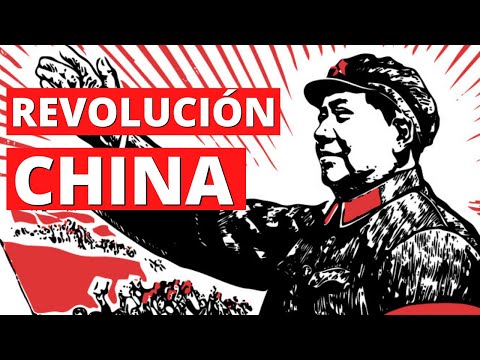
¿Qué fue la Revolución China de 1949 y cuáles fueron sus causas? Desarrollo, consecuencias y líderes
The Chinese Revolution of 1949: Causes and Consequences
Overview of the Chinese Civil War
- The Chinese Revolution of 1949, also known as the Chinese Communist Revolution, marked the final stage of a civil war that began in 1927, involving the communists led by Mao Zedong and nationalists under Chiang Kai-shek.
- Root causes of the civil war trace back to significant economic inequality, particularly in rural areas, exacerbated by colonialism and territorial losses which fueled widespread discontent.
Impact of World War II
- Both factions temporarily united against Japanese invasion during World War II; however, post-war tensions reignited their conflict leading to communist victory and establishment of the People's Republic of China in October 1949.
- Initially, Mao's communist system faced severe economic challenges resulting in famine but eventually transformed China into a global power by the early 21st century.
Historical Context Leading to Revolution
- Early 20th-century China experienced cultural changes influenced by European ideas alongside industrialization efforts with foreign factories and banks entering traditional markets.
- In 1905, Sun Yat-sen founded a democratic party aiming for republican governance; formal actions began in 1911 leading to the establishment of a republic and provisional constitution due to Qing dynasty's political decline.
Political Turmoil Post-Republic Establishment
- The initial years following the republic's formation were tumultuous with numerous armed uprisings; dissatisfaction grew after Japan gained rights over territories through treaties like Versailles post-WWI.
- The May Fourth Movement emerged as an anti-imperialist response among intellectuals influenced by Russia’s revolution in 1917, ultimately leading to the founding of the Communist Party in 1921 under Mao Zedong's leadership.
Escalation into Civil War
- Following President Sun Yat-sen’s death in March 1925, Chiang Kai-shek initiated a crackdown on communists marking the start of civil war amidst ongoing Japanese invasions.
- Despite attempts at unity against common enemies from both sides during Japanese aggression (1937–1945), internal conflicts resumed immediately after WWII ended.
Underlying Causes of Discontent
- Fundamental issues stemmed from imperial China's last days under Qing rule where social inequalities were starkly evident; land ownership was concentrated among elites while peasants lived impoverished lives without government intervention.
- Colonialism further deepened grievances as ineffective Qing rulers allowed loss of territories like Taiwan and Manchuria while Western powers exploited China's resources leading to widespread resentment among citizens.
Rise Against Imperial Rule
- Continuous rebellions against Qing dynasty reflected public frustration over its inability to maintain sovereignty or improve living conditions for common people.
Expansion of Communism
Historical Context and Influence
- The influence of communism in Europe grew since the late 19th century, culminating in the Russian Revolution of 1917, which established the first communist state.
- The newly formed Soviet Union's geographical position facilitated the spread of communism into Asia, particularly China, where it received support from Soviet forces.
Civil War Dynamics in China
- Prior to the resumption of civil war in China, four major military factions existed: Japanese occupiers, a collaborationist Chinese government based in Nanking, Kuomintang nationalists, and Mao's communists.
- After Japan's defeat in 1945, peace talks began involving the U.S. and USSR; however, these negotiations failed by 1946.
Military Engagement and Negotiations
- The initial phase aimed to prevent renewed conflict but ultimately failed despite international interest.
- Chiang Kai-shek recognized his inability to stop communist advances and negotiated with the USSR for troop movements in Manchuria.
Nationalist Offensive and Communist Response
- General George Marshall was sent by the U.S. to mediate between Kuomintang and communists; his proposal for a coalition government was rejected by both sides.
- In spring 1946, hostilities resumed as nationalists launched an offensive into Manchuria.
Shifts in Power Dynamics
- Nationalist troops captured significant territory initially but faced U.S. protests leading to an arms embargo against them.
- A new democratic constitution was adopted by China's National Assembly but lacked communist representation.
Communist Counteroffensive
Resurgence of Communist Forces
- By mid-1947, Lin Biao led a successful counteroffensive that immobilized nationalist garrisons while disrupting their supply lines.
- The communists expanded their control over southern provinces like Shanxi and Hebei amidst declining morale among nationalist troops.
Turning Points Leading to Victory
- By March 1948, communist forces had encircled key nationalist positions; defections from Kuomintang increased due to low morale.
- Significant victories for communists occurred throughout late 1948 as they regained control over Manchuria with heavy losses inflicted on nationalists.
Final Stages of Conflict
Collapse of Nationalist Resistance
- As communist forces entered Beijing on January 22, 1949, it became clear that victory was imminent for them after brief negotiation attempts failed.
Establishment of New Regime
- Following their victory, communists proclaimed the establishment of a new republic on October 1st; Chiang Kai-shek retreated to Taiwan with loyal supporters.
Consequences of the Chinese Revolution
Formation of New Government
- The People's Republic of China adopted a distinct form of communism known as Maoism which included four revolutionary classes: workers, peasants, national bourgeoisie, and petty bourgeoisie.
Cold War Alignment
Post-War China: Instability and Transformation
The Aftermath of the Revolution
- The triumph of the revolution did not lead to immediate stability in China; areas remained anarchic for years.
- Mao acknowledged the presence of approximately 400,000 bandits obstructing government consolidation, leading to military confrontations in Guangdong against a guerrilla force of 40,000.
- Economic measures were implemented by the People's Republic to address inequality but took years to yield positive results.
Economic Reforms and Failures
- Land expropriation from landlords was executed, redistributing it among peasants and establishing rural communes.
- The "Great Leap Forward" reforms were deemed a failure, resulting in famines that claimed millions of lives due to poor planning and execution.
International Relations During the Cold War
- China's lack of commercial allies during the Cold War limited its economic options; hostility from the U.S. followed its communist regime establishment.
- A campaign initiated by the communist government aimed at eradicating remnants of ancient Chinese culture included extreme actions like desecrating Confucius's tomb.
Cultural Revolution and Leadership Changes
- Mao's death in 1976 did not immediately alter China's communist model; however, Deng Xiaoping's rise in 1978 introduced a more pragmatic economic system resembling state capitalism.
Key Figures in Communist China
Mao Zedong
- Mao Zedong (1893–1976), leader during the civil war against nationalists, adapted Marxism-Leninism into "Maoism," aligning it with Chinese societal characteristics.
Zhou Enlai
- Zhou Enlai was a prominent politician who served as Prime Minister and Foreign Affairs Minister post-revolution, representing China at significant international conferences until his death in 1976.
Liu Shaoqi
- Liu Shaoqi was an important Communist Party leader who fell out of favor during the Cultural Revolution, ultimately dying under harsh conditions while imprisoned after being labeled a traitor.
Lin Biao