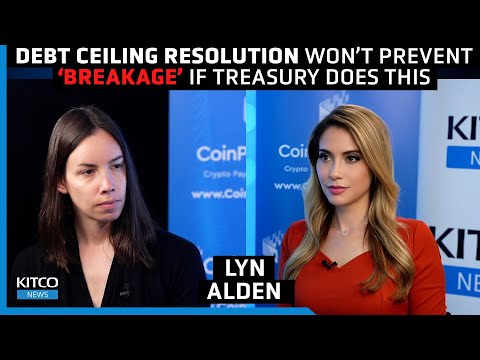
Yellen can cause ‘breakage’, ‘liquidity crisis’ even if debt ceiling resolved - Lyn Alden (Pt 1/2)
Bitcoin 2023: Macro Perspective
In this section, Michelle McCrory interviews Lynn Olden about the macro perspective of Bitcoin and the latest comments from Fed Chair Jerome Powell.
Fed Chair's Comments
- The Fed does not need to be as aggressive with its rate hikes because the banking crisis has tightened credit and slowed down the economy.
- Financial stability tools helped calm conditions in the banking sector, contributing to tighter credit conditions that are likely to weigh on economic growth, hiring, and inflation.
- The Fed is steadfast with its fight against inflation.
Interpretation of Comments
- Banks' liquidity constraints slow down the economy; it's not just about rates but also about money creation.
- The Fed raised rates too quickly in an effort to control inflation faster than they should have. This created financial instability that makes it difficult for them to raise rates as quickly as they have been without causing more issues.
- They're forced to go a little slower and more measured now. They now have to justify that narrative and see if that thesis plays out that credit contraction is enough to offset inflation.
Market Expectations
- Markets are largely expecting a pause in June.
- The Fed will be more data-dependent and try to balance between financial stability and inflation.
The Fed's Focus on Inflation
This section discusses the Fed's focus on inflation and whether there will be a pivot in the second half of the year.
The Idea of a Pause and a Pivot
- There has been a belief in the markets that at some point, the Fed is going to pivot.
- Powell is trying to turn off the market's idea that he's going to have a sharp pivot.
- To the extent that he does pivot, it would only be due to pretty severe economic contraction at that point.
Controlling Credit vs. Fiscal Deficits
- Inflation was not caused by excessive credit creation during this inflationary cycle.
- Large monetized fiscal deficits led to inflation in both the 1940s and 2020.
- The Fed doesn't have tools to counteract fiscal-driven inflation, so they're using primarily credit control tools.
What Will Control Inflation?
This section discusses what will control inflation and how much focus should be placed on Powell versus fiscal spending.
Changes in Fiscal Spending
- The longer-term question of what will control inflation will be changes in fiscal spending.
- There doesn't seem to be any political will to reduce fiscal spending; instead, there is an impulse with the debt ceiling right now.
Banking Crisis and Rate Hikes
This section discusses how interest rate increases triggered banking collapses and whether another banking collapse would change the Fed's perspective on cutting rates.
Triggering Banking Collapses
- The rapid rate of interest rate increases triggered banking collapses.
- Another banking collapse would start to get contagious and reduce the Fed's expectations of how much they can raise rates.
Controlling Financial Instability
- If there were another round of bank failures, it would open the possibility of a pivot, especially if combined with economic contraction data.
- The Fed can't let financial instability get completely out of control; they're able to have controlled bank failures from time to time.
Banks' Risk and Potential Liquidity Crisis
The risk for banks is that they may have to reduce share buybacks, slow or pause dividend growth, and try to build capital. It's more of a profitability challenge than a liquidity challenge. However, there are still risks of further liquidity crisis if the Fed gets re-aggressive again or if there's some sort of unexpected catalyst.
- Banks may face a profitability challenge rather than a liquidity challenge.
- There are still risks of further liquidity crisis if the Fed gets re-aggressive again or if there's some sort of unexpected catalyst.
- Banks may have to reduce share buybacks, slow or pause dividend growth, and try to build capital.
Deposit Flight and Commercial Real Estate Risks
Depositors pulling money out of smaller banks caused a bank run. The FDIC has said that they're practically ensuring deposits endlessly. We're seeing a slowing down of this deposit flight. Commercial real estate is a risk for the shadow banking sector more than the banking system.
- Deposit flight has slowed down.
- Commercial real estate is more of a risk for the shadow banking sector than the banking system.
- Smaller banks have larger commercial real estate exposure.
- Loan-to-value ratios are generally not super high in commercial real estate loans.
Potential Bank Failures
Regional bank failures will largely come down to Fed decisions. Unlike the 2008 crisis which was mostly a solvency crisis, this is mostly a duration problem and industry matching problem. The Fed can determine whether or not banks keep failing by cutting rates by 200 basis points for example but would risk letting inflation run hot.
- Regional bank failures will largely come down to Fed decisions.
- This is mostly a duration problem and industry matching problem.
- The Fed can determine whether or not banks keep failing by cutting rates.
- Cutting rates would reduce the chance of more bank failures but would risk letting inflation run hot.
The Debt Ceiling and its Implications
In this section, the speaker discusses the potential implications of the debt ceiling on the Federal Reserve and Treasury officials. They also highlight how the treasury has been offsetting a lot of the Fed's quantitative tightening.
Debt Ceiling Negotiations
- The speaker notes that while unelected officials like Powell at the Fed may play a role in managing treasury general account refilling after the debt ceiling, elected officials such as senators and house members could also have an impact.
- The consensus is that they will come down to the wire before making a deal. However, there is a risk that they might underestimate going days or even weeks over that line and having some sort of technical default for a period of time.
- The focus should not only be on what happens during but also after the debt ceiling negotiations.
Treasury Offsetting Quantitative Tightening
- The treasury has been emptying their cash account into the financial system to offset much of the Fed's quantitative tightening.
- However, with their cash account now under 100 billion (way below their target), it could lead to liquidity issues if they are unable to issue new debt.
- While this is happening, it's actually offsetting much of QT that's been happening.
Refilling Process
- If they want to keep doing quantitative tightening and refill their cash account back up to their target after solving the debt ceiling issue, it could result in pulling liquidity out of banks already constrained by liquidity issues.
- To avoid causing another liquidity crisis, traders hope that they will try to refill more slowly than usual.
Overall, this section highlights the potential implications of the debt ceiling negotiations on the Fed and Treasury officials. It also emphasizes the importance of considering what happens after the debt ceiling negotiations, particularly with regards to treasury offsetting quantitative tightening.
English Market Liquidity and Portfolio Investment Strategies
In this section, the speaker discusses the state of market liquidity in the US Treasury and UK Gilt markets. They also provide insights into how to navigate these conditions from a portfolio investment perspective.
Market Liquidity Conditions
- The US Treasury market was very liquid for most of the year, but it became fragile when the treasury started drawing down its cash balance without offsetting it.
- The UK Gilt market required unexpected QE temporarily by the Bank of England to stabilize it.
- If there is a breakage in these markets, you would probably see a higher move index, weaker treasury auctions, and a stronger dollar because the dollar generally benefits from a weaker liquidity situation.
Portfolio Investment Strategies
- A diversified approach is recommended with three pillars: Cash equivalence (money markets), equities (long-term compounding), and commodities/hard monies (inflation component).
- Defensive investments are recommended until signs of liquidity stabilizing after debt ceiling are seen. Money markets are attractive due to low counterparty risk.
- Defensive equities such as energy pipelines or income-focused recession-resistant businesses along with money market exposure can be good ways to be defensive until signs of liquidity change.
Bitcoin as an Alternative to Traditional Finance
- Interest in Bitcoin has increased due to banking crisis repricing forward expectations for how aggressively FED can hike rates.
- Scarce assets like gold and Bitcoin become more attractive when forward expectations for hawkish FED soften.
Financial Stability and Liquidity Questions
In this section, the speaker discusses the relationship between financial stability and Bitcoin. They also talk about liquidity questions and how they can affect Bitcoin's value.
The Challenge of Refilling Tragic Cash Account
- The speaker talks about the challenge of refilling a tragic cash account quickly while the Fed is still doing QT.
- This scenario is not good for Bitcoin for a multi-week period.
Buying Capitulation
- The speaker would be a buyer of that capitulation if there is a pivot either the FED ends its QT program or has to launch some sort of new liquidity program or the treasury has to take some other action.
Bottom in for Bitcoin
- The speaker thinks that most likely, the bottom is still in for Bitcoin even if there is a scenario where you have the treasury not play it correctly and drain too much liquidity at once in conjunction with the FED.
- However, he mentions that you can never know for sure.
Prior Cycle Destructive on Bottoms
- The prior cycle was destructive on bottoms because Bitcoin formed a very big bottom in late 2018 early 2019, then it grinded significantly higher but then retested that bottom briefly during the March 2020 sell-off.
- It didn't hit lower lows but briefly went back and plumb those depths.
Brief Problem Brings Down Price
- You could see a similar thing where you get kind of a brief problem that brings down prices. Maybe it's lower than we expect, but he doesn't think it would stay in that lower band anywhere near as long as it did in this prior bottom.
Price Range of Lower Band Considered Bottom
- He wouldn't be surprised to see it touched lower 20s again if we get that specific scenario of a liquidity crisis from trying to refill the treasure general account.
- There are scenarios that could push it to the upper teens again, but he thinks that would probably spend less time there than it did in this prior bottom.
Uncertainty in Next Six Months
- The next six months for Bitcoin is very unclear. He can make the case for retesting the lows or not going below 25,000.
- There are very key decision points that a handful of individuals can make and that can determine pretty big swings and what happens.
Constructive Two to Three Years
- Long term, he is very much a Bitcoin Maxi or Bitcoin ball safe to say.
- The next two years or three years look very constructive.
Bitcoin Price Prediction
In this section, the speaker talks about his prediction for the price of Bitcoin in the next three years.
Bitcoin Price Prediction
- The speaker predicts that there is a good chance of seeing six figures in the next three-year cycle.
- He advises not to assume it as a sure thing and not to build a business specifically based on this prediction.
- The base case for him is to expect six figures over the next three years, starting with $100,000 or $120,000 before making higher price targets from there by 2025.
Inflation vs Deflation
In this section, the speaker discusses inflation and deflation scenarios and how they could impact Bitcoin's price.
Signal for Inflation or Deflation
- The biggest signal would be if the FED has to begin changing its hawkishness despite meeting their inflation targets.
- If they have to pivot prematurely in an above-target inflation environment, it would be a sign that they've lost control of inflation.
- This would be a strong suit to want to buy other assets like hard assets or anything that would benefit from a weaker dollar at that point.
Risks Associated with Bitcoin
In this section, the speaker talks about potential risks associated with investing in Bitcoin.
Risk Factors
- Draconian government crackdown on Bitcoin could significantly extend bullish thesis play out time.
- Longer-term it wouldn't change the thesis of Bitcoin being much higher than it is now but could add several years towards reaching new all-time highs or six-figure price targets.
- A catastrophic bug or some other problem with consensus itself could damage reputation of network.
Bitcoin and Quantum Computing
In this section, the speaker discusses the potential impact of quantum computing on Bitcoin's encryption and how the community might respond to such a threat.
Quantum Computing Threat
- Quantum computing is a potential threat to Bitcoin's encryption.
- If a significant quantum computer were to emerge, it could damage Bitcoin's encryption.
- The community would be split on how to deal with it, similar to the block size war.
Regulation as an Immediate Threat
- A more immediate threat is regulation, which is causing a lack of clarity from regulators and withholding institutional investment in crypto.
- Operation choke point 2.0 is a government attempt to block off the on-ramps and off-ramps to bitcoin and crypto at large.
- There are two different buckets of regulation happening simultaneously - one related to securities laws violations by some crypto entities, and another related to choke points that restrict access to bitcoin.
Regulatory Picture for Bitcoin
In this section, the speaker discusses the regulatory picture for bitcoin from a security standpoint.
Security vs. Commodity
- The chair of SEC has pointed out that bitcoin is not a security but rather a commodity.
- The threats to bitcoin are not securities-related but rather choke-point-related.
Choke Point Risks
- s If governments move aggressively against choke points by restricting access to bitcoin, it could significantly damage bitcoin.
- Choke point 2.0 is happening clandestinely and not overtly.
Lack of Clarity from Regulators
In this section, the speaker discusses the lack of clarity from regulators and how it is affecting institutional investment in crypto.
Securities Law Violations
- Many crypto entities are potentially violating securities laws by not registering as such.
- Banks are less likely to bank entities that are potentially engaging in securities fraud.
Government Actions
- The government is taking aggressive actions behind the scenes to get these companies to have more banking frictions.
- Governments are trying to increase the frictions of getting money out of fiat currency into buying bitcoin.
Institutional Capital and Bitcoin
In this section, the speaker discusses the impact of institutional capital on Bitcoin and the potential for capital controls. They also explore how de-dolarization trends may affect Bitcoin in the long term.
Institutional Capital and Capital Controls
- The United States encourages innovation, rule of law, and open markets.
- Extreme actions such as capital controls or industry-specific crackdowns could indicate that something is not right with a country's currency.
- Nigeria and Argentina have cut off Bitcoin in the past due to issues with their currencies.
- Political backlash would likely occur if the US were to take similar action against Bitcoin.
- De-dolarization is a trend that may cause the dollar to lose its place as the king of reserve currencies in the long term.
De-Dolarization Trends and Bitcoin
- De-dolarization is a long-term trend towards a multi-polar currency world.
- This trend necessitates a multi-polar payments world so that one country cannot shut off payment systems of another country larger than itself.
- While de-dolarization is not a big theme for short-term outlooks, it factors into longer-term outlooks (5+ years).
- As Bitcoin grows in market capitalization, liquidity, and reduces volatility, it could become a relevant sovereign reserve asset for countries seeking more independent unsanctionable reserves.
De-Dolarization Trends Impacting Bitcoin
In this section, the speaker further explores how de-dolarization trends may impact Bitcoin in both near-term and long-term scenarios.
Near-Term Outlook
- Near-term de-dolarization trends are overstated.
- It is easier to say something than to agree on it, build it, make it credible, and start using it at significant volumes.
- Bitcoin is generally too small for most sovereigns to be a soft reserve asset.
Long-Term Outlook
- The long-term trend towards de-dolarization is clear.
- As India, China, and the BRICS nations become a larger percentage of global GDP than the G7, it results in inherently more multiplayer world and necessitates a multi-polar currency world.
- Bitcoin could become a relevant sovereign reserve asset for countries seeking more independent unsanctionable reserves after another couple cycles of growth.
Bitcoin and Gold Outlook
In this section, the speaker discusses the potential impact of Bitcoin on gold and shares their outlook for both assets.
Bitcoin's Impact on Gold
- Smaller countries may signal to Bitcoin companies that they are a friendly jurisdiction, potentially leading to more business.
- The speaker is constructive on gold in the long term due to higher commodity prices and inflationary conditions. However, Bitcoin may take some of the monetization that gold would otherwise have for itself.
Outlook for Gold
- The speaker expects gold to break out of its current triple top and reach mid-2000s in cost by 2025.
- While there are many variables at play, the speaker predicts that gold will be higher than it is now but is hesitant to give a specific price target.
The transcript does not provide timestamps for every bullet point.