Ciclos biológicos de las plantas (1º bach)
Ciclo Biológico de las Plantas
Definición del Ciclo Biológico
- Un ciclo biológico es la secuencia de procesos vitales que atraviesa un organismo desde su nacimiento hasta la formación de gametos en la fase adulta.
- Se refiere a las variaciones a lo largo de la vida de un ser vivo, aplicable también al mundo vegetal.
Fases del Ciclo Biológico en Plantas
- Las plantas presentan dos fases: el esporofito (diploide) que produce esporas y el gametofito (haploide) que genera gametos.
- Existen tres tipos de ciclos biológicos según el momento en que ocurre la meiosis: aplonte, diplonte y aplodiplante.
Tipos de Ciclos Biológicos
- En el ciclo aplonte, la mitosis ocurre tras la fecundación; mientras que en el ciclo diplonte, la meiosis solo forma gametos. Ejemplo: los humanos son diploides toda su vida.
- El ciclo aplodiplante se observa en plantas donde la meiosis produce esporas, las cuales germinan para formar el gametofito.
Briofitas y su Estructura
- Las briofitas fueron las primeras plantas en colonizar tierra y dependen del agua para reproducción sexual. Su estructura incluye un gametofito visible (verde) y un esporófito sobre él.
- El gametofito haploide forma órganos sexuales como arquegonios (gametos femeninos) y anteridios (gametos masculinos). La fecundación requiere agua para dispersar espermatozoides hacia los óvulos.
Desarrollo del Esporófito
- Tras fecundación, se forma un esporófito diploide que producirá esporas mediante meiosis; estas darán lugar a nuevos gametofitos o musgos visibles.
- En briofitas, el ciclo se caracteriza por una fase haploide predominante con estructuras visibles principalmente como parte del gametofito.
Tridofitas y Estructuras Visibles
- En tridofitas como helechos, el esporófito visible es diploide mientras que el gametofito suele ser microscópico (prótalo).
- Los frondes contienen estructuras llamadas soros donde se forman las esporas mediante meiosis; los anteridios y arquegonios producen los respectivos gametos masculinos y femeninos.
Espermatofitas: Gimnospermas y Angiospermas
- Las espermatofitas producen semillas; su estructura incluye flores visibles donde se encuentran los órganos sexuales reducidos al grano de polen y saco embrionario.
- Gimnospermas tienen semillas desnudas sin fruto; sus órganos sexuales suelen tener forma cónica o piña, diferenciándose así de angiospermas que poseen flores más complejas.
Reproductive Processes in Gymnosperms and Angiosperms
Overview of Flower Structure and Function
- The part of the pine cone where seeds (piñones) are housed revolves around a central axis. Each ovule in the flower produces four cells through meiosis, with only one developing into the embryo sac while the others degenerate.
- In flowers, meiosis occurs within the ovule, resulting in one viable cell that forms the embryo sac and oosphere through mitosis.
Male Flower Structures
- Male flowers cluster in cones; each scale contains two pollen sacs. Meiosis here leads to microspores that mature into pollen grains, which are essential for fertilization.
Pollination Process
- Pollination is defined as the transfer of pollen to the female reproductive organ. In gymnosperms, wind serves as the primary pollinator.
- Upon reaching the female reproductive system, pollen forms a pollen tube. One nucleus fertilizes the oosphere to create a zygote while another degenerates.
Seed Development
- Alongside embryo formation, endosperm or albumen develops as reserve substances aiding seed growth. The outer protective layer of seeds is formed from remnants of the embryo sac known as tegument.
Angiosperm Complexity
- Angiosperms exhibit more complex structures and dispersal capabilities than gymnosperms. Their gametophytes are reduced to flowers—female parts (gynoecium/carpel/pistil) and male parts (androecium/stamen).
Biological Cycle of Angiosperms
- Key processes include pollination, fertilization, seed formation, fruit development, and germination. Pollination involves several phases including dehiscence—the opening of anthers to release pollen.
Vectors for Pollination
- Various vectors facilitate pollination: abiotic factors like wind (anemophily), water (hydrophily), and biotic factors such as insects which are attracted by colorful flowers.
Types of Pollination
- Two main types exist: self-pollination (within one plant's flowers) and cross-pollination (between different plants), promoting genetic diversity.
Timing in Fertilization
- Plants often stagger maturation between male and female structures to prevent self-fertilization; male structures mature first allowing for cross-pollination opportunities.
Mechanism of Fertilization
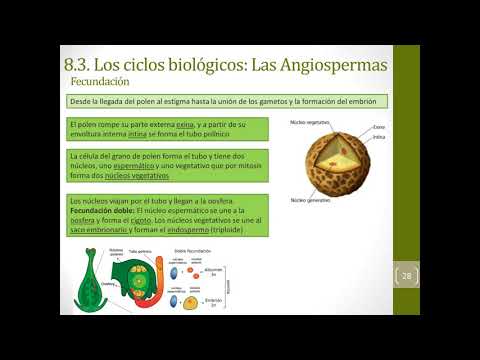
- Fertilization begins when pollen reaches stigma leading to gamete fusion forming an embryo. Pollen consists of two nuclei: vegetative and generative.
Formation of Pollen Tube
- Upon landing on stigma, pollen breaks its exine layer forming a tube that transports nuclei towards oosphere for double fertilization—one nucleus forms an embryo while others contribute to endosperm development.
Plant Reproduction and Seed Development
Fertilization Process
- The vegetative nuclei join the cells of the embryo sac, leading to the formation of a triploid endosperm. This occurs after pollination when pollen reaches the stigma and forms a pollen tube.
- The generative nucleus divides to form two sperm nuclei; one fuses with the egg cell to create an embryo, while the other combines with vegetative cells to form endosperm or albumen.
Embryo Formation
- Following fertilization, a structure called the suspensor connects the embryo to the endosperm, facilitating nutrient transfer during development. The embryo begins forming cotyledons while developing within the ovary.
- Seeds serve as structures housing embryos along with nutritive tissues and protective coverings that vary by species; in gymnosperms, albumen is often replaced by energy-storing oils.
Seed Structure
- A seed consists of an undeveloped plant (embryo), which includes parts like radicle (future root), hypocotyl (connects radicle and cotyledons), and cotyledons (first leaves). Monocots have one cotyledon while dicots have two.
- Seed coverings are formed from thickened archegonium tissue; depending on species, there may be a single integument or an outer testa layer for protection. Endosperm serves as a reserve for germination nutrients.
Germination Process
- Germination can occur under favorable conditions such as adequate water and light; seeds can remain dormant until these conditions are met. Once triggered, embryos develop into seedlings through specific stages: first roots emerge followed by stem growth and leaf development.
- There are two types of germination: epigeal (cotyledons emerge above ground) where they perform photosynthesis, and hypogeal (cotyledons remain underground) where initial photosynthesis is conducted by emerging leaves instead of cotyledons serving mainly protective roles.
Fruit Development
- Fruits develop from mature ovaries post-fertilization, protecting seeds while aiding in their dispersal—an evolutionary success for angiosperms. Initial changes include petal loss and thickening of floral receptacles based on fruit type characteristics.
- Two types of ovaries exist: superior ovaries sit above other floral structures leading to fruits formed solely from ovary modifications; inferior ovaries lie below them involving all flower structures in fruit formation processes.
Structure of Fleshy Fruits
- Fleshy fruits consist of three distinct layers: exocarp (outer skin), mesocarp (edible flesh), and endocarp (hard inner layer protecting seeds). For example, in peaches, these layers are clearly defined with each serving specific functions related to seed protection and dispersal mechanisms.
Fruit Types and Seed Dispersal
Overview of Fruit Structure
- The endocarp is the protective layer where seeds are located; fruits can be classified as dry or fleshy based on ovary modifications.
- Fruits are categorized into simple (one seed per fruit, e.g., peach) and compound (multiple seeds, e.g., strawberry).
- Dehiscent fruits open to release seeds, while indehiscent fruits retain them; most edible fruits are indehiscent.
Seed Dispersal Mechanisms
- Angiosperms' ability to disperse seeds is crucial for their evolutionary success and helps reduce competition among species.
- Four main types of seed dispersal:
- Anemochory: Wind dispersal (e.g., dandelions).
- Zoochory: Animal-assisted dispersal through external attachment or ingestion.
Detailed Dispersal Methods
- Epizoochory involves seeds attaching to animals' fur; this method ensures that seeds travel away from the parent plant.
- Endozoochory occurs when animals consume fruit, aiding in seed germination after passing through their digestive system.
Unique Dispersal Strategies
- Hydrochory, exemplified by coconuts, allows seeds to float across water bodies for colonization on new islands.
- Autocoria refers to plants that can eject their seeds away from the parent plant, enhancing distance from competition.