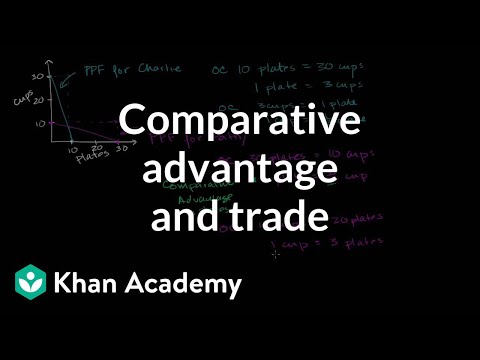
Comparative advantage and absolute advantage | Microeconomics | Khan Academy
Understanding Comparative Advantage vs. Absolute Advantage
Introduction to Concepts
- The video aims to clarify the distinction between "comparative advantage" and "absolute advantage," using Patty and Charlie as examples.
- Patty has a comparative advantage in plates due to her lower opportunity cost of producing one plate compared to Charlie's.
Opportunity Costs Explained
- Absolute advantage refers to being more productive with the same inputs; it cannot be determined without knowing input quantities.
- If both have the same number of inputs, Patty can produce more plates than Charlie, giving her an absolute advantage in plates.
Specialization Based on Advantages
- Despite having an absolute advantage, specialization is based on comparative advantages rather than absolute productivity levels.
- A scenario is introduced where Charlie improves his productivity, potentially gaining an absolute advantage in both products.
Analyzing New Productivity Levels
Updated Production Possibilities Frontier (PPF)
- With improved productivity, Charlie can now produce 40 cups or 40 plates per day using the same inputs, establishing his absolute advantage in both.
Opportunity Cost Re-evaluation
- To determine opportunity costs: if Charlie produces 40 plates, he gives up 40 cups; thus, his opportunity cost for one plate equals one cup.
- Conversely, Patty’s opportunity cost for producing a plate remains at one-third of a cup despite changes in Charlie's productivity.
Comparative Advantages After Changes
Assessing Comparative Advantages
- Even with increased productivity, Patty retains her comparative advantage in plates since she sacrifices less (one-third of a cup).
- For cups, Charlie's opportunity cost is now one plate while Patty's remains three plates; hence he still holds the comparative advantage in cups.
Implications for Specialization
- Both should specialize according to their comparative advantages: Charlie in cups and Patty in plates for optimal production efficiency.
Exploring Trade Benefits
Potential Gains from Trade
- Any trade that falls below their respective opportunity costs will benefit both parties; e.g., Patty would trade two plates for one cup since she values it less than making it herself.
Willingness to Trade
- Charlie would also find trading two plates for one cup beneficial since it’s better than his own production costs.
Outcomes from Specialization and Trade
Final Trading Scenario
- If Charlie trades ten cups for twenty plates, he ends up with outcomes beyond what was possible without specialization—demonstrating gains from trade.
Mutual Benefits Realized
- Similarly, after trading twenty plates for ten cups, Patty also achieves a favorable outcome beyond her original Production Possibilities Frontier.
Turn any video into a summary like this
YouTube links, meetings, lectures. With transcripts, search, and chat.