Origen Geológico de Panamá
[Música] New Section
This section provides an overview of the geological changes that have occurred in Panama over millions of years, leading to the formation of its unique geography and diverse marine life.
Geological Changes and Formation of Panama
- Around 225 million years ago, there was a single continent called Pangea.
- Approximately 140 million years later, the first fragmentation of the supercontinent occurred due to the emergence of a Mesozoic mountain range, leading to the formation of the North Atlantic Ocean.
- The expanding Atlantic Ocean separated Africa from South America around 80 million years ago.
- The Galapagos hotspot on the Farallon Plate initiated a significant basalt infusion, which later became the Caribbean Plate.
- About 20 million years ago, the Caribbean Plate extended considerably towards the east, while the submerged Farallon Plate split into two units: Cocos Plate to the north and Nazca Plate to the south.
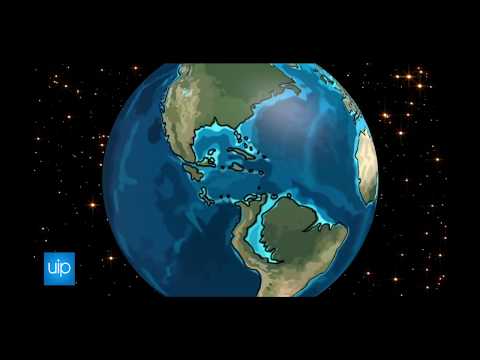
- As a result of movement between Cocos and Caribbean Plates, an archipelago emerged between the Pacific and Atlantic Oceans around 15 million years ago.
- Four million years later, this archipelago had already emerged, leaving only two marine corridors - Canal Corridor and Atrato Corridor.
- Three million years ago, when Panama Isthmus formed, it created a corridor allowing migration of species between North and South America due to permanent ice in Arctic causing glaciations. The exchange primarily occurred from north to south.
Complex Geology and Tectonic Activity in Central America
- Central America is one of the most geologically complex areas in terms of plate movements. It experiences frequent plate collisions.
- Panama is the only place where the Caribbean Plate makes contact with the Nazca Plate, as both move in the same direction and at the same speed.
- Prior to the formation of Panama Isthmus, the strong equatorial current flowed directly from the Caribbean to the Pacific. After its uplift, this current turned northward, becoming known as the Gulf Stream.
- The geological changes resulted in different characteristics for the Caribbean and Pacific Oceans. The Caribbean became a closed sea with little tidal movement and low nutrient content, while the Pacific became more complex, colder, less salty, richer in nutrients, and had fewer coral reefs.
Impact on Ocean Circulation and Climate
- The formation of Panama Isthmus created two types of oceans in terms of global wind circulation. During the rainy season, two major wind fronts collide to form what is now known as the Intertropical Convergence Zone (ITCZ).
- In dry season, ITCZ moves southward, subjecting Central America to strong trade winds.
- In lower parts of Panama Isthmus, trade winds displace warm surface water causing cold nutrient-rich water from deep ocean to rise - a phenomenon called upwelling. This is particularly notable in Gulf of Panama.
- Upwelling zones are rich in microplants due to sunlight availability and serve as an important food source for fish, shellfish, and seabirds.
Geological Phenomena's Impact on Marine Life
- The geological origin of Panama has caused extraordinary changes in oceans and global climate. It has also had significant effects on marine and terrestrial life.