¿Quién inventó el ABECEDARIO?
The Origins of the Alphabet
The Importance of Shared Language
- Jorge Luis Borges stated, “All language is an alphabet of symbols whose exercise presupposes a shared past among interlocutors.” This emphasizes the necessity of a common language for effective communication.
- The concept of an alphabet arises from a code that allows individuals to share ideas and meanings through symbols.
Early Writing Systems
- The first known writing systems were pictograms, developed around 3200 B.C. in Mesopotamia, combining numbers and animal drawings. These were inscribed on wet clay tablets using a reed stylus.
- Cuneiform writing was deciphered by Georg Friedrich Grotefend, who identified its structure and established that it recorded language rather than mere decoration. He discovered an alphabet with 30 letters through careful analysis of inscriptions found at Persepolis.
Diverse Ancient Scripts
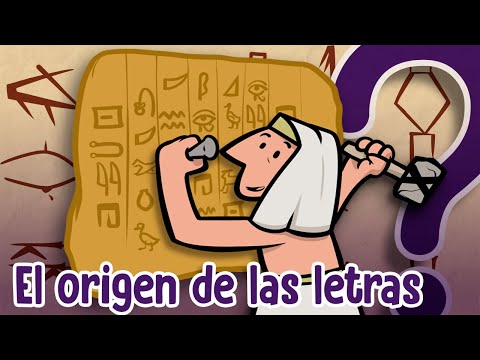
- Cuneiform was used for various records over two millennia, including royal chronicles and private letters. Similarly, ancient Egyptian hieroglyphics emerged around 3200 B.C., derived from Greek words meaning "sacred writing."
- Other cultures like the Maya and Hittites also developed their own hieroglyphic systems, which were complex and primarily understood by priests and scribes due to their intricate symbolism.
Deciphering Hieroglyphics
- In 1799, soldiers discovered the Rosetta Stone containing texts in three scripts: hieroglyphics, demotic Egyptian, and ancient Greek; this discovery was crucial for understanding Egyptian writing. Jean François Champollion successfully translated these texts in 1822 using the Greek version as a reference point.
- Hieroglyphics could be read in multiple directions depending on the orientation of the symbols; this flexibility added complexity to their interpretation.
Evolution of Alphabets
- The phonetic alphabet was created by the Chaldeans around 1500 B.C., later refined by Phoenicians into a system with only twenty-two consonants; Greeks then added vowels around 800 B.C., forming our modern alphabet structure.
- Examples illustrate how letters evolved from representations (e.g., 'A' originated from an ox head symbol) through modifications made by different cultures over centuries until they became recognizable letters today (e.g., 'D' from a door symbol).
Cultural Variations in Writing Systems
Understanding Chinese Characters and Ciphers
The Nature of Chinese Writing
- Chinese characters can be formed using a single character or by combining multiple characters. This writing system is the oldest continuously used living language, remaining unchanged for thousands of years.
Development of Secret Codes
- Various codes, such as Morse code and encrypted alphabets, have been developed to ensure that only a few people understand them. These are often created during wartime to keep plans hidden from enemies.
Examples of Ciphers
- The Caesar cipher involves substituting each letter with another letter a fixed number of positions away in the alphabet (e.g., A becomes D when shifted three places).
- Substitution ciphers allow direct replacement of the standard alphabet with any collection of symbols or numbers. An example includes the Pigpen cipher used by Freemasons in the 18th century.
Unique Literary Techniques
- A lipogram is a text that deliberately omits a specific letter; for instance, "Gadsby: Champion of Youth" contains over 50,000 words without using 'e'. Similarly, Georges Perec's "A Void" also avoids this common letter.
- A pangram is a sentence that includes every letter in the alphabet. An example provided is: "Le gustaba cenar un exquisito sándwich de jamón con zumo de piña y vodka frío."
Importance of Written Language
- Having an alphabet or symbol system is crucial for human development since written language preserves ideas better than spoken language, which can lose meaning over time.
Evolution of Language
- As cultures evolve, new letters may be added to alphabets while others may become obsolete. The ongoing evolution indicates that there’s still much more to express through language.
Acknowledgments