Producción industrial de ácido clorhídrico HCl
Industrial Production of Hydrochloric Acid
Overview of Hydrochloric Acid
- Hydrochloric acid, also known as muriatic acid, spirit of salt, marine acid, and salfumán, consists of one hydrogen atom and one chlorine atom.
- In aqueous solution, hydrochloric acid is a strong acid that completely dissociates into chloride ions and hydrogen ions at room temperature.
Properties and Historical Context
- Hydrogen chloride gas is slightly yellow, corrosive, non-flammable, denser than air with a strong irritating odor; it forms dense white corrosive vapors when exposed to air.
- The saturated solution at 0 degrees Celsius has a concentration of 37% and a density of 119 grams per cubic centimeter. It releases heat upon dissolving in water.
- First obtained around the year 800 by a Muslim scientist named Jabir through mixing common salt with vitriol (sulfuric acid).
Industrial Demand and Production Methods
- During the Industrial Revolution in Europe, the demand for alkaline substances increased; Nicolas Leblanc's process allowed large-scale production of sodium carbonate while releasing hydrochloric acid as waste.
- By the early 20th century, although the Solvay process replaced Leblanc's method for sodium carbonate production, hydrochloric acid became widely used in various applications.
Chemical Characteristics
- Hydrochloric acid is colorless and highly corrosive; it readily forms hydrates due to its affinity for water.
- As a monoprotic acid, it can release only one proton (hydrogen ion), which combines with water to form hydronium ions in aqueous solutions.
Production Processes
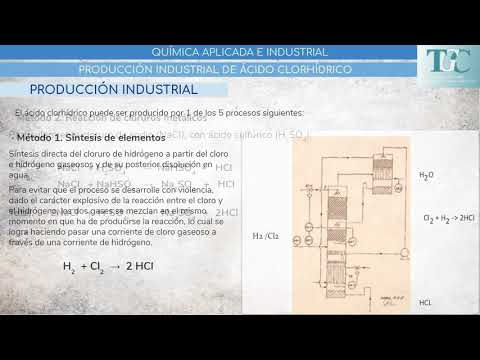
Method 1: Direct Synthesis
- The first method involves direct synthesis from gaseous chlorine and hydrogen followed by dissolution in water to produce hydrochloric acid safely.
Method 2: Reaction with Metal Chlorides
- The second method uses sodium chloride (table salt) reacting with sulfuric acid to yield sodium sulfate and hydrochloric acid.
Method 3: Byproduct from Organic Chlorination
- The third method produces hydrochloric acid as a byproduct during chlorination processes involving organic compounds like chloroform or vinyl chloride.
Method 4: Thermal Decomposition
- The fourth method involves thermal decomposition during hydration treatment of heavy metals such as ferric chloride yielding iron oxide and hydrochloric acid.
Method 5: Incineration of Chlorinated Organic Waste
Acid Chlorhydric: Production and Applications
Production of Hydrochloric Acid
- The burning of plastics in landfills releases chlorinated compounds, including hydrochloric acid. A simplified diagram illustrates the steps for producing hydrochloric acid as a byproduct of organic product chlorination.
- Hydrochloric acid is produced alongside chlorine gas and concentrated hydrochloric acid, with some impure hydrochloric acid being released into a scrubber.
Industrial Importance of Hydrochloric Acid
- Hydrochloric acid is the second most important industrial acid after sulfuric acid, used for cleaning, treating metals, tanning leather, and manufacturing various products due to its low cost and volatility.
- It effectively removes calcium carbonate deposits from pipes and equipment by converting it into soluble calcium chloride while releasing carbon dioxide and water.
Chemical Reactions Involving Hydrochloric Acid
- Hydrochloric acid is utilized in synthesizing organic chlorides through substitution reactions or addition to alkenes for PVC production.
- It plays a role in regenerating ion exchange resins to remove cations like sodium and calcium from hard water, essential for producing demineralized water used in industrial boilers.
Environmental Impact and Emissions
- Studies indicate that over 89% of atmospheric hydrochloric acid emissions result from coal combustion, highlighting coal's continued use as an energy source.
- Less than 1% of emissions come directly from hydrochloric acid production; contaminants include hydrogen chloride gas and chlorinated organic compounds.
Safety Considerations
- Although one of the less dangerous strong acids to handle, hydrochloric acid can still be hazardous. Its solutions are relatively stable up to 6 molar concentrations over time.
- It is commonly used in chemical analysis but can irritate tissues upon contact. High exposure levels may lead to severe respiratory issues or even death.
Risks Associated with Mixing Chemicals