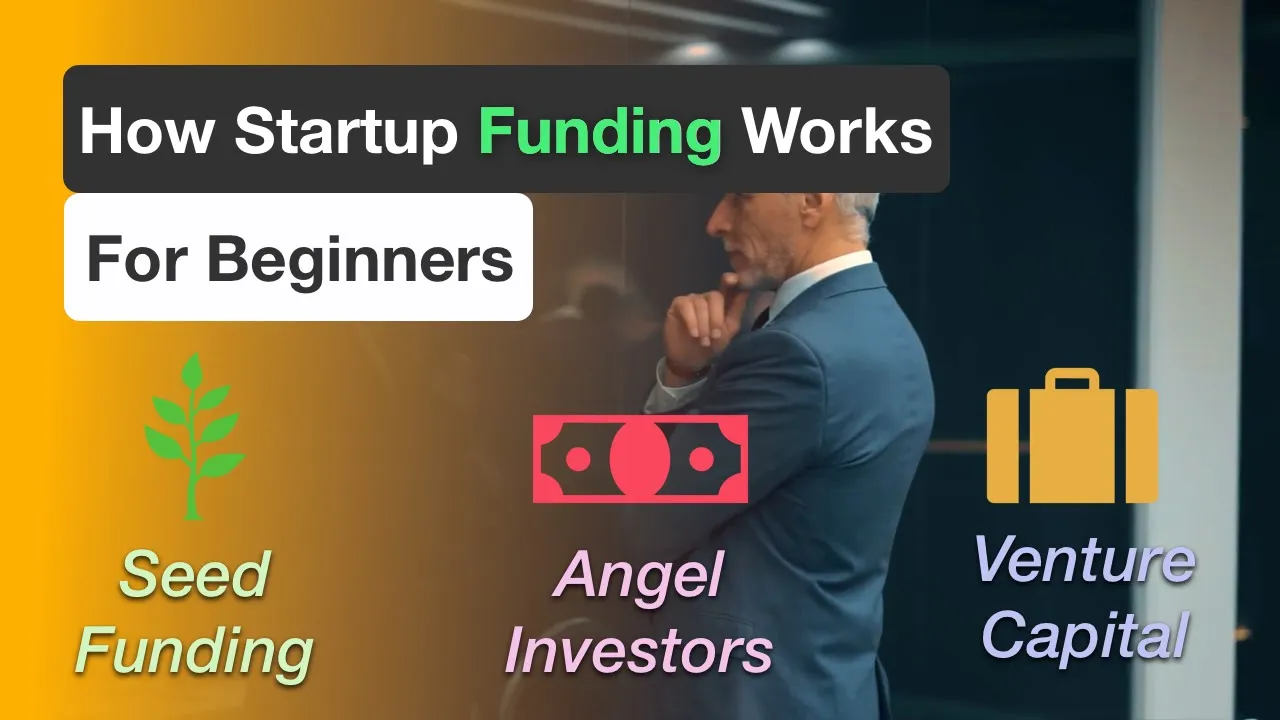
How Startup Funding works: Seed money, Angel Investors and Venture Capitalists explained
Understanding Startup Funding
This section introduces the process of startup funding, detailing the journey from ideation to securing investments at different stages of company growth.
Ideation and Initial Funding
- The journey begins with having a promising idea that requires funding to materialize.
- Most ideas do not progress, but when one shows potential, building a prototype becomes crucial.
- At the idea stage, minimal funds are needed to kickstart the project. Options for funding include friends, family, or personal investment in exchange for equity.
Seed Stage Funding
- As the project gains traction and requires further development, seed funding becomes essential.
- Initial investors receive ownership in exchange for their contributions, leading to dilution of the founder's equity.
- With proof of concept through user engagement, seeking investments from angel investors or seed capital firms is common.
Angel Investors vs. Seed Capital
- Entrepreneurs navigate between angel investors and seed capital firms for financial support.
- Angel investors offer personal funds and expertise but may be harder to access compared to seed capital firms.
- Seed capital firms provide larger investments but with less personalized attention due to managing multiple portfolios.
Scaling Up: Growth Stage
This segment delves into the growth stage of startup funding where substantial investments are sought from venture capitalists to propel company expansion.
Venture Capital Investment
- Transitioning into the growth stage involves securing significant funds from venture capitalists.
- With an established product and user base, attracting venture capital investors becomes pivotal for rapid company growth.
How Startup Funding Works
This section discusses the stages of startup funding, from initial rounds to exit strategies like acquisition and IPO.
Startup Growth Rounds
- Private companies raise series funding periodically for growth, even if profitable.
- Success leads to Series B and C funding rounds within a few years.
Exit Strategies: Acquisition vs. IPO
- Stage four involves exits through acquisition or IPO.
- Acquisition entails cash-stock mix with founder retention; IPO allows public share trading.
Becoming a Public Company
- Preparing for an IPO involves detailed discussions with bankers and accountants.
- Successful IPO results in a valued company, CEO ownership, and public trading.
Post-IPO Considerations