9. El proceso.
Introduction to Civil Law Process
Understanding the Legal Process
- The speaker emphasizes the importance of understanding civil law processes, noting that codes do not serve as comprehensive manuals for legal education.
- A definition is provided: the process is a legal relationship aimed at resolving petitions through a series of legislatively ordered acts, highlighting the principle of legality.
- Key elements identified include:
- A legal relationship
- Preordained acts by legislators
- Resolution of parties' requests (claims and defenses)
- Involvement of state jurisdiction.
The Nature of Legal Processes
- The speaker discusses various theories explaining procedural law, starting with the theory that views the process as a contract based on Roman origins.
- This contract theory suggests parties voluntarily seek a third party to resolve disputes; however, it is deemed unacceptable due to its reliance on mutual consent which does not exist in all cases.
Critique of Contract Theory
- The speaker argues against viewing processes as contracts because:
- Parties are compelled into proceedings without mutual agreement.
- The defendant's participation is mandatory upon being summoned, contradicting voluntary contract principles.
Alternative Perspectives on Legal Processes
- Another theory presented is Galschmit's view that characterizes processes as dynamic legal situations akin to states of war due to their unpredictable nature.
- Criticism arises from this perspective since it fails to differentiate between dynamic relationships and static definitions within legal contexts.
Relationship vs. Situation in Legal Processes
- The speaker advocates for understanding processes as legal relationships rather than mere situations, emphasizing:
- Relationships express dynamics more effectively than static definitions.
Understanding the Legal Relationship in Judicial Processes
The Nature of Judicial Relationships
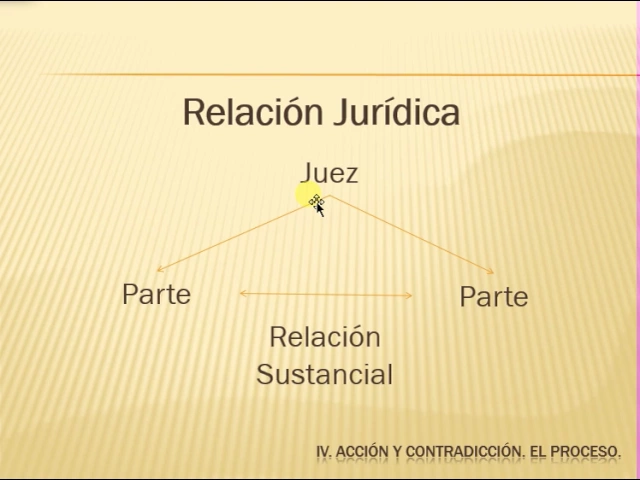
- A judicial process is characterized as a legal relationship between parties and the judge, where obligations exist. The judge provides justice to the parties involved.
- This relationship is dynamic and complex, akin to consulting an oracle due to varying interpretations of law; thus, uncertainty prevails in outcomes.
- The obligation of the judge is to deliver justice, which necessitates requests from parties and responses from the judge, similar to a right of petition.
- It’s possible for a process to commence without ownership of substantive rights; hence, procedural relationships can exist independently of substantial ones.
Distinction Between Action Rights and Substantive Rights
- There’s a clear distinction between action rights (the right to access jurisdiction) and substantive rights (ownership or entitlement). All subjects have action rights by virtue of being legal entities.
- For successful litigation outcomes, both action rights and legitimacy in cause are required. Legitimacy pertains specifically to substantive relationships that may not always be present.
Dynamics Within Judicial Processes
Process as a Series of Preordained Acts
- A judicial process consists of preordained acts regulated by legislation aimed at resolving disputes through structured procedures leading up to a judgment.
- Each act within this series supports others; for instance, foundational acts must precede conclusive judgments like sentences.
Role of Parties and Judges
- Both parties engage in petitions while judges respond with judicial provisions. This interaction forms the backbone of procedural dynamics within trials.
- The principle of due process ensures that all actions taken during proceedings are legally sound and predictable for participants.
Rational Discourse in Legal Proceedings
Conditions for Rational Discussion
- Effective rational discourse requires minimum conditions such as clarity in expressing grievances so that opposing parties can adequately respond.
- Conflicts often appear larger than they are until clarified through dialogue; this demarcation simplifies resolution efforts.
Stages Leading Up to Judgment
- After establishing clarity on disputes through interrogations or discussions, parties present evidence supporting their claims during trial phases leading up to final arguments.
Classification and Structure of Legal Processes
Types of Legal Processes
- Various classifications exist within legal processes: declarative (seeking certainty), executive (enforcing obligations), liquidatory (dividing assets), among others.
- Declarative processes aim at resolving uncertainties through court declarations backed by evidence presented during trials.
Importance of Procedural Clarity
- Clear definitions within legal frameworks help maintain order during proceedings. Misclassifications can lead to confusion regarding requirements like conciliation before proceeding with certain types.
Executive Titles and Their Legal Implications
Understanding Executive Titles
- The discussion begins with examples of executive titles recognized by law, emphasizing that all value titles are executive titles, but not all executive titles qualify as value titles.
- Value titles are defined in the commercial code as documents necessary to legitimize a literal and autonomous right. They serve as proof of an obligation and are considered mercantile goods.
- The definition from Article 619 of the Commercial Code states that a value title is essential; losing it results in losing the associated right, highlighting its importance beyond mere documentation.
- Other legal documents also serve as executive titles, such as conciliation records and certificates from property administrators, which can facilitate debt collection without unnecessary conflicts.
Classification of Executive Processes
- The speaker notes that there is currently one general executive process in law, which adapts to special cases when guarantees exist. This simplification aids understanding for students and practitioners alike.
- Although theoretically possible to classify processes into various types (e.g., quirografarios, real guarantee processes), the current legal framework recognizes only one type of executive process with specific adaptations for guarantees.
Liquidation Processes
- Liquidation processes aim to resolve unresolved patrimonial situations. These include determining ownership of assets after events like death or dissolution of companies.
What are Voluntary Jurisdiction Processes?
Understanding Voluntary Jurisdiction
- Voluntary jurisdiction processes involve the judge acting as a certifying official rather than resolving a conflict, which is often debated.
- The role of the judge in these processes is analogous to that of a notary, providing certification and declaration with judicial authority.
- These processes allow individuals to fulfill legal requirements without an actual conflict between parties; they do not lead to res judicata (final judgment).
Characteristics of Voluntary Jurisdiction
- Key characteristics include the absence of conflict and no designated plaintiff or defendant since there is no contention involved.
- While typically non-contentious, exceptions exist where conflicts may arise, such as when family members seek to manage an incapacitated relative's affairs.
Contention in Specific Cases
- In cases involving mental incapacity, there may be contention if relatives dispute the status of the individual’s capacity; this can complicate definitions of voluntary jurisdiction.
- The notion that there is always no contention in voluntary jurisdiction is contingent and cannot be universally applied; it varies by case specifics.
Nature of Judicial Decisions
- The presence or absence of contention does not strictly define voluntary jurisdiction; it depends on circumstances surrounding each case.
- A defining feature is that these processes do not result in final judgments because they address situations that can change over time.
Exceptions to General Rules
- Certain voluntary jurisdiction processes, like declarations regarding incapacity or permissions for asset sales, can lead to definitive outcomes due to their nature requiring permanence.