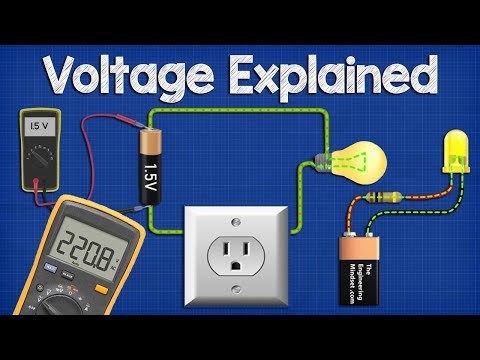
Voltage Explained - What is Voltage? Basic electricity potential difference
What is Voltage and How Does It Work?
Understanding Voltage
- Voltage is the force that pushes free electrons around a circuit, enabling current flow. Without voltage, electrons move randomly and are ineffective for practical use.
- The analogy of water pressure in pipes illustrates voltage: higher pressure (voltage) results in more water (current) flowing through the pipe.
Potential Difference Explained
- Voltage is often referred to as potential difference, indicating how much work can potentially be done by a circuit. A height difference between two lakes represents this concept; one lake has the potential to flow down to another if given a path.
- A battery creates a potential difference (e.g., 1.5 volts), causing electrons to flow in one direction when connected in a circuit.
Series vs Parallel Connections
- Connecting batteries in series increases voltage (e.g., two 1.5V batteries yield 3V), resulting in brighter lamps due to increased electron flow.
- In parallel connections, voltage remains the same while current capacity increases; thus, lamps will be dimmer but powered longer.
Measuring Voltage
- Voltage is measured in volts (symbol: V). Electrical appliances indicate their required voltage next to this symbol.
- The term "volt" originates from Alessandro Volta, who created the first steady electrical battery.
Distinction Between Voltage and Volts
- It's crucial to differentiate between voltage (the pressure pushing electrons) and volts (the unit of measurement).
- To measure voltage accurately, connect a voltmeter across two points in parallel within the circuit.
Practical Examples of Voltage Measurement
- In circuits with multiple components like lamps, measuring reveals how voltage divides among them—1.5V across both lamps combined but only 0.75V individually.
Understanding Voltage and Current in Electrical Circuits
The Basics of Powering a Lamp
- To keep a 0.3-watt lamp lit using a 1.5-volt battery, approximately 0.2 coulombs or about 1 quintillion,872 quadrillion,600 trillion electrons must flow every second.
Effects of Voltage on Brightness
- Lower voltage results in decreased brightness of the lamp due to reduced electron flow; less pressure means fewer electrons can pass through.
Voltage Ratings and Safety
- Lamps have specific ratings for voltage and current; exceeding these can cause the lamp to blow due to excessive electron flow.
Types of Voltage: Direct vs Alternating
- AA batteries provide direct voltage (1.5 volts), which moves electrons consistently in one direction, akin to water flowing down a river.
- In contrast, wall sockets supply alternating voltage where electrons switch directions periodically, represented by sine waves when plotted against time.
Global Variations in Voltage Standards
- Worldwide voltage standards vary: most regions use 220 to 240 volts while North America typically uses 110 to 127 volts; this affects device compatibility.
- Historical lack of standardization led to different voltages being adopted globally as companies grew and regulations were established over time.
Implications for Device Compatibility
- Using devices rated for different voltages can lead to malfunction; e.g., a U.S. hair dryer plugged into a European socket may burn out due to excess voltage.
Turn any video into a summary like this
YouTube links, meetings, lectures. With transcripts, search, and chat.