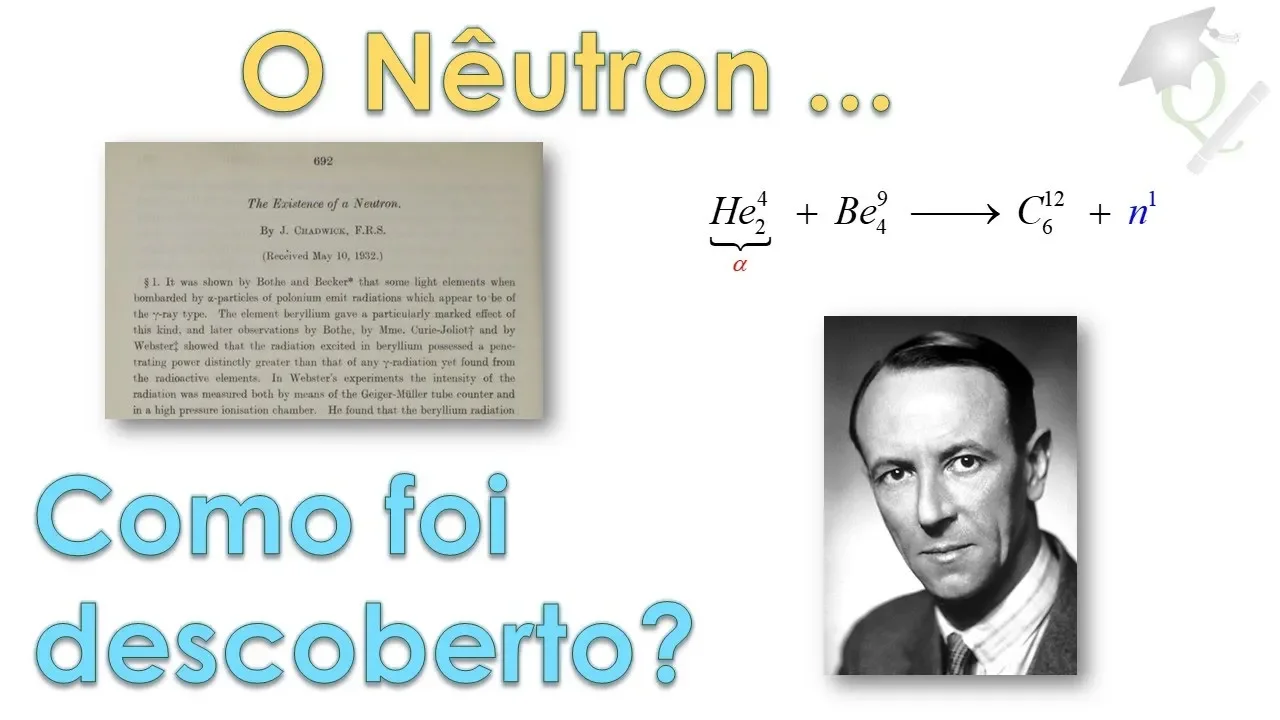
Você sabe como o Nêutron foi descoberto? Quem o identificou?
Chemistry and Nuclear Reactions
In this section, the speaker discusses the discovery of the neutron in nuclear reactions and its significance in stabilizing atomic nuclei.
Discovery of Neutron
- The neutron was challenging to identify due to its neutral charge, unlike charged particles.
- The reaction involved a helium nucleus colliding with a beryllium nucleus, resulting in the formation of a carbon nucleus and the emission of a neutron.
- Initially, the emitted particle was thought to be radiation like X-rays or gamma rays due to its high penetration power.
Importance of Neutrons
- Neutrons were crucial for stabilizing atomic nuclei, a concept often overlooked in high school education.
- The existence of neutrons was proposed in the early 1920s to explain nuclear stability.
Experimental Confirmation
- Physicists conducted experiments involving nuclear reactions to identify the emitted particle as a neutron.
- The correct interpretation led to the publication confirming the existence of neutrons in 1932.
Significance of Neutron Discovery
This part delves into how identifying neutrons contributed to understanding atomic structure and stability.
Mass and Charge Identification
- By analyzing mass conservation principles, it was determined that the emitted particle had mass but no charge, leading to its identification as a neutron.
- James Chadwick's correct interpretation confirmed that the emitted entity possessed mass equivalent to one atomic mass unit.
Scientific Contribution
- Chadwick's proposal regarding neutrons being composed of protons and electrons was groundbreaking for nuclear physics.
- His work highlighted the importance of experimental validation in scientific discoveries.
Closing Remarks
Concluding thoughts on Chadwick's contributions and encouraging further exploration into nuclear chemistry concepts.
Educational Outreach
- Encouragement for viewers to share knowledge about Chadwick's discoveries with educators and students.