3.4-2 Principles of Reliable Data Transfer (Part 2)
Developing a Reliable Data Transfer Protocol
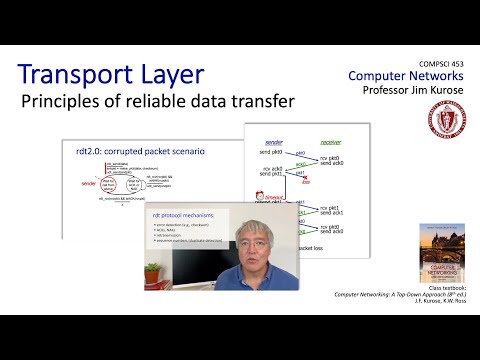
Introduction to Message Loss and Corruption
- The discussion begins with the need for a reliable data transfer protocol that addresses both message corruption and loss, particularly in scenarios where datagrams can be discarded due to congestion.
- The focus shifts to extending the existing protocol to handle lost messages, emphasizing its relevance for both data packets and acknowledgments.
Human Analogies in Communication
- A comparison is drawn between human communication and data transmission; when no acknowledgment is received, individuals often repeat their statements after a timeout.
- This concept of setting timers and retransmitting will be central to the new protocol (referred to as dt 3.0).
Sender Mechanisms in dt 3.0
- The sender will wait for an acknowledgment after transmitting a packet; if none is received within a set time, it will retransmit the packet.
- A key change involves the receiver indicating the sequence number of acknowledged packets, differing from previous versions (2.1 and 2.2).
Timer Operations and State Transitions
- A countdown timer will be introduced to manage retransmissions effectively; this timer starts upon sending a packet.
- The finite state machine for the sender retains four states from earlier protocols but incorporates timer operations highlighted in yellow.
Handling Timeouts and Packet Loss
- When waiting for an acknowledgment of packet number 0, if a timeout occurs, the sender simply resends that packet.
- Corrupted packets are treated similarly to lost packets; they are ignored until retransmission occurs.
Sequence Number Management
- If an acknowledgment has been received but another packet arrives from the receiver, it can also be ignored since it's already acknowledged.
Demonstrating dt 3.0 Functionality
- An example illustrates how packets are sent from sender to receiver with corresponding acknowledgments being exchanged without errors initially.
Addressing Packet Loss Scenarios
- In cases where packet one is lost after being sent by the sender, it waits until a timeout occurs before resending it.
Lost ACK Handling
- If an acknowledgment is lost while everything else proceeds correctly, eventually leading to a timeout at the sender which triggers retransmission of packet one.
Premature Timeout Considerations
- Discussion on premature timeouts highlights potential issues when either messages or acknowledgments experience delays rather than actual losses.
Performance Metrics of dt 3.0
- Utilization metrics are introduced as critical performance indicators; calculations show poor utilization rates due to stop-and-wait behavior inherent in dt 3.0.
Enhancing Performance through Pipelining
Introduction of Pipelining Techniques
- To improve performance limitations observed in dt 3.0's stop-and-wait mechanism, pipelining techniques allow multiple unacknowledged packets in transit simultaneously.
Go Back N Protocol Overview
- Go Back N allows up to n transmitted but unacknowledged packets using cumulative acknowledgments which acknowledge all prior packets upon receipt of any specific ACK.
Receiver Behavior Under Go Back N
- The receiver sends back cumulative ACKS based on highest ordered sequence numbers received while discarding out-of-order packets unless buffered.
Selective Repeat Protocol Explanation
- Selective Repeat acknowledges each individual correctly received packet allowing buffering for later delivery while maintaining separate timers per unacknowledged packet.
Conclusion on Reliable Data Transfer Protocol Development
- Finally, various mechanisms such as checksums and timeouts have been integrated into protocols ensuring reliable communication over channels susceptible to message loss or corruption across different layers.
Turn any video into a summary like this
YouTube links, meetings, lectures. With transcripts, search, and chat.