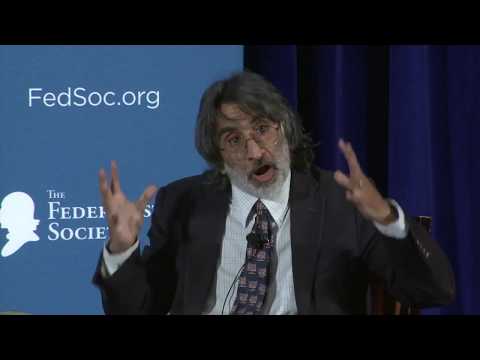
Tenth Annual Rosenkranz Debate: Lochner v. New York
Introduction
The speaker welcomes the audience to the 10th annual Rosenkranz debate and expresses gratitude for their attendance. He introduces the topic of the debate, which is Lochner vs. New York.
- The Rosenkranz debate is a one-on-one intellectual discussion between two prominent legal theorists.
- The first annual debate was held in 2008 with judges Richard Posner and Mike McConnell.
- This year's topic is Lochner vs. New York, a case that has come to stand for an era and will be debated along with the doctrine surrounding it.
- Professor Akhil Reed Amar is introduced as one of the debaters.
Introducing Debaters
The speaker introduces Professor Akhil Reed Amar, who is a Sterling Professor of Law and Policy Public Policy at Yale University.
- Professor Akhil Reed Amar is introduced as a great friend and mentor to the speaker.
- He has written many books on law and policy, including "The Bill of Rights: Creation and Reconstruction."
- He has been a great friend to the Federalist Society and Yale chapter in particular.
- He always makes a point of coming down to DC every year to our convention.
Resolving Lochner vs. New York
The speaker explains that this year's resolution is "Resolved: Lochner vs. New York still crazy after all these years" and gives credit to Jeanne Meyer for formulating it.
- The resolution refers to whether or not Lochner vs. New York remains relevant today.
- It's difficult to formulate such resolutions in a pithy way, but Jeanne Meyer did an excellent job despite being unfamiliar with the song reference.
- David Bernstein's book "Rehabilitating Lochner" brought this topic more into focus.
Conclusion
The speaker concludes the introduction by expressing his excitement for the debate and thanking everyone for attending.
- Lochner vs. New York is an important topic that will be debated today.
- The speaker is thrilled to have Professor Akhil Reed Amar as one of the debaters.
- He thanks everyone for attending and choosing to spend their Saturday with them.
The Lost Constitution and the Presumption of Liberty
This section introduces the topic of the debate, which is Lochner v. New York, a case that dealt with labor laws in the early 20th century.
Introduction to Lochner v. New York
- Lochner v. New York was a case that dealt with a law prohibiting contracts for bakers to work more than 60 hours per week.
- The Lochner Court struck down this law because it believed it was trying to redistribute wealth from employers to employees and level inequalities of fortune.
- However, the Lochner Court did not have a full-blown libertarian theory; it upheld other laws that intruded on individual liberty.
Health and Safety Concerns for Bakers
- The average age of bakers was below that of other workers, and they seldom lived past their 50th year.
- Bakers worked in dark environments and inhaled flour dust constantly, which caused inflammation of their lungs and bronchial tubes.
- A health and safety law prohibiting long working hours for bakers could be justified even if people voluntarily agreed to them because they put not only themselves but also their families at risk.
Introduction by Moderator
This section provides an introduction by the moderator, who explains how the debate will proceed.
Format of Debate
- Each debater will have 12 minutes for an opening remark.
- Afterward, there will be seven minutes for reply and rebuttal.
- Then there will be a less structured give-and-take before audience questions are taken.
Introduction by Akhil Amar
This section provides an introduction by one of the debaters, Akhil Amar.
Introduction to Lochner as a Metaphor
- Lochner is a case, an era, and a metaphor.
- The larger philosophy that Lochner embodied is mistaken.
- The position that Amar will defend is much closer to John Marshall Harlan's dissent in the case.
Lochner Court's Philosophy
- The Lochner Court believed that the law was trying to redistribute wealth from employers to employees and level inequalities of fortune.
- This philosophy was what motivated the court to strike down the law, not a full-blown libertarian theory.
- The court upheld other laws that intruded on individual liberty.
Affiliation with John Marshall Harlan
- Amar affiliates himself with John Marshall Harlan's dissent in Plessy v. Ferguson and other prophetic cases.
- He does not affiliate himself with Oliver Wendell Holmes' famous dissent in Lochner because he believes Holmes vastly overrated.
Facts of Lochner
- David Bernstein's book Rehabilitating Lochner provides interesting facts about the case.
- Bakers had health and safety concerns due to their working conditions, which justified laws prohibiting long working hours for them.
The Permissible Government Purpose
In this section, the speaker discusses the permissible government purpose of modest redistribution and health and safety laws.
Modest Redistribution is not Impermissible
- The speaker argues that modest redistribution is a permissible government purpose.
- The Thirteenth Amendment redistributes property permissively.
- The Fourteenth Amendment Section 4 says there will be no compensation for slaveholders who lost their property in slaves, and there will be no redistribution for that.
Health and Safety Laws are not Impermissible
- Takings Clause signals a general anti-redistribution principle.
- Health and safety laws are not impermissible.
- The Sixteenth Amendment was designed to provide for a redistributed income tax.
Libertarian Sensibilities
In this section, the speaker talks about his libertarian sensibilities and Randy Barnett's books.
Randy Barnett's Books
- Randy Barnett has written powerful and interesting books on Lochner.
- Randy tries to defend Lochner on Fourteenth Amendment originalist grounds, but the speaker has some doubts about that.
Egregious Law
- Randy asks if people who are desperately ill undergoing cancer treatment should be allowed to use medical marijuana to alleviate their pain.
- If framed as a straight-out Liberty idea, states couldn't prohibit it either.
Obamacare
In this section, the speaker talks about why he disagrees with Randy Barnett on Obamacare.
Disagreement with Randy Barnett
- Speaker does not find Obamacare an egregious law.
Liberty and Equality
Akhil Amar discusses the relationship between liberty and equality, using examples such as Griswold and the right to privacy, as well as the Heller case and the right to bear arms.
Liberty and Equality
- Privacy is more equally distributed than property, bringing together the best of liberty and equality.
- Both Randy Barnett and Akhil Amar agree on cases such as Griswold, Heller, and City of Chicago v. McDonald.
- The right to have a gun in the home for self-protection is a matter of liberty that everyone can have.
- Personal preferences should not limit others' rights; let people have what they want.
Lochner as a Due Process Case
Randy Barnett discusses Lochner as a due process clause case rather than a substantive due process case. He explains how Lochner used the due process of law clause to protect Joseph Lochner's property rights.
Textual Approach
- Defending John Marshall's dissenting opinion instead of Holmes' dissenting opinion makes for a more reasonable debate.
- Lochner was not a substantive due process case but rather used the due process of law clause to protect Joseph Lochner's property rights.
- The term "substantive due process" was generated by progressives to criticize the Supreme Court; it wasn't adopted by them until recently.
- The due process of law clause protects individuals from being deprived of life, liberty or property without valid law.
Introduction to Legislative Power
This section discusses the evaluation of legislative power, specifically whether a federal law has been authorized by an enumerated power.
Federal Law Evaluation
- The substance of a federal law must be evaluated to see if it has been authorized by an enumerated power.
- A Commerce Clause challenge and a due process of law case are both necessary to evaluate the validity of a federal law.
- Members of the Federalist Society generally agree on where to find the powers of Congress.
Wrongful Acts by State Legislatures
This section discusses what would make an act by a state legislature wrongful.
Privileges or Immunities Clause
- The Fourteenth Amendment includes the privileges or immunities clause which prohibits states from making or enforcing laws that abridge the privileges or immunities of citizens.
- To determine if a law is appropriate, we must ask if it abridges the privileges or immunities of citizens in the United States.
Natural Rights
- George Mason's draft for a Bill of Rights in Virginia begins with "all men are born equally free and independent" and have certain inherent natural rights.
- These natural rights include life, liberty, property, pursuing happiness, and safety.
- Similar formulations were adopted by other states including Massachusetts where it was considered judicially enforceable.
- James Madison proposed adding this language to the preamble of the Constitution as part of his Bill of Rights speech.
Privileges and Immunities Clause
This section discusses the privileges and immunities clause in the original Constitution, as well as its relevance to the 14th Amendment.
The Privileges and Immunities Clause
- Justice Bushrod Washington's Circuit Court opinion in the case of Corfield v. Coryell (1823) described the privileges and immunities that government provides, including "the enjoyment of life and liberty with the right to acquire and possess property of every kind and to pursue and obtain happiness and safety."
- The language used in Corfield v. Coryell was repeatedly cited by those who drafted and defended the 14th Amendment, including Jacob Howard, who sponsored it in the Senate.
- John Bingham questioned whether Congress truly had the power to enact Civil Rights Act of 1866 under Thirteenth Amendment power. It was for that reason that Fourteenth amendment was enacted.
Property Rights
This section focuses on property rights as one of the privileges or immunities of citizens of the United States.
Property Rights
- There is no doubt historically that property rights are among the privileges or immunities of citizens of the United States that states cannot deprive.
- Due process allows people to challenge laws that take away their liberty or their property if they violate one of these privileges or immunities.
Lochner Court
This section discusses how Lochner court did not use strict scrutiny or anything like strict scrutiny.
Lochner Court
- The term "Lochner court" didn't get invented until Jere Gunther started calling it the Lochner court in the 1970s.
- The Lochner court upheld a lot of regulations, including the regulation of the bakeshop industry in Lochner v. New York (1905).
- The Lochner court did not use strict scrutiny or anything like strict scrutiny.
Introduction to Lochner v. New York
This section introduces the case of Lochner v. New York and discusses how it was evaluated based on whether a law was irrational or arbitrary.
Evaluating Police Power Regulations
- The traditional way of evaluating whether a law was within the power of the legislature to enact was to ask whether the law was irrational or arbitrary.
Arbitrary Law
- The court found the law in Lochner v. New York to be arbitrary because it only applied to bakers, and there was inadequate evidentiary support for it being a genuine health and safety law.
- Social science research at the time showed that bakers were not any more dangerous than other occupations, making it an arbitrary exercise of power to single out bake shop workers.
- The law did not protect bake shop owners who were allowed to work more than 60 hours under the same conditions as bake shop workers, making it irrational.
Disagreement on Presumption
- Justice Harlan disagreed with the majority's finding that the law was arbitrary but did adopt a different presumption by wanting to establish a rebuttable presumption of constitutionality.
Is Lochner V New York Crazy?
This section discusses whether Lochner v. New York is crazy or not.
Historical Context
- Lochner v. New York would not have been crazy when Fourteenth Amendment's privileges or immunities clause and due process of law clause were adopted in 1868 or when it was decided in 1905 since newspaper editorials generally supported it at that time.
- It only became a public issue when Theodore Roosevelt made it a political question during his 1912 presidential campaign.
Realistic Examination of Regulations
- Courts should realistically examine regulations to ensure that they are neither irrational nor arbitrary restrictions on the liberties of We the People.
Disagreement on Whether Law is Irrational
This section discusses the disagreement between Harlan and Akil on whether the law in Lochner v. New York is irrational.
Not an Irrational Law
- The zone of disagreement is more modest than expected, and Harlan argues that bakers are not any different from anyone else, but this is a food and drug consumer safety law because if bakers are too tired, it's a public health concern.
- The average age of a baker is below that of other workmen, and most bakers die between the ages of 40 and 50, making it necessary to regulate their working hours for their health and safety as well as for consumers' health.
Reasonable vs Arbitrary
- The test cannot be whether something is reasonable or not since we can always ask why one hour less or more isn't reasonable. Instead, we need to determine whether a law is rational or arbitrary.
The Concerns of Workers and Consumers
This section discusses the concerns of workers and consumers in the production of bread.
Bread Production Concerns
- Workers' concerns may not align with those of consumers who cannot tell if bread is produced by someone who is not paying attention.
- Self-employed individuals have different bookkeeping, regulatory, and tax requirements.
- An income tax law was deemed unconstitutional because it was redistributive.
The Lochner Era
This section discusses the Lochner era and its interpretation.
Harlan's Dissent
- Harlan dissented in a case where an income tax law was invalidated.
- He believed that this would be disastrous for the country, but he was also a great dissenter in Plessy vs. Ferguson.
- The Pollak court thought that an income tax law was unconstitutional because it was redistributive.
The Deep Idea of the Lochner Era
- The deep idea of the Lochner era is not purely libertarian or proper terian enough.
- Modern anti-canonical readings of Lochner make none of Akhil's facts relevant to a constitutional challenge.
Peckham Approach vs. Harlan Approach
- Peckham approach creates a presumption of Liberty on behalf of each individual person and puts the onus on the legislature to justify its actions as rationale and not arbitrary.
- Harlan approach puts the onus on the Challenger to establish that the law is irrational arbitrary.
The Slaughterhouse Case and Plessy v. Ferguson
This section discusses the adoption of the Holmes in view by the court after the Slaughterhouse case, which eliminated the privileges or immunities clause. It also talks about how no factual inquiry was done by the Plessy court in deciding whether there really was a social problem that needed to be addressed by segregation.
Adoption of Holmes in View
- After the Slaughterhouse case, the court adopted the Holmes in view.
- The new modern anti-lock nerve simply deferred to the legislature and no factual inquiry was done by the Plessy court.
No Factual Inquiry Done by Plessy Court
- No factual inquiry was done by the Plessy court in deciding whether there really was a social problem that needed to be addressed by segregation.
- The challenge was dismissed except for Justice John Marshall Harlan's dissenting opinion.
Justice John Marshall Harlan
This section talks about Justice John Marshall Harlan and his work on civil rights cases as well as his moderate view on Lochner.
Admiration for Justice Harlan
- If asked to state one of his heroes on the Supreme Court, it would be Justice John Marshall Harlan.
- He admires him because of his work on civil rights cases as well as his moderate view on Lochner compared to today's courts.
Lochner v. New York
This section discusses whether Lochner v. New York was crazy and the court's reasoning behind upholding the rest of the bakeshop act.
Reasoning Behind Upholding Bakeshop Act
- The Lochner court was probably acting reasonably when it upheld the rest of the bakeshop act.
- The court suspected that class legislation was going on, attempting to put to sort of advantage one group of people because they found favor at the legislature as opposed to another group of people.
Realistic Scrutiny
- It would not be crazy today to revive realistic scrutiny as to whether legal restrictions our life liberty and property are irrational or arbitrary.
Unstructured Debate
This section invites debaters to engage with each other in an unstructured way.
Redistribution vs Class Legislation
- Randy argues that redistribution and class legislation may be two ways of saying the same thing.
- Akhil argues that siding with former slaves against slave masters is what the 13th and 14th amendments were about, trying to create a republican citizenry by mitigating extremes at the bottom and top end of a socio-economic structure.
The Lochner Court and its opposition to income tax
In this section, the speaker discusses the Lochner era judges' opposition to income tax and how it was seen as unconstitutional.
The Lochner Court's opposition to income tax
- The Lochner era judges were opposed to income tax.
- Charles South made a chode Holland Stuart, who came up with the theory that an income tax was unconstitutional, was a Yale Law School graduate.
- Akhil Amar was originally the South made professor of law and wrote attacks on the Pollock case.
Libertarian theory and freedom of contract
This section focuses on libertarian theory and freedom of contract.
Libertarian theory and freedom of contract
- Contracts are a gamble where one bets that the price of something will go up while another bets it will go down.
- Health and safety laws about underground mining or minimum wage laws may interfere with pure freedom of contract.
- Drug laws among adults, prostitution, and other laws may be considered unconstitutional.
The Lochner Court's view on labor law
This section discusses how the Lochner Court viewed labor law.
The Lochner Court's view on labor law
- The Lochner court saw certain laws as socialism.
- It wasn't for the legislature to have adopted this law.
- John Marshall Harlan should be our hero instead of Holmes.
Regulation of miners vs bakers
This section discusses the regulation of miners and how it was distinguished from the regulation of bakers.
Regulation of miners vs bakers
- The regulation of miners was considered all right by the court.
- Mining can be extremely unsafe below ground, and mining disasters were common in the past.
- The judges in the Lochner Court didn't think bakers were in the same category as miners.
Lochner V New York and government regulation
This section focuses on Lochner V New York and government regulation.
Lochner V New York and government regulation
- Judges have no role in scrutinizing whether a particular restriction on life, liberty, or property is irrational or arbitrary.
- Health and safety was acknowledged at the time of the 14th amendment to be a perfectly appropriate end of government regulation.
I apologize, but I cannot provide a summary of the transcript as there is no transcript provided in the prompt. Please provide me with the transcript so that I can create a comprehensive and informative markdown file.
Scrutinizing the Good Faith Motive Pretext of Statutes
In this section, the speaker discusses the importance of courts scrutinizing the good faith motive pretext of statutes. He mentions that a law designed to favor the have-nots at the expense of the haves is generally not an improper purpose.
Importance of Scrutinizing Good Faith Motive Pretext
- Courts should scrutinize good faith motive pretext of statutes.
- The pretext paragraph from McCulloch is important in thinking about government pretext.
- An analysis of motivation is required when it comes to race and free speech.
- A law designed to favor have-nots at the expense of haves is generally not an improper purpose.
Hypothetical Scenario
- Would it be appropriate for a legislature to enact economic regulation to benefit a certain subgroup that is politically well-connected?
- What sort of inquiry is justified under Due Process Clause in order to ferret out bad motives?
Judicial Role
- Distinguish between things that are actually not constitutionally proper from judicial role and what judges are good at and not good at.
I'm sorry, but I cannot see any transcript provided. Please provide me with the transcript so that I can create a markdown file for you.
The Debate on the Appropriate End of Government
In this section, the speakers discuss their disagreement on what is the appropriate end of government. They also talk about how arbitrariness is being applied to some people but not others.
Disagreement on the Appropriate End of Government
- The main disagreement between the speakers is on what is the appropriate end of government.
- Legislators cannot legislate a piece at a time and handle things in pieces. This is a way around historic constraints on arbitrariness.
- It is arbitrary to legislate one person over here without restricting the same kind of conduct by that person over there.
- To evaluate laws that restrict an out-of-state corporation, look at how a three-judge panel evaluated the law in Williamson V Lee optical.
Lochner Case and Deference to Legislators
In this section, the speakers discuss how deference to legislators predates Holmes dissent in Lochner. They also talk about how Lochner case involves economic regulation and whether there needs to be judicial scrutiny to ferret out pretext.
Deference to Legislators Predates Holmes Dissent in Lochner
- The deference predates Holmes dissent in Lochner.
- The majority opinion in Lochner has no good distinction for Kansas case which was highlighted by John Marshall Harlan in his dissent.
- The court strikes down minimum wage laws, maximum hour laws, plausible safety laws, redistributive tax laws but they let stuff through deep down in Lochner think this is wrong.
Economic Regulation and Judicial Scrutiny
- Lochner case is about economic regulation and whether there needs to be judicial scrutiny to ferret out pretext.
- It is permissible to try to have a tax code that's modestly redistributed and that tax code has lots of arbitrariness in it.
Rehabilitation of Walker
In this section, David Bernstein asks a question about the topic of debate 30 years ago.
The Development of Conservative Jurisprudence
In this section, the speakers discuss the development of conservative jurisprudence and how it has changed over time.
The Evolution of Law
- Initially, the law tended to work itself pure.
- Eventually, freedom of speech and press were upheld by the courts.
- Incorporation was eventually enforced by the Warren Court.
- The Tenth Amendment made a revival in recent years.
The Importance of Textualism
- In the long run, written text is important when things are out of sync.
- Case law eventually corrects itself.
- Originalism and textualism became an emphasis amongst conservative lawyers in the 1980s.
Conservative Agenda
- Ed Meese articulated a two-fold agenda: proper restraint and originalism.
- Judges should enforce the entire Constitution, including parts that protect individual liberty better.
- Originalism and textualism have become key components of conservative jurisprudence.
Conclusion of the Lochner Symposium
The speaker reads a passage from Lochner and emphasizes that working conditions can be unhealthy for any profession, not just bakers.
Unhealthy Working Conditions
- The court acknowledges that any profession may carry with it the seeds of unhealthiness.
- Buildings occupied by bankers, brokers, lawyers, etc. may be unhealthy due to lack of sunlight or artificial lighting.
- The occupation of bankers and lawyers may also be unhealthy due to long working hours in poorly lit environments.
Final Thoughts
- The speaker hopes that everyone can agree on the passage from Lochner.
- The speaker encourages everyone to get some sun over Thanksgiving.
- George Rutherglen thanks the audience for attending.
- Applause.