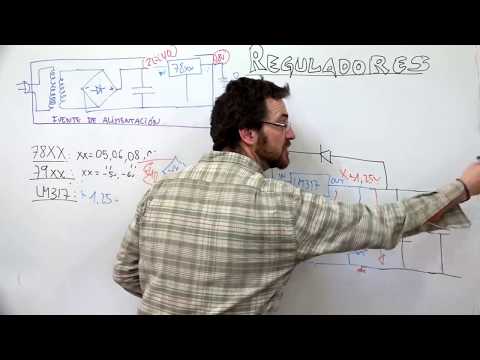
reg#2 REGULADOR de tensión VARIABLE
Understanding the 327 Family of Voltage Regulators
Overview of the 327 Family
- The 327 family provides a fixed output voltage of 1.25 volts, which is essential for various applications.
- It can be used in conjunction with other components to create higher voltages, such as combining it with a transformer that outputs around 40 volts.
Voltage Division Concept
- A voltage divider can be created using two equal resistors (5k each), resulting in an output of 15 volts when supplied with a higher input voltage.
- By adjusting resistance values, particularly using variable resistors like potentiometers, one can manipulate the output voltage effectively.
Potentiometer Functionality
- A potentiometer allows for adjustable resistance; moving its wiper changes the output voltage dynamically.
- If set to zero ohms, it can drop the output to very low levels while still maintaining functionality within specified limits.
Creating Adjustable Power Supplies
Regulating Output Voltage
- The design allows for creating adjustable power supplies by utilizing a potentiometer to regulate voltages down to as low as 1.25 volts.
- Adding capacitors and diodes improves performance by reducing noise and stabilizing the output during operation.
Importance of Capacitors and Diodes
- Proper capacitor placement ensures they discharge safely without affecting circuit integrity; diodes provide protection against reverse current flow.
Exploring Negative Voltage Regulation
Introduction to the 337 Family
- The 337 family serves similar functions but is designed for negative voltage regulation, allowing for symmetrical power supply configurations.
Symmetrical Power Supply Design
Understanding LED and Diode Functionality
Key Concepts in LED and Diode Operation
- The discussion begins with the importance of using a diode, specifically an LED, which requires proper resistance to function correctly. Without it, the LED may not operate as intended.
- It is noted that many power supplies can provide a minimum voltage output of 0 volts but can also reach up to +95 volts, showcasing the range of voltage adjustments available.
- The speaker explains how adjusting voltages works: starting from -0.75 volts and going up to 38 volts demonstrates the flexibility in voltage regulation for various applications.
- There are mentions of different configurations involving resistors and diodes that allow current to flow effectively while maintaining specific voltage levels (e.g., 0.6V or 1.2V), indicating practical solutions for circuit repairs.
Turn any video into a summary like this
YouTube links, meetings, lectures. With transcripts, search, and chat.