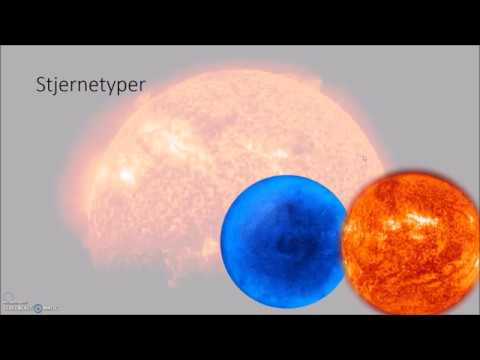
Stjerners udvikling
Understanding Stellar Development
Introduction to Stellar Physics
- The film aims to explain significant concepts in physics, particularly focusing on the immense forces and masses involved in stellar phenomena. It emphasizes the nature of stars and their development.
Scale of Celestial Bodies
- The discussion begins with a comparison of planets within our solar system, starting from Mercury and Mars, leading up to Earth. This sets the stage for understanding relative sizes in the universe.
- As we progress outward, Neptune is introduced, followed by Saturn and Jupiter, highlighting how small Earth appears compared to these larger celestial bodies. Jupiter is noted as the largest planet in our solar system but still relatively small compared to the Sun.
Notable Stars and Their Sizes
- Sirius is mentioned as significantly larger and hotter than our Sun, followed by other stars like Pollux and Arcturus. The concept of size disparity among stars is emphasized with examples such as Rigel and Betelgeuse, which are classified as red supergiants.
- The film illustrates how certain stars belong to constellations (e.g., Orion), providing visual representations that help viewers understand their positions in the night sky.
Color Differences Among Stars
- A key point made is about star colors: Rigel appears blue while Betelgeuse appears red; this color difference indicates temperature variations among stars—blue being hotter than red contrary to common assumptions about color associations with heat.
- The explanation clarifies that blue stars have shorter wavelengths and higher temperatures compared to red stars, which are cooler despite still being very hot overall. This challenges typical perceptions where red signifies warmth (like fire) while blue suggests coldness (like water).
Brown Dwarfs: Between Planets and Stars
- Brown dwarfs are introduced as objects that fall between heavy planets (like Jupiter) and lighter stars; they lack sufficient mass for nuclear fusion but share characteristics with both categories. They do not shine brightly or generate significant heat like true stars do.
- These brown dwarfs represent a unique classification within astrophysics due to their insufficient mass for fusion processes that characterize true stellar bodies, making them difficult to detect against the backdrop of space.
Formation of Stars from Nebulae
- The process of star formation begins with a nebula—a vast cloud of gas where gravity causes material clumping together over time until conditions allow for nuclear fusion to ignite a new star's life cycle. This includes stages leading from protostar formation through various evolutionary phases including becoming a red giant or white dwarf later on in its lifecycle.
- An overview of stellar evolution highlights how massive clouds can eventually lead to different types of celestial objects based on their mass accumulation during formation processes influenced by gravitational forces acting upon them throughout time spans measured in millions or billions of years.
Understanding Stellar Evolution and Supernovae
The Lifecycle of Stars
- A white dwarf remains after all the material has been converted into weight; this is explained later. Below it, a larger star evolves into a red supergiant, exemplified by Betelgeuse.
- When fusion ceases in a massive star (up to 50 times the mass of the Sun), it collapses violently, leading to a supernova explosion.
- In cases of even more massive stars, they collapse into black holes due to extreme gravitational forces that compress matter into an incredibly small point.
Characteristics of Different Star Types
- Light stars (up to 8 times the mass of the Sun) become red giants and eventually shed their outer layers as planetary nebulae when they can no longer sustain nuclear fusion.
- The core contracts under gravity, forming a dense object known as a white dwarf after shedding its outer layers.
Massive Stars and Their Explosive Endings
- More massive stars (between 8 and 50 times the mass of the Sun) end their lives in supernova explosions that release immense energy within seconds, brightening significantly in the night sky.
- A supernova can emit light equivalent to all stars in an entire galaxy for a brief period, showcasing its extraordinary luminosity and energy output.
Neutron Stars and Black Holes
- After a supernova, if the remnant core is between 1.4 and about 3 solar masses, it becomes a neutron star—an extremely dense object where atomic nuclei are tightly packed together.
- If a star exceeds approximately 50 solar masses before collapsing, it results in an even more powerful supernova that leaves behind a black hole—a region so dense that not even light can escape from it.
Observational Challenges with Black Holes
- Black holes are difficult to observe directly because they do not emit light; however, their presence can be inferred through their gravitational effects on surrounding matter.
- The lifecycle includes stages where massive stars expand into red supergiants before undergoing catastrophic explosions that disperse material back into space for potential new star formation.
Summary of Stellar Remnants
- Post-explosion remnants vary: neutron stars emerge from moderate-mass stellar cores while black holes form from very high-mass cores compressed into singularities.
- Illustrating these concepts involves comparing Earth’s mass with that of other celestial bodies like our Sun—showing vast differences in scale and density across cosmic structures.
Mass and Size of Celestial Bodies
Comparison of Masses
- The sun's mass is approximately one million times greater than that of Earth, highlighting the vast differences in celestial body sizes.
- A neutron star can weigh about twice as much as the sun, emphasizing its extreme density compared to Earth.
Size and Density Insights
- The discussion includes a comparison between Earth and a dwarf star, illustrating how remnants from stellar evolution can be significantly smaller yet much denser than planets like Earth.
- Neutron stars are described as incredibly dense objects, with masses concentrated into an extremely small volume, posing potential dangers if located near Earth.
Classification of Stars
- Stars are categorized based on their mass and luminosity; heavier stars fall into specific classifications such as OB-AFG-KMRNS.
Turn any video into a summary like this
YouTube links, meetings, lectures. With transcripts, search, and chat.