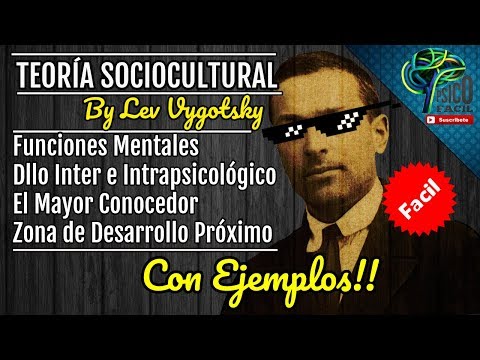
TEORIA SOCIOCULTURAL DE VYGOTSKY | FACIL Y CON EJEMPLOS!!
Influence of Social Context on Cognitive Development
Introduction to Vygotsky's Sociocultural Theory
- The discussion begins with the question of how social context influences cognitive development and whether the environment can enhance or hinder cognitive skill acquisition.
- Lev Vygotsky introduces his sociocultural theory, emphasizing that learning is a result of interaction with others and one's social environment.
Role of Biological and Social Factors
- Vygotsky argues that biological and genetic factors play a minimal role in cognitive development; they serve as a foundation for thought and language development.
- He highlights that cultural influences lead to diverse beliefs, habits, languages, arts, and customs based on geographical location.
Functions of Mental Processes
- Vygotsky distinguishes between lower (natural functions determined genetically) and higher mental functions (acquired through social interaction).
- Higher mental functions are open to greater possibilities due to social interactions, contrasting with limited behaviors derived from lower functions.
Stages of Development
- He describes two stages: interpsychological (social level where higher mental functions manifest) and intrapsychological (individual level where these functions become internalized).
- An example illustrates this distinction: a child's crying as a natural reaction versus intentional crying for communication reflects the transition from lower to higher mental function.
Importance of Social Interaction
- Vygotsky emphasizes that anyone with greater knowledge can facilitate learning—regardless of age—highlighting the importance of social interaction in education.
- He asserts that children can learn complex theories if guided by knowledgeable individuals but must first reach certain developmental milestones.
Zone of Proximal Development
- The concept of the "zone of proximal development" is introduced, referring to skills not yet matured but achievable with guidance from someone more knowledgeable.
- A metaphor comparing video buffering illustrates how mediation helps children progress in their learning journey.
Practical Application
Desarrollo del Lenguaje y Herramientas Psicológicas
Importancia del Desarrollo del Lenguaje
- Se menciona que en la segunda parte de la entrevista se abordará el desarrollo del lenguaje, sugiriendo su relevancia en el contexto de la teoría discutida.
- El desarrollo del lenguaje es presentado como un componente crucial que influye en otros aspectos psicológicos y cognitivos.
- Se anticipa una discusión sobre las herramientas psicológicas que complementan el desarrollo del lenguaje, indicando un enfoque multidimensional hacia la comprensión de este proceso.
- La invitación a no perderse la segunda parte resalta la continuidad y profundidad de los temas tratados, sugiriendo que hay más información valiosa por descubrir.
Turn any video into a summary like this
YouTube links, meetings, lectures — with transcripts, search, and chat.