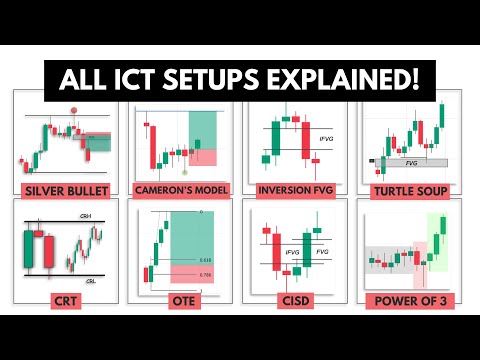
Every ICT Trading Strategy Explained in 13 Minutes!
ICT Trading Strategies Overview
Silver Bullet Trading Setup
- The Silver Bullet strategy combines three key concepts: market structure shift, liquidity sweep, and fair value gap.
- To execute this strategy, wait for the price to break above the day's high during major trading sessions and then return inside the range, indicating a potential reversal.
- A bearish market structure shift is confirmed when the price closes below a recent swing low, suggesting demand is weakening.
- Mark bearish fair value gaps as supply zones and set sell limit orders at these levels while adhering to risk management practices.
Cameron's Model
- Cameron's model consists of three components: draw on liquidity, stop rate, and entry point.
- Identify a key liquidity level that the price is approaching; this often includes equal highs or lows where orders are waiting to be filled.
- Use lower time frames (15-min or 5-min charts) to find stop rates in the opposite direction of your draw on liquidity before setting buy limits based on fair value gaps.
- In bearish scenarios, locate a key liquidity zone and look for stop rates above recent swing highs before placing sell limits.
Inversion Fair Value Gap
- An inversion FVG occurs when a fair value gap is disrespected by subsequent market movements after an initial imbalance.
- If prices close above an expected bullish FVG area without respecting it, traders can place sell limits anticipating further declines.
- This method works best when combined with other strategies like higher time frame levels or trend lines for increased reliability.
Turtle Soup Setup
- The Turtle Soup setup involves raiding liquidity around recent highs/lows while resting near fair value gaps for entry points.
- A bullish setup occurs when prices raid below a low while being positioned above a bullish FVG; similarly for bearish setups but in reverse conditions.
- Enter trades after observing signs of rejection at FVG areas following liquidity raids; set stop losses appropriately below demand zones.
Funded Next's New Trading Plans
Instant Access to Trading Capital
- Funded Next introduces a new instant plan that allows traders immediate access to capital without a challenge phase.
- The plan features no daily drawdown limit and no minimum trading days, enabling withdrawals of profits at any time.
- Account sizes range from $5,000 to $200,000, catering to various trader needs.
Candle Range Theory (CRT)
Understanding Candle Range Theory
- CRT focuses on the price range of individual candlesticks, typically involving three candles: the first defines the range, the second creates a sweep, and the third provides an entry point.
Trading Setup with CRT
- The high and low of each candle serve as critical liquidity levels for subsequent candles.
- In an uptrend, if price breaks below a bearish candlestick's low but quickly returns inside the range after sweeping liquidity, it signals a valid trading setup.
Optimal Trade Entry (OTE)
Concept Overview
- OTE is based on Fibonacci retracement levels aimed at identifying optimal correction zones for trades.
Key Entry Zone
- The ideal entry zone lies between Fibonacci levels 0.786 and 0.618 due to better risk-to-reward ratios and safer stop-loss placements.
Advantages of OTE
- Entering closer to swing lows minimizes stop-loss risks while avoiding early traps set by market movements.
Change in State of Delivery (CISD)
Identifying CISD Patterns
- CISD indicates a sudden shift in price momentum; for example, strong bullish trends can reverse unexpectedly due to selling pressure creating bearish fair value gaps.
Trading Strategy for CISD
- To trade this pattern effectively, wait for price re-entry into fair value gaps showing rejection signs before opening short positions.
Power of Three in Price Action
Phases of Price Action
- The Power of Three concept divides price action into accumulation (consolidation), manipulation (fake outs), and distribution phases where trades are ideally opened post-manipulation.
Execution Strategy
- After confirming fake outs during consolidation phases that sweep liquidity, traders should zoom into lower time frames for supply zones before entering trades.
Turn any video into a summary like this
YouTube links, meetings, lectures — with transcripts, search, and chat.