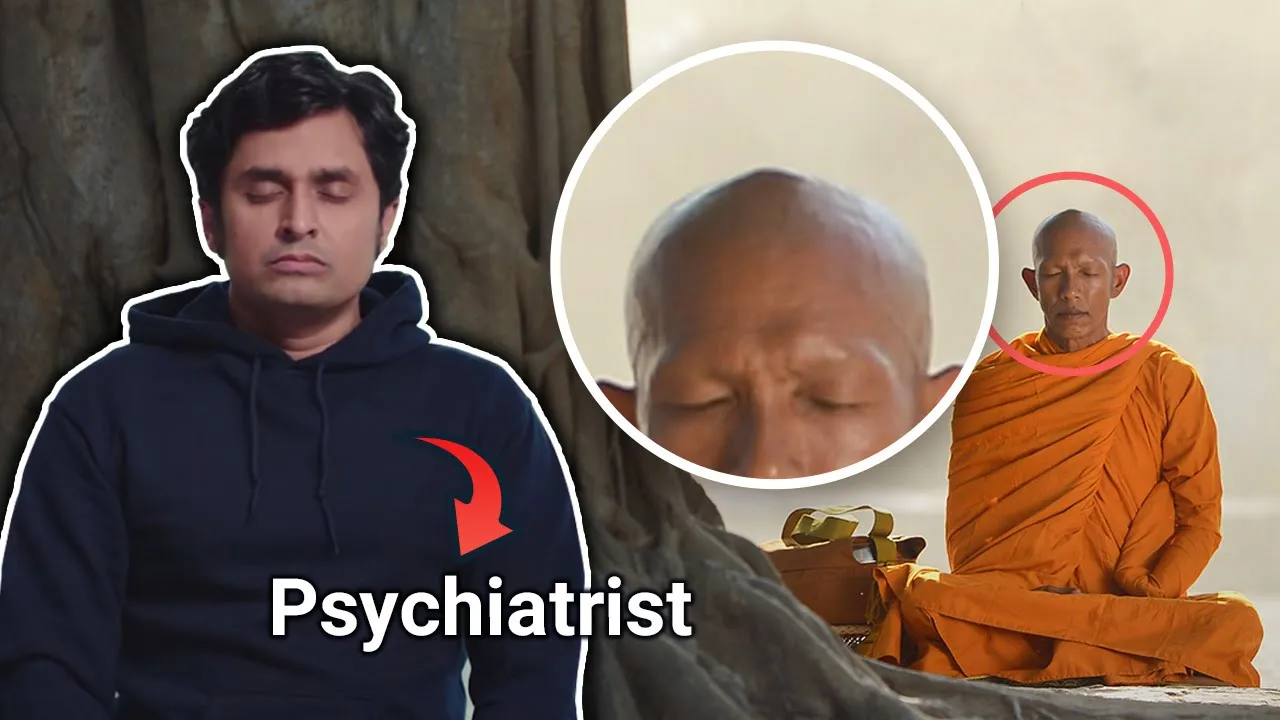
Meditation to Improve Focus
Paying Attention to Motivation
In this section, the speaker introduces two meditations. The first meditation focuses on paying attention to oneself and observing what happens when having a goal and seeking motivation.
Meditation 1: Paying Attention to Motivation
- Notice the thought that arises when you have a goal and are looking for motivation.
- Observe what happens to the thought without trying to hold onto it.
- Open up your mind's user manual and learn about yourself.
Tarataka Meditation - Yantra Gazing
The second meditation introduced is Tarataka, which involves fixed point gazing at a yantra. The speaker explains how to perform this meditation.
Meditation 2: Tarataka - Yantra Gazing
- Stare at a picture or object without blinking.
- Concentrate on one point while allowing your attention to move around the periphery.
- Relax tension and continue focusing on the center of the afterimage with eyes closed.
Relief and Afterimage Concentration
This section focuses on finding relief after performing the previous meditation and concentrating on the afterimage.
Relief and Afterimage Concentration
- Close your eyes, feel relief, and concentrate on the center of the afterimage.
- Allow the image to float forward by relaxing your grip on it.
Conclusion
The video concludes with a final step to complete the meditation practice.
Conclusion
- Rub your hands together and cup them over your eyes, taking deep breaths in and out.
Timestamps are approximate and may vary slightly.
New Section
In this section, the speaker discusses the practice of Trataka and its benefits, focusing on the importance of relaxed focus and the physiological aspects behind it.
The Practice of Trataka
- Trataka is a practice that involves gazing at a fixed point or object.
- Adept meditators can comfortably practice Trataka for extended periods of time, ranging from 20 minutes to even an hour.
- The key aspect of Trataka is focused attention and relaxed focus.
- Optimal flow state is not a state of stress but a state of relaxed focus.
- Trataka helps in cultivating relaxed focus, especially in the second phase after closing our eyes.
Benefits and Physiology
- There are various benefits associated with practicing Trataka.
- It helps in developing psychological effects and neuroscientific effects.
- The longer one can keep their eyes open during Trataka, the clearer the image becomes due to physiological reasons related to photo receptors in the eyes.
- The shape used in Trataka is called Sri Yantra, which also has spiritual elements associated with it.
New Section
In this section, the speaker explains different perspectives on meditation - psychological, neuroscientific, and spiritual/physiological. They emphasize focusing on psychological and experiential aspects as well as neuroscience's role in understanding how meditation aids motivation.
Perspectives on Meditation
- Meditation can be viewed from psychological, neuroscientific, and spiritual/physiological perspectives.
- Psychological effects and experiential aspects are significant outcomes of meditation practice.
- Neuroscience helps us understand how meditation enhances motivation by improving our ability to hold one thing in mind for an extended period.
Motivation and Focus
- Motivation is akin to holding one thing in mind for an extended duration.
- Practicing meditation acts as "push-ups" for enhancing this ability.
- When wanting to quit something, thinking about not doing it is still thinking about it. Instead, stop thinking about it to effectively quit.
- The example of quitting games illustrates how we stop playing them when we no longer think about them.
New Section
In this section, the speaker discusses the relationship between obsessive-compulsive disorder (OCD) and going too far with focus. They also address questions related to learning Ayurveda knowledge and provide insights into their approach to teaching meditation.
OCD and Going Too Far
- Obsessive-compulsive disorder (OCD) is an example of going too far with focus.
- OCD involves excessive thoughts and behaviors that interfere with daily life.
Learning Ayurveda Knowledge
- The discussion in the video is more focused on yoga rather than Ayurveda.
- The information shared on stream is a synthesis of various knowledge sources, including neuroscience, psychology, yoga, meditation, and Buddhism.
- Dr. K's guide provides comprehensive information for those interested in learning more.
This summary covers only a portion of the transcript provided.
New Section
In this section, the speaker discusses different types of meditation and how mindfulness became a common component in the study of meditation.
Understanding Different Types of Meditation
- There are various types of meditation such as mantra chanting, zen meditation, dantrix meditation, kundalini meditation, and kriya meditation.
- The diversity of these practices makes it challenging to study and understand them.
The Concept of Mindfulness
- Researchers aimed to find a common component among different meditative traditions.
- They settled on mindfulness as the most common element.
- Mindfulness was chosen because it could be reduced to its basic form and studied more easily.
Mindfulness vs. Other Forms of Meditation
- Mindfulness is just one branch or type of meditation.
- There are many other branches or types of meditation beyond mindfulness.
- Mindfulness focuses on cultivating a witnessing attitude and observing things.
- Other forms like dharana involve focusing the mind rather than observing.
Mindfulness and Trauma
- When working with patients who have trauma, mindfulness may not be suitable.
- Trauma can trigger psychological defense mechanisms that may not respond well to simply observing and letting go.
- Grounding techniques or focusing techniques may be more appropriate for individuals with trauma.
New Section
In this section, the speaker discusses how mindfulness techniques for trauma are actually grounding techniques rather than true mindfulness. Additionally, they provide guidance on the frequency and duration of meditation practice.
Grounding Techniques vs. True Mindfulness
- Techniques that work for people with trauma are often referred to as mindfulness techniques but are actually grounding techniques.
- These techniques focus on grounding oneself in the present moment rather than simply observing thoughts or emotions.
Frequency and Duration of Meditation Practice
- It is recommended to practice meditation at least every other day, ideally every day.
- The duration can range from five to twenty minutes.
- Sakshibhav, meaning witnessing attitude in Sanskrit, is considered the most basic state of consciousness on the path to meditation.
Starting Meditation Practice
- Begin with 30 to 60 seconds of open-eyed thratika (a specific meditation technique).
- Then, close your eyes and continue the practice.
- Gradually increase the amount of time with your eyes open during the practice.
Timestamps are provided for each section.