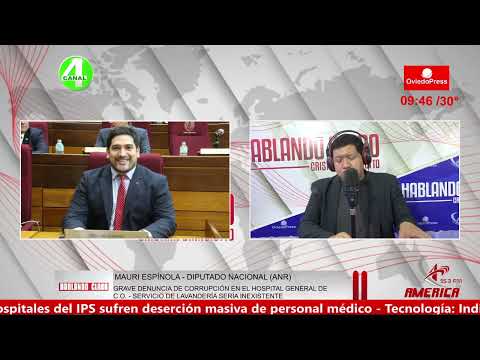
MAURI ESPÍNOLA - DIPUTADO NACIONAL (ANR)
Concerns Over Laundry Services at Coronel Oviedo General Hospital
Introduction to the Issue
- A serious allegation has been raised regarding the apparent lack of laundry services at the General Hospital in Coronel Oviedo, which is contracted out to a private company.
- The discussion begins with an acknowledgment of the gravity of the situation and inquiries about how this information was obtained.
Investigation Findings
- The investigation stems from a bidding process by the Institute of Social Security, coinciding with a contract signed with the Ministry of Public Health around late 2024 for laundry services.
- Upon visiting the hospital, it was confirmed that there is no operational laundry service, raising concerns about health safety and biosecurity for patients and staff.
Lack of Transparency
- The deputy describes finding an opaque operation where accountability is absent; access to critical areas was restricted.
- Concerns were raised about potential emergencies (e.g., fires), emphasizing that such secrecy creates a "ghost machinery" scenario post-contract signing.
Contractual Obligations and Financial Aspects
- The contract specifies requirements for industrial-grade equipment, yet access to these facilities was denied during inspections.
- The total amount involved in this contract is approximately 98 million (around 14 million dollars), highlighting significant financial implications if services are not being rendered as promised.
Accountability Issues
- There’s an alarming admission from hospital management regarding their inability to supervise or control operations effectively due to lack of access.
- This situation raises questions about transparency and governance within public health institutions, suggesting a shift towards privatization without proper oversight.
Biosecurity Risks
- The absence of operational laundry services poses severe risks to patient safety; existing linens may not be sanitized properly.
- Reports indicate that some linens are taken outside for cleaning, further complicating biosecurity measures and potentially leading to widespread infection risks.
Conclusion on Current Operations
- The director's comments reveal systemic issues within hospital operations concerning hygiene practices and compliance with health regulations.
- Overall, there’s a pressing need for accountability in managing public health resources effectively amidst allegations of corruption.
Investigation into Hospital Corruption
Allegations of Mismanagement and Corruption
- Lorena Ocampos discusses findings from journalistic investigations revealing a company named Labatec, which is allegedly involved in hospital laundering operations, indicating a possible triangulation scheme.
- The speaker emphasizes that health services should not be treated as negotiable commodities, criticizing the opacity surrounding financial dealings within healthcare institutions.
- There is a strong condemnation against using public funds for private interests, particularly those linked to political figures. The speaker demands immediate intervention from health authorities.
Accountability and Transparency Issues
- Questions are raised about the Ministry of Health's response to these allegations and whether they will take action against the implicated parties.
- The speaker expresses distrust towards health authorities, suggesting complicity in covering up irregularities instead of addressing them transparently.
Contractual Concerns and Service Quality
- Discussion on whether contracts with service providers are being honored properly; concerns arise regarding the quality of services provided at various hospitals under questionable agreements.
- The potential for further corruption is highlighted with fears that funds may be mismanaged through new contracts at different healthcare facilities like IPS (Instituto de Previsión Social).
Critique of Healthcare Management Practices
- A critical analysis reveals systemic issues within Paraguay’s healthcare system, where privatization leads to inefficiencies and increased costs rather than improved patient care.
- The speaker argues that outsourcing essential services like laundry or laboratory work does not reflect prudent financial management but rather prioritizes profit over public health needs.
Broader Implications of Corruption
- An assertion is made that Paraguay cannot afford to outsource basic healthcare functions due to limited resources; this reflects deeper issues in national priorities regarding public spending.
- The discussion culminates in identifying a pervasive culture of corruption across all levels of government, emphasizing the need for accountability and reform in how public funds are managed within the healthcare sector.
- Highlighting misallocated resources, examples include inflated costs for simple services like fumigation while critical medical equipment remains neglected due to lack of maintenance.
This structured overview captures key discussions around corruption allegations in Paraguay's healthcare system as presented by Lorena Ocampos.
Discussion on Health Sector Legitimacy
Importance of Transparency and Coherence in Health Leadership
- The speaker emphasizes the need for legitimacy in health leadership, which should be grounded in transparency and coherence.
- There is a strong call to prioritize the actual needs of the health sector, indicating that current leadership may not be adequately addressing these concerns.
- The speaker expresses a clear opinion that the Minister of Health should resign, suggesting dissatisfaction with her performance.
- Acknowledgment of political dynamics is present, as the speaker mentions an interaction with Deputy María Teresa Barán, highlighting potential missed opportunities for direct dialogue about health issues.
- The conversation reflects broader themes of accountability and responsiveness within government roles related to public health.