BAC 109-REGULATORY FRAMEWORK & LEGAL ISSUES IN BUSINESS
Understanding Seller's Rights in Goods Delivery
Article 1529: Unconditional Delivery and Ownership Transfer
- The article states that if a seller delivers goods to a carrier for transmission to the buyer without reserving ownership, this delivery is equivalent to delivering directly to the buyer.
- Once the seller has delivered the goods without reservation of rights, they lose their right to stop delivery while in transit. This situation indicates that ownership has effectively transferred to the buyer.
- If there was no prior agreement regarding reservation of rights, it implies that ownership or possession has been fully given up by the seller upon delivery.
Possessory Lien and Its Implications
- A possessory lien allows a seller to retain possession of goods until payment is made; however, once ownership is transferred through unconditional delivery, this right ceases.
- If a buyer lawfully obtains possession at sale time, ownership transfers immediately, and thus the unpaid seller loses any claim over those goods.
- The seller’s lien can be lost either through express or implied agreements when allowing alterations that increase the value of goods by the buyer. For example, if fabric is altered into clothing by the buyer after purchase, it forfeits any possessory lien from the seller.
Right of Stoppage in Transit
Definition and Scope
- The right of stoppage in transit refers to a seller's ability to halt transportation of goods while they are en route due to non-payment by the buyer. This includes not only stopping delivery but also ordering redelivery back to themselves.
- Sellers can exercise this right as long as they cover necessary charges related to transport costs incurred during stoppage actions (e.g., freight fees).
Practical Application
- When exercising this right, sellers must ensure they have not yet received payment from buyers; otherwise, they risk losing their claim over those goods during transit. They can reclaim items even if already on their way towards buyers' locations under certain conditions.
- To enact stoppage in transit effectively, sellers may need actual possession or provide notice of their claim regarding these goods either directly or through an intermediary involved with them during transport processes.
Understanding the Rights of an Unpaid Seller
Actual Possession and Notice
- The concept of actual possession is crucial when reclaiming property or goods. An unpaid seller must give notice of their claim to the carrier or another party in possession of the goods.
- Notice can be directed either to the person currently holding the goods or to a principal, indicating that the seller intends to exercise their right of stoppage in transit.
Right of Resale
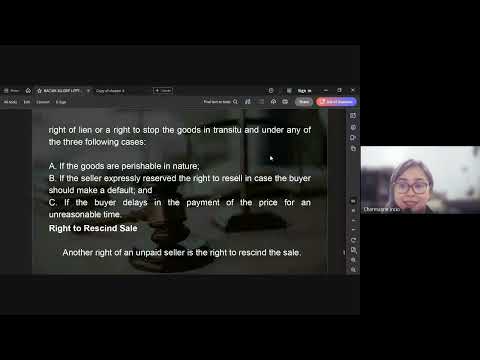
- An unpaid seller has a right to resell goods under specific conditions:
- A) If the goods are perishable in nature (e.g., fish).
- B) If the seller expressly reserves this right at the start of a transaction.
- C) If there is an unreasonable delay in payment by the buyer.
- For example, if fish is sold but not paid for before it spoils, the seller may choose to sell it to another buyer instead.
Conditions for Exercising Right of Resale
- The right to resell can be exercised if:
- A) Goods are perishable and cannot wait for payment.
- B) The seller has reserved this right explicitly during initial negotiations.
- C) Payment delays extend beyond a reasonable timeframe (e.g., after February 5, 2026).
Right to Receive Sale
- Another important right for an unpaid seller is the "right to receive sale," which essentially allows them to cancel ongoing transactions if necessary. This cancellation can occur under various circumstances related to real property sales.
Sale of Real Property Regulations
- Article 1539 outlines rules governing real property sales based on unit measure or number:
- Sellers must deliver entire properties as agreed upon; partial deliveries are not acceptable.
- Buyers have rights if there’s a deficiency in area exceeding one-tenth (1/10) of what was stated in contracts. They may rescind contracts under these conditions.
Buyer’s Rights Upon Deficiency
- Buyers are entitled to rescind contracts if:
- A) The lack in area is at least one-tenth (1/10).
- B) Quality deficiencies exceed what was specified.
- C) They would not have purchased had they known about these deficiencies beforehand.
This structured overview captures key insights from discussions regarding sellers' rights and obligations within commercial transactions, particularly focusing on unpaid sellers and real estate regulations while providing timestamps for easy reference back into detailed discussions.
Understanding Buyer Rights in Real Estate Transactions
Cancellation of Sale Due to Area Deficiency
- If the area sold is less than 1/10 of the agreed size (e.g., selling 10 hectares but only delivering 1 hectare), the buyer can cancel the sale.
- Alternatively, if there is a deficiency, the buyer may enforce the contract with a proportional price reduction (e.g., if only 5 hectares are delivered instead of 10, the price could be adjusted from 10 million to 5 million).
Conditions for Exercising Right to Cancel
- The buyer has the right to cancel if:
- The area deficiency is at least 1/10 of what was stated in the contract.
- The quality specified in the contract does not meet expectations and exceeds this threshold.
- It’s crucial for buyers to remember that any significant quality or area deficiency allows them to seek cancellation.
Buyer Awareness and Inspection
- A buyer can cancel if they would not have purchased had they known about a smaller area or inferior quality. This applies regardless of how much smaller or inferior it is.
- For instance, if a property appears appealing during initial discussions but reveals issues upon inspection (like being near undesirable features), cancellation is justified.
Double Sales: Legal Implications
Definition and Resolution of Double Sales
- A double sale occurs when one seller sells the same property to multiple buyers. Ownership disputes are resolved according to Article 1544.
- In cases involving movable property, ownership goes to whoever first took possession in good faith; for immovable property, it goes to whoever registered their sale first.
Registration and Title Considerations
- If neither registration nor possession exists, ownership belongs to whoever presents the oldest title. This emphasizes due diligence in verifying titles before purchase.
Case Study on Double Sale Scenario
- An example illustrates complications where Seller X sells a property first to Buyer Y and then again to Buyer Z. Despite Y's payment, Z holds an annotated title indicating legitimate ownership due to proper registration.
- Courts typically favor Z as they possess documentation showing that X's previous title was canceled following their transaction.
Property Transactions and Legal Implications
Importance of Title Annotation
- The annotation on the back of a title serves as public information, indicating that a transaction has occurred. This must be respected by all parties involved.
- If a buyer is aware that a property was previously sold to another party (Z), proceeding with the purchase from X constitutes bad faith under legal presumption.
Double Sale Scenarios
- In cases where titles are canceled due to prior sales, buyers should refrain from purchasing properties that have been marked as canceled to avoid complications like double sales.
- For movable properties sold to different buyers, ownership goes to the first buyer who took possession in good faith.
Good Faith Ownership
- A buyer (Celebrar) who unknowingly purchases an item already sold (by Gentiles) retains priority if they were the first to take possession without knowledge of prior transactions.
- For immovable properties, ownership belongs to the buyer who registers their sale first with the registry of deeds, assuming they acted in good faith.
Registration and Possession Rules
- If both parties fail to register their sale, ownership defaults to the buyer who first took possession in good faith.
- Annotations on titles serve as critical information; if an absolute sale is noted, it must be respected by subsequent buyers.
Resolving Ownership Disputes
- In absence of registration or possession evidence, ownership will go to the buyer presenting the oldest title. This emphasizes the importance of maintaining proper documentation during transactions.
- A possessory buyer acting in good faith is one unaware of any flaws in their title or acquisition method.
Legal Advice for Buyers
- Buyers should seek legal advice before purchasing properties with unclear titles or unresolved issues regarding previous owners' rights.
- In situations involving multiple sales without registration or clear possession history, presenting proof of an older title can determine rightful ownership.
Challenges Faced by Buyers
- Buyers may encounter difficulties when attempting to acquire property not properly transferred into their name due to complex family situations or unresolved estate matters.
- It’s crucial for potential buyers to verify property titles thoroughly before making purchases, especially when dealing with deceased sellers and heirs.
This structured summary provides insights into property transaction laws and highlights key considerations for prospective buyers navigating complex legal landscapes.
Obligations in a Contract of Sale
Seller's Motivation and Emotional Considerations
- The seller is eager to sell the property to return home for their child, highlighting emotional factors influencing real estate transactions.
- Advising buyers requires sensitivity to the seller's situation, emphasizing the need for empathy in negotiations.
Introduction to Obligations
- Transitioning into Chapter 4, the focus shifts to obligations within contracts of sale, specifically those of sellers and buyers.
- The intended learning outcomes include summarizing buyer obligations and explaining seller responsibilities.
Core Obligations of Buyers
- Buyers have two fundamental obligations:
- Accept delivery of purchased goods.
- Pay the agreed price for those goods.
- The relationship between buyer and seller is characterized by mutual expectations regarding payment and delivery.
Elements of a Contract
- Key elements include:
- Object: Goods being sold.
- Consideration: Payment made by the buyer.
- Both parties have specific expectations; buyers expect goods while sellers expect payment.
Rules on Payment and Delivery
- Payments must occur at stipulated times and places as per agreement; if no stipulation exists, payment occurs where delivery happens.
- Simultaneous performance is essential; neither party is obligated until the other fulfills their part (e.g., seller delivers before buyer pays).
Installments in Transactions
- Generally, buyers are not required to accept goods in installments unless previously agreed upon; this applies similarly to payments.
- If installment agreements exist, both parties must adhere strictly to them without forcing changes outside prior consent.
Acceptance and Inspection Rights
- Buyers possess the right to inspect goods before ownership transfer, ensuring they meet contract specifications—this right protects against non-conforming deliveries.
Delivery and Acceptance in COD Sales
Understanding Buyer Rights and Seller Liabilities
- The buyer generally cannot inspect goods before payment in Cash on Delivery (COD) sales unless otherwise agreed or permitted by trade usage.
- Acceptance can be expressed verbally or in writing, indicating the buyer's agreement to the goods. Implied acceptance occurs if the buyer acts inconsistently with the seller's ownership, such as reselling or altering the goods.
- Buyers must notify sellers of any defects within a reasonable time after acceptance; failure to do so may release sellers from liability for those defects.
- In COD transactions, buyers typically lack inspection rights due to prior seller expenditures on delivery, necessitating immediate acceptance and payment unless exceptions apply.
- Exceptions to inspection rights include prior agreements allowing checks before payment or established trade practices permitting inspections.
Implications of Acceptance and Liability
- Retaining goods for a reasonable time without rejection implies acceptance; however, this does not absolve sellers from liability for defects if notified promptly by buyers.
- Example: If a buyer purchases an electric vehicle but discovers defects later, they must inform the seller within a reasonable timeframe to hold them liable under warranty terms.
- Sellers remain liable for defects even after delivery until proper notification is made by buyers regarding any issues encountered with the product.
Refusal of Goods: Justified vs Unjustified
- Justified refusal occurs when there are discrepancies in quantity or quality; buyers are not obligated to return goods but must notify sellers of their refusal. This notification suffices as it relieves buyers from returning items that do not meet expectations.
- Upon justified refusal, buyers become custodians of the goods and must take reasonable care while risk remains with the seller until ownership is formally transferred upon acceptance of correct items.
- An example illustrates that if a damaged item is received (e.g., a shoe cabinet), notifying the seller suffices without needing to return it immediately; risk remains with the seller during this process until resolution is achieved.
Understanding Buyer Obligations and Seller Remedies
Buyer’s Acceptance and Risk of Loss
- The buyer accepted the damaged goods, notifying the seller via the Shopee app, indicating a refusal to receive them due to unmet obligations regarding damage.
- Unjustified refusal occurs when a buyer changes their mind about the product (e.g., preferring a different color), which does not absolve them from accepting delivery.
- Ownership transfers to the buyer upon delivery, shifting liability for loss or damage to them once they accept the item.
Payment of Interest
- Buyers are obligated to pay interest between delivery and payment under three conditions: if stipulated in agreement, if sold items produce income, or if in default after demand.
- If an item generates income (like fruit-bearing trees), sellers may claim interest until full payment is made by buyers.
- Interest serves as compensation for damages incurred due to non-payment or delay in fulfilling financial obligations.
Suspension of Payment
- Buyers can suspend payments if they face disturbances in possession or ownership, fearing further issues (e.g., potential repossession).
- However, suspension is not allowed if sellers provide security for price return or if it was agreed that payment must continue regardless of circumstances.
- Disturbances must be significant; minor trespasses do not justify suspending payments.
Seller's Remedies for Noncompliance
- Sellers have rights when buyers fail to comply with agreements. They can rescind contracts if buyers do not appear at agreed times or fail to tender payment.
- Immediate rescission is possible for nonpayment as per Article 592; this includes automatic remedies available until judicial resolution occurs.
- Sellers can cancel sales as a matter of right when buyers neglect their responsibilities during transactions involving personal property.
Contractual Obligations and Breaches in Sale Agreements
Overview of Payment Obligations
- The seller may receive the sale even if the buyer has not made a payment, unless there was an agreed credit term.
- An anticipatory breach occurs when one party indicates they will not fulfill their obligation before the performance date, allowing the other party to terminate the contract immediately.
Anticipatory Breach Explained
- If a seller informs a buyer that they cannot deliver goods due to shortages, this constitutes an anticipatory breach, enabling immediate action from the non-breaching party.
- Sellers can predict potential breaches based on prior knowledge or circumstances indicating that buyers may fail to comply with payment agreements.
Legal Recourse for Nonpayment
- In cases of nonpayment, even if automatic rescission is stipulated in the contract, buyers can still make payments until a formal demand for rescission is made by the seller.
- A seller must formally demand cancellation through judicial means or notarized communication before a buyer can cease payments.
Actions Following Breach of Contract
- Once a demand for payment is made by the seller, courts cannot grant additional time for payment; compliance with demands is crucial.
- Students should understand available actions in case of breach: sellers can seek price payment or damages while buyers can pursue specific performance or rescission.
Remedies Available to Parties
- Sellers have several remedies including seeking payment (Article 1595), damages for nonacceptance (Article 1596), and rescission (Article 1597).
- Buyers also have options such as pursuing specific performance (Article 1598) and claiming damages due to warranty breaches (Article 1599).
Seller's Rights and Remedies Under Article 1595 of the Civil Code
Overview of Seller's Actions for Price
- Article 1595 allows sellers to take action against buyers who wrongfully refuse to pay for goods after ownership has passed, regardless of delivery.
- If a buyer justifiably refuses receipt, the seller must notify them about holding the goods and explain remedies available under the contract.
Scenarios Illustrating Seller's Rights
- A scenario is presented where Ronnie sells a laptop to Bobby for Php45,000. Three instances are outlined where Ronnie can claim payment:
- If Bobby receives the laptop but unjustifiably refuses to pay.
- If they agreed on a fixed payment date (e.g., December 20), Bobby must pay regardless of delivery.
Conditions for Payment Obligation
- The seller can maintain an action for price if goods have been delivered and ownership transferred but the buyer refuses to pay.
- Even if ownership hasn't passed, if payment is due on a specific date as per contract terms, the seller can sue if payment isn't made.
Defenses Available to Buyers Against Seller's Actions
Buyer’s Defense Mechanisms
- Buyers may defend against actions by demonstrating that before judgment, the seller showed inability or intention not to perform their contractual obligations.
Consequences of Buyer’s Refusal
- If goods cannot be readily resolved at a reasonable price and the buyer wrongfully refuses acceptance, sellers may offer delivery and subsequently hold goods while suing for payment.
Damages and Rescission Under Article 1596
Seller's Recourse When Buyer Refuses Goods
- Article 1596 permits sellers to claim damages when buyers wrongfully refuse acceptance or payment. Damages typically reflect losses incurred from breach.
Additional Considerations in Breach Cases
- Sellers may resign from contracts involving undelivered goods by notifying buyers in cases of refusal or inability to pay. Buyers can seek specific performance along with damages if sellers fail to deliver specific items.
Seller's Rights and Remedies in Contract Breaches
Seller's Right to Sue for Damages
- Sellers can file a civil case for damages against buyers who breach contracts, with damages calculated based on the estimated loss from the breach.
- If a buyer unjustifiably refuses to accept goods, the seller has the right to sue for non-acceptance and claim damages incurred due to this refusal.
Calculating Damages
- Damages awarded are determined by direct losses incurred by the seller, including costs related to packaging, transportation, and employee time spent preparing goods for delivery.
- In cases where a contract is signed but not honored by the buyer, sellers can seek compensation for expenses incurred during preparation for sale.
Applicability of Article 5096
- Article 5096 applies specifically to executory contracts where ownership hasn't transferred; it allows sellers to recover costs when buyers back out without valid reasons.
Buyer's Options Under Warranty Breaches
Remedies Available to Buyers
- Article 1599 outlines four options available to buyers if a seller breaches a warranty:
- Accept goods and reduce price.
- Counterclaim for damages.
- Refuse goods and sue for damages.
- Rescind contract and return goods.
Example of Price Reduction
- For instance, if a seller sells defective tomatoes at Php2000 but one basket is worth Php600, the buyer can deduct this amount from their payment.
Understanding Warranties in Sales
Definition of Warranty
- A warranty is an assurance from the seller regarding the quality of goods delivered. It implies that products should be functional and free from defects upon delivery.
Consequences of Breaching Warranties
- When a seller violates their warranty commitment (e.g., delivering defective items), buyers have rights such as accepting goods while claiming damages or refusing them altogether.
Actions Buyers Can Take Against Defective Goods
Claiming Damages on Returned Goods
- Buyers can return defective products (e.g., malfunctioning vehicles like Montero), claim damages due to issues caused by these defects, or cancel contracts entirely.
Summary of Buyer’s Rights under Article 1599
- The article defines how buyers can either accept or reject goods based on warranty breaches while also detailing how they may adjust purchase prices accordingly.
Breach of Warranty and Buyer Rights
Understanding Breach of Warranty
- A breach of warranty occurs when a seller fails to deliver goods that meet the promised quality, allowing the buyer to take action for damages.
- The buyer has options: they can either keep the goods and file for damages or refuse acceptance based on the seller's failure to meet commitments.
Buyer’s Options Upon Breach
- Buyers may cancel the contract, return received goods, or recover any paid amounts if there is a breach by the seller.
- However, cancellation is not possible if buyers accepted goods knowing about the breach without protest or failed to notify promptly.
Conditions Affecting Return of Goods
- If goods are returned in substantially good condition, buyers cannot claim refunds unless damage was caused by the seller's breach.
- Buyers must act quickly; delays in notifying sellers about issues can hinder their ability to cancel sales or recover payments.
Importance of Timely Action
- Delayed complaints from buyers after using defective items may result in losing rights to cancel sales or recover payments.
- Warranties often have time limits (e.g., one year), emphasizing prompt reporting of issues to maintain rights under warranty agreements.
Natural Wear and Tear Considerations
- Items naturally deteriorate over time due to wear and tear; thus, warranties typically do not cover such damages beyond specified periods.
- Buyers should be aware that prolonged use without reporting issues could lead them to lose warranty protections.
Upcoming Discussions
- Future discussions will focus on extinguishment of sale as part of ongoing learning before exams. Attendance tracking will also be addressed.