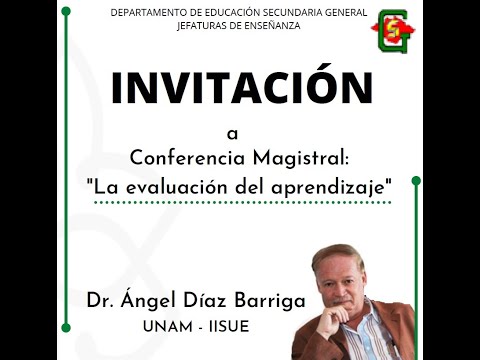
Conferencia Magistral: "La evaluación del aprendizaje"
Introduction and Welcome
Opening Remarks
- The event is introduced as an academic conference, welcoming attendees and emphasizing the importance of continuous training for academic coordinators in supporting teachers.
Speaker Introduction
- Dr. Ángel Díaz is introduced, highlighting his extensive background in education, including his role as a researcher and educator since 1986.
Importance of Evaluation in Education
Discussion on Educational Challenges
- Dr. Díaz discusses the challenges faced in educational evaluation, particularly post-pandemic, emphasizing the need to reassess learning outcomes rather than simply measuring them through standardized tests.
Critique of Current Evaluation Practices
- He critiques the current focus on quantitative evaluations that prioritize scores over genuine learning experiences, arguing that this approach distorts educational objectives.
The Role of Pedagogy and Assessment
Historical Context of Pedagogy
- Dr. Díaz explains that pedagogy emerged from 18th-century philosophy and has often been misapplied in modern educational contexts, leading to a focus on classification rather than development.
Misconceptions about Learning Outcomes
- He argues against equating student performance with numerical scores, stating that such metrics fail to capture true cognitive development and learning processes.
Reassessing Educational Metrics
Critique of Standardized Testing
- The speaker highlights the ineffectiveness of standardized testing as a measure for improving educational quality, citing stagnant results despite increased investment in education.
Call for Diverse Evaluation Methods
- Dr. Díaz advocates for more holistic approaches to evaluation that consider individual student growth rather than mere numerical assessments or rankings.
Constructing Meaningful Assessments
Emphasis on Formative Assessment
- He stresses the importance of formative assessment practices that encourage students to reflect on their learning processes instead of focusing solely on grades.
Need for Teacher Training
- There is a call for better teacher training programs focused on developing effective assessment strategies that foster meaningful learning experiences among students.
Future Directions in Education
Vision for Educational Reform
- Dr. Díaz outlines a vision for reforming education systems by integrating diverse pedagogical approaches while addressing contemporary challenges faced by educators today.
Conclusion
- The session concludes with an emphasis on collaboration among educators to enhance teaching methodologies and improve overall student engagement and success rates.
Planning and Curriculum Development
Importance of Contextual Knowledge
- The speaker emphasizes the need for planning in educational activities, referencing a 2016 article to highlight the importance of contextual knowledge in curriculum development.
- There is a discussion about how French educational concepts influence current practices, particularly regarding the understanding of "knowledges" that shape learning contexts.
Teaching Mathematics with Real-Life Applications
- A challenge posed to high school teachers involves teaching the Pythagorean theorem through real-world problems, leading to innovative solutions after extensive discussion.
- The speaker reflects on traditional methods where mathematical concepts are often presented without connection to reality, advocating for more engaging teaching strategies.
Critique of Curricular Documents
- The speaker critiques existing curricular documents as overly complex and disconnected from practical teaching needs, suggesting they require significant revisions based on teacher feedback.
- There's a call for curricular changes that support collaborative knowledge integration among educators across different subjects.
Student Involvement in Assessment
Collaborative Learning Approaches
- The idea is proposed that students should participate in their own assessment processes, reflecting on their learning gaps and contributing to instructional design.
- Emphasis is placed on reducing curriculum complexity by focusing on four main axes that facilitate collaboration among teachers from various disciplines.
Integration of Knowledge Areas
- The speaker discusses previous writings on curriculum integration and stresses its feasibility despite requiring substantial effort from educators.
Emotional and Social Aspects of Learning
Holistic Education Perspectives
- Acknowledgment is made regarding the interplay between knowledge acquisition, emotional engagement, and skill development within educational settings.
Challenges in Educational Practices
Addressing Diverse Needs
- Discussion includes addressing therapeutic needs for students while maintaining focus on academic responsibilities without overwhelming educators.
Innovative Program Structures
Rethinking Educational Frameworks
- Suggestions are made for organizing curricula around problem-based learning rather than traditional subject divisions to enhance student engagement.
Evaluation Methods
Shifting Assessment Paradigms
- The necessity for evolving evaluation methods away from standardized testing towards more dynamic forms such as portfolios is highlighted.
Teacher Responsibilities
Navigating Complex Classroom Dynamics
- Teachers are encouraged to embrace their responsibility towards students' diverse challenges while fostering an environment conducive to learning.
Building Relationships with Students
Fostering Positive Interactions
- Emphasis is placed on developing strong relationships with students as a means to enhance educational outcomes amidst varying classroom dynamics.
Individualism vs. Collaboration
Collective Efforts in Education
- Reflection occurs on how individualistic approaches have permeated education since the 1990's, stressing the need for collective efforts among educators.
Group Dynamics in Teaching
Encouraging Cooperative Work
- It’s suggested that group work should be structured not just around tasks but also include elements of enjoyment and community building among teachers.
Turn any video into a summary like this
YouTube links, meetings, lectures. With transcripts, search, and chat.