El ciclo del carbono | Ecología | Biología | Khan Academy en Español
Introduction to Carbon Recycling in the Biosphere
In this section, the speaker introduces the concept of carbon recycling in the biosphere and highlights the importance of carbon in various molecules.
Importance of Carbon in Molecules
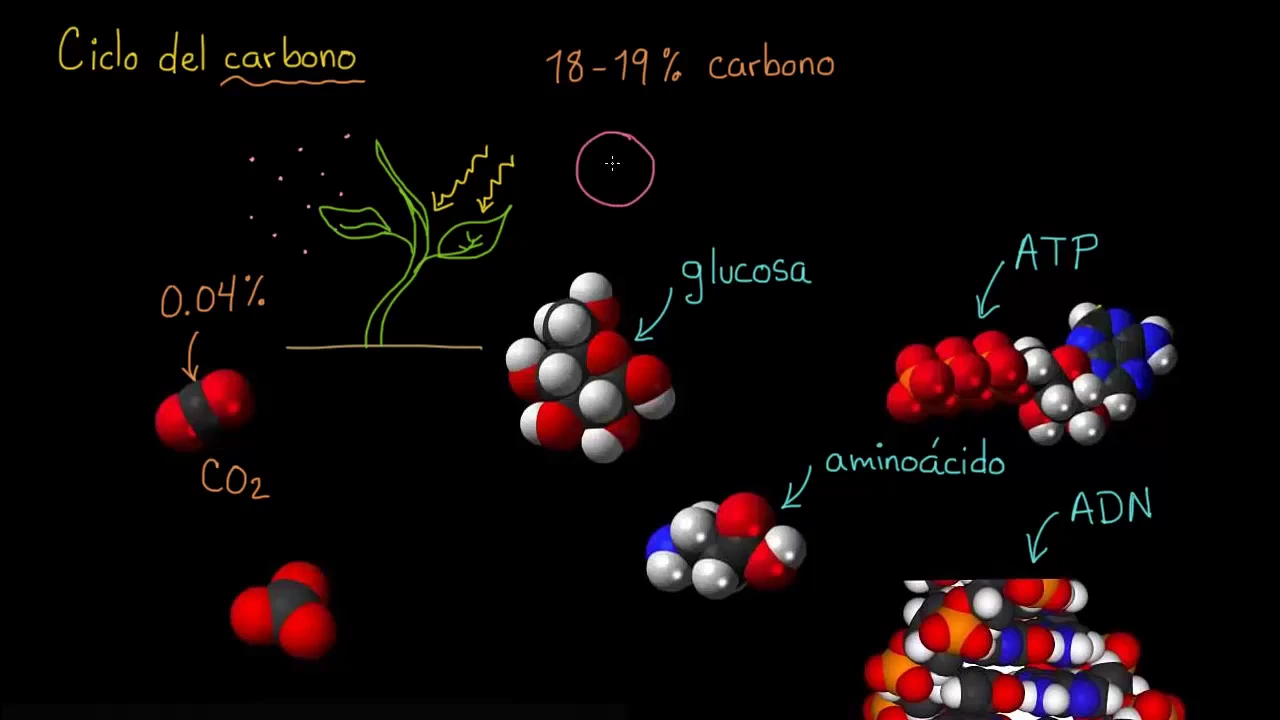
- Glucose, ATP, amino acids, and DNA are examples of important molecules that contain carbon.
- Carbon plays a crucial role in providing energy and forming structures in biological systems.
The Carbon Cycle
This section explains the simplified version of the carbon cycle and how carbon moves through different components of the biosphere.
Simplified Version of the Carbon Cycle
- Atmospheric carbon dioxide (CO2) is present and mainly consists of carbon bonded to two oxygen atoms.
- Autotrophs, such as plants, can fix atmospheric CO2 by using sunlight energy to convert it into organic molecules.
- Animals consume plants to obtain energy stored in these organic molecules.
- During metabolism, animals release CO2 back into the atmosphere.
- Autotrophs can again absorb CO2 from the atmosphere, completing the cycle.
Proportions of Gases in Atmosphere
This section discusses the proportions of gases present in Earth's atmosphere and emphasizes that despite its importance for living organisms, CO2 represents a small percentage.
Proportions of Gases in Atmosphere
- CO2 constitutes only 0.04% of gases present in Earth's atmosphere.
- Nitrogen makes up 78% while oxygen accounts for 21%.
- Although CO2 has an impact on global warming, it is a minor component compared to nitrogen and oxygen.
Role of Plants in Carbon Fixation
This section explains how plants play a crucial role in fixing carbon from the atmosphere through photosynthesis.
Carbon Fixation by Plants
- Plants can capture sunlight energy and use it to convert atmospheric CO2 into organic molecules.
- This process allows plants to grow and build their structures using carbon from the air.
- The mass of a growing plant comes from the carbon it takes in, not magically appearing.
Carbon Cycle in Food Chain
This section discusses how carbon moves through the food chain as animals consume plants for energy.
Carbon Cycle in Food Chain
- Animals that cannot perform photosynthesis rely on consuming plants for energy.
- When animals metabolize organic molecules obtained from plants, they release CO2 back into the atmosphere.
- The released CO2 can be absorbed again by autotrophs, continuing the cycle.
Other Forms of Carbon Cycling
This section explores other ways carbon cycles through different components of the biosphere, such as absorption by oceans and fossil fuel formation.
Other Forms of Carbon Cycling
- CO2 can be absorbed by oceans, leading to the formation of calcium carbonate (carbonate ions bonded with calcium).
- Calcium carbonate is used by marine organisms to form shells, which eventually become limestone over time.
- Organic matter that does not decompose completely can be compressed over time to form fossil fuels like petroleum.
Conclusion and Formation of Fossil Fuels
In this final section, the speaker concludes by highlighting that fossil fuels are formed from ancient organic matter and contain stored energy derived from sunlight millions or tens of millions of years ago.
Formation of Fossil Fuels
- Over time, organic matter that has not fully decomposed can be compressed and transformed into fossil fuels.
- Fossil fuels, such as petroleum, store energy that plants captured from sunlight millions of years ago.
The transcript has been summarized in a clear and concise manner using timestamps to help navigate the content.
Proceso de Combustión
En este segmento se explica el proceso de combustión y cómo se liberan los enlaces de carbono-carbono, ya sea a partir del petróleo o de la madera.
Proceso de Combustión
- La combustión puede ocurrir con diferentes tipos de materia orgánica, como el petróleo o la madera.
- Durante la combustión, se rompen los enlaces carbono-carbono presentes en la materia orgánica.
- Este proceso es inverso a la fotosíntesis, ya que durante la fotosíntesis se forman estos enlaces y se libera oxígeno.
- Durante la combustión, el carbono es liberado en forma de dióxido de carbono (CO2).
- Teóricamente, este dióxido de carbono puede ser fijado nuevamente por los autótrofos, como las plantas.
- El carbono fijado por las plantas puede ser quemado nuevamente en un proceso de combustión, liberando así el carbono nuevamente a la atmósfera.
Ciclo del Carbono
En esta parte se menciona cómo el ciclo del carbono está relacionado con los procesos de fotosíntesis y combustión.
Ciclo del Carbono
- Los autótrofos, como las plantas, realizan la fotosíntesis para fijar el carbono y producir oxígeno.
- Durante la fotosíntesis, los autótrofos utilizan dióxido de carbono (CO2) del ambiente y liberan oxígeno.
- El carbono fijado por las plantas puede ser liberado nuevamente a la atmósfera mediante procesos de combustión.
- Durante la combustión, se rompen los enlaces carbono-carbono y se libera dióxido de carbono (CO2) a la atmósfera.
- Este dióxido de carbono puede ser nuevamente fijado por los autótrofos en un ciclo continuo.
The provided transcript is in Spanish. The notes and headings are also written in Spanish to match the language of the transcript.